Law may unlock leadership — but voters hold the key
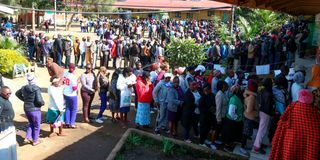
Voters queue to cast their votes at AC Ol Kalou Primary School polling station during the Ol Kalou by-election on July 16, 2026.

There is a question Kenya must confront honestly after the recent ruling that removes the requirement for a university degree for those seeking elective political office:
What exactly should qualify a person to make decisions on behalf of millions of citizens?
This is not a question about whether a Kenyan without a degree is intelligent. It is not a question about whether academic qualifications make one morally superior. And it certainly should not become an excuse to look down upon those who, for one reason or another, never had the opportunity to attend university.


It is a question about responsibility, competence and the standards we choose for those entrusted with the most consequential decisions in our republic.
Consider the absurdity of our priorities.
If you are sick and need surgery, you do not want someone who merely has confidence, popularity and good intentions. You want a qualified doctor.
If you are constructing a bridge, you want an engineer who understands structural principles.
If you are defending yourself in court, you want someone trained in law. We understand that certain responsibilities require preparation.
So why should the people responsible for making the laws under which all these professionals operate be held to no meaningful educational standard?
Parliament is not a popularity contest. The National Assembly and the Senate deal with taxation, public expenditure, constitutional amendments, national policy, oversight, legislation and matters that can alter the lives of millions of Kenyans.
Proof of wisdom
A poorly understood medical decision may harm one patient. A poorly drafted law can harm an entire country. That is why education should matter.
Not because a degree magically transforms somebody into a good leader, but because education develops habits of reading, research, analysis, questioning and engagement with complex ideas.
A degree is not proof of wisdom. But neither is the absence of a degree proof of wisdom. And that distinction is important.
We have misunderstood what discrimination means. Some will immediately say that demanding a degree discriminates against Kenyans who did not attend university. We must be careful with that argument. There is a difference between discriminating against a person because of who they are and establishing qualifications for a position because of the responsibilities attached to it.
If we required a pilot to demonstrate aviation training, would that be discrimination against people who never went to flight school? If we required a doctor to study medicine, would that be discrimination against people who never entered medical school?
No.
We recognise that certain responsibilities require demonstrated preparation. Political leadership should not be exempt from that principle simply because elections are involved.
Indeed, if anything, elected leaders deserve greater scrutiny because they exercise power over the entire population.
The argument should therefore never be that a Kenyan without a degree is incapable of leadership. The argument should be that Kenya has a legitimate interest in encouraging people who seek positions of enormous legislative responsibility to demonstrate serious preparation for that responsibility.
What are we telling our children?
For generations, Kenyan parents have sacrificed everything to educate their children. A mother sells vegetables so her daughter can stay in school. A father works two jobs so his son can finish university.
Families borrow money because they believe education will give their children a better future.
The message has always been simple:
Education matters. Education opens minds.
Education creates opportunities. Education gives us the ability to compete with the rest of the world. Education helps us understand our rights and responsibilities. Education helps us challenge ignorance. Education has helped Kenya produce professionals who work across Africa and around the world.
Yet somehow, when we arrive at political leadership, we are tempted to say that all those years of learning suddenly do not matter. That is a contradiction we should be brave enough to confront.
We should not diminish education in the name of political inclusion. We should make education more accessible so that more Kenyans can attain it.
There is a crucial difference.
If poor access to university is the problem, fix access to university. Do not solve educational inequality by pretending education itself is unnecessary.
The danger of civic ignorance
There is an even bigger reason education matters in politics: civic ignorance is dangerous. Democracy is not simply the act of putting a ballot into a box every five years.
A functioning democracy requires citizens who can interrogate political claims, understand public policy, read legislation and demand accountability.
It also requires leaders who understand the institutions they are elected to operate.
When political debate becomes detached from knowledge, slogans replace policy. Emotion replaces evidence. Tribal loyalty replaces national interest. Popularity replaces competence. And propaganda becomes more powerful than truth. That is not the democracy Kenya fought so hard to build.
We should be moving toward a Kenya where a candidate is asked:
What do you understand about the Constitution?
What is your economic policy? How will you fund your promises? What is your position on public debt?
How will you improve healthcare? How will you create jobs? What legislation will you introduce? And perhaps most importantly: Can you explain your answers?
These questions require more than charisma. They require preparation.
But let us not worship degrees either.
There is another uncomfortable truth. Kenya has educated people who have failed us. We have graduates who have participated in corruption. We have highly educated individuals who have made terrible decisions. A degree does not produce integrity.
It does not manufacture patriotism. It does not guarantee wisdom. It does not automatically make somebody a good leader.
Therefore, a degree requirement should never become the entire definition of political competence.
Follow our WhatsApp channel for breaking news updates and more stories like this.
The writer is a Broadcast Editor, NMG