Leaders should refrain from talk that stirs ethnic tension
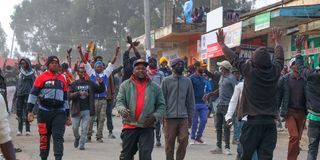
Angry residents chase away vehicles carrying hooded gunmen who attempted to force their way into at AC Primary School polling station during the Ol Kalou by-election on July 16, 2026.

Kenya has learnt, often painfully, that words matter.
Ethnic insinuations, claims of communal superiority, and language that divides citizens into "us" and "them" carry consequences far beyond the political rally or viral video in which they are uttered.
Recent controversy surrounding remarks attributed to Health Cabinet Secretary Aden Duale has reignited a necessary conversation about the dangers of ethnocentric rhetoric in a multi-ethnic democracy. Senators from across the political spectrum have warned that such language risks deepening divisions at a sensitive political moment.


At the heart of the issue is not simply the reputation of one politician. The deeper concern is the enduring temptation to mobilise people through ethnic grievance, ethnic pride, and ethnic comparison.
Whenever leaders suggest that one community is superior, more deserving, or more authentic than another, they undermine the constitutional promise of equal citizenship. Kenya cannot afford a return to forms of political speech that encourage citizens to see one another primarily through ethnic categories.
Political insults
Equally troubling is the use of animals as political insults. Across the world, political discourse frequently relies on comparisons that reduce opponents to animals. Such language works because it assumes that being compared to an animal is degrading. Yet that assumption reflects a deeper hierarchy in which humans imagine themselves superior to all other forms of life and treat animals as symbols of inferiority.
Kenyan cultures offer a different perspective. Animals are woven into stories, clan identities, place names, moral traditions, and systems of ecological knowledge. The hyena, in particular, occupies a complex place in many African traditions. Depending on the context, it may symbolise intelligence, resilience, vigilance, adaptability, or survival. To invoke the hyena solely as an insult is to ignore these richer cultural meanings.
One of Kenya's most distinguished scholars, the philosopher and theologian John S Mbiti, bore a name derived directly from the Kamba word for "hyena". In Kamba thought, naming a child Mbiti is not an act of disparagement but of aspiration. The child is symbolically endowed with the toughness and resourcefulness associated with the hyena, qualities believed to help confront life's adversaries: death, disease, misfortune, and ignorance. What some politicians deploy as a term of abuse is, in another context, a name of dignity, endurance, and hope.
Nor is this symbolism confined to personal names. Mbari ya Hiti—the "Clan of Hyenas"—is a real place in Murang'a County. Its very existence reminds us that the hyena has long occupied a meaningful place within Kenyan social and cultural geography. The people of “Clan of Hyenas” do not derive their identity from contempt.
Their name stands as a reminder that what is mocked in political rhetoric may be embraced as a source of belonging, resilience, and pride. They can stand their ground in the face of both chauvinism and poverty without feeling diminished by the animal from which their community takes its name.
Cultural symbols
Such examples remind us that words and symbols have histories. Meanings that serve as insults in one context may function as markers of identity, memory, and belonging in another. Political rhetoric often flattens these complexities, reducing cultural symbols to convenient weapons in contemporary disputes.
One might even argue that the hyena deserves better treatment than it receives in political discourse. Hyenas do not steal from public coffers, manipulate historical grievances, or mobilise communities against one another. When politicians use animals as insults, they reveal less about those they attack than about the assumptions underlying the insult itself. The target is not merely another community; it is the very idea of difference.
The broader danger lies in the political implications of ethnic rhetoric. Statements that frame public life through ethnic loyalties rather than civic principles encourage suspicion, profiling, and collective blame. In polarised environments, citizens can begin to see ordinary members of communities not as neighbours or fellow citizens but as representatives of political camps. Such dynamics rarely remain confined to speeches. They can shape social relations, influence public institutions, and distort perceptions long after the microphones have been switched off.
Kenya's history offers ample reason for caution. The country has repeatedly paid a heavy price when politicians have sought short-term advantage through ethnic mobilisation. Every generation inherits the responsibility of ensuring that legitimate political competition does not degenerate into ethnic antagonism.
For that reason, Kenya's leaders should embrace a higher standard of public communication. They need not agree on policy. They need not avoid difficult conversations about history, representation, or justice. But they should reject language that assigns moral worth according to ethnicity or caricatures entire communities through derogatory labels. Democracies flourish through persuasion rather than humiliation.
The lesson is simple. Ethnocentrism is dangerous not merely because it insults people. It is dangerous because it normalises the idea that citizenship can be graded according to ancestry. Speciesist insults are harmful not merely because they demean animals. They teach us to associate difference with inferiority and hierarchy with virtue.
A democratic society requires the opposite habit of mind: the recognition that human communities are equal in dignity and that the natural world is not a reservoir of metaphors for contempt. Respect for fellow citizens begins with the refusal to rank them according to ethnicity.
Respect for other living beings begins with the refusal to treat them as symbols of worthlessness. The two principles are more closely connected than they appear. Both reject the logic of superiority. Both affirm the dignity of difference.
Kenya deserves leaders who can speak about communities without ranking them, debate differences without inflaming them, and seek support without appealing to prejudice. In a nation as diverse as ours, the most patriotic political language is not the language of ethnic comparison but the language of shared citizenship.
The future of the republic depends not only on the policies its leaders pursue, but also on the moral imagination through which they conceive the nation and its people. If Kenyans are to build a more just and democratic future, they must reject every doctrine of superiority—whether directed at other communities or projected onto the natural world. Citizenship is strongest when it rests not on hierarchy, but on mutual dignity.
Follow our WhatsApp channel for breaking news updates and more stories like this.
The writer is a Professor of English and Comparative Literature at Northwestern University, U.S., where he is also the Melville J. Herskovits Professor of African Affairs. Email: [email protected].