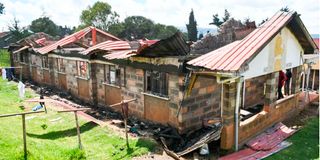
Kenya’s boarding schools were built to produce discipline, national unity and academic excellence. But in recent years, they have also become places of fear, fire, trauma and death. From dormitory fires to overcrowding, from mental pressure to weak emergency response, the boarding school crisis is no longer a private school matter. It is a matter of national concern and emergency.
The problem is not boarding itself. The problem is a boarding culture that has placed grades above children’s lives. We celebrate mean scores, but rarely ask whether the dormitory has enough exits, whether fire extinguishers work, whether a child has slept enough, or whether students from humble background feel invisible during visiting days and other school activities.
This is not only a moral failure. It is also a constitutional and legal failure. Article 43(1)(f) of the Constitution of Kenya, 2010 guarantees every person the right to education. Article 53(1)(b) gives every child the right to free and compulsory basic education, while Article 53(1)(d) protects children from abuse, neglect, all forms of violence, inhuman treatment and punishment. Article 53(2) is even clearer: the best interests of the child are of paramount importance in every matter concerning the child. A school that teaches a child but fails to protect that child has betrayed both the Constitution and the parent’s trust.
As a former student of Mother of Apostles, Eldoret, I remember a school rhythm that understood students needs more than books. Lunch was from 1pm to 2pm. From 2pm to 3pm, we had siesta. From 3pm to 5pm, games were compulsory. Saturday was entertainment, including dancing and drama. Sundays, we had a day off after church and returned to school before 5pm. That timetable may look simple, but it carried wisdom. It gave the body rest, the mind recovery, and the student space to breathe.
Holistic character building
Today, many boarding schools run like academic factories. Students wake up before dawn, attend classes all day, go for night preps, sleep late, and repeat the same cycle. Rest is treated as laziness. Games are sacrificed for exams. Counselling is replaced with punishment. Yet a tired student/pupil is not a better learner. A frightened student/pupil is not a disciplined child. Subject teachers have to deliver A’s or miss trips to Mombasa or even Dubai and motivational fee.
The Basic Education Act, No. 14 of 2013, which was enacted by Parliament to give effect to Article 53 of the Constitution, was not designed to create examination factories. It exists to promote and regulate free and compulsory basic education and the governance of basic education institutions. Education, therefore, must be understood as a protected right, not a race where schools can sacrifice safety and welfare for mean grades.
Kenya can learn from countries like Japan, where education includes holistic character building, civic responsibility and academic rigor. Finland also offers a useful lesson. Its education system values balance, trust, meals, breaks, play and student welfare. Kenya does not have to copy Japan or Finland blindly. The lesson is simple: excellence does not have to mean exhaustion.
Another neglected wound in boarding schools is visiting day inequality. For some children, visiting day is joy. Parents arrive with food, drinks, shopping, pocket money and encouragement. Some students receive one visitor, others receive many. But for poor children, or those whose parents cannot afford transport, visiting day can be a day of quiet shame. They watch others being hugged, fed and celebrated while they sit alone.
Safety must be non-negotiable
Schools must design visiting days with dignity. There should be common meals, shared activities, counselling support, and deliberate care for children who are not visited. Boarding schools must become communities, not places where poverty is publicly exposed.
My personal experience came through my daughter, who had a deskmate who lacked basic necessities and school fees. After carefully listening to her, I offered to pay the girl’s school fees and buy basic necessities every term for my daughters’ deskmate from Form One to Form Four. That student went on to become a doctor at a national hospital in Nairobi. I did not have enough, but I remain proud that my daughter raised the alarm and chose compassion over silence.
Safety must now become non-negotiable. Every dormitory should have working fire alarms, extinguishers, openable emergency exits and regular fire drills. No dormitory should be locked from outside. Metal grills should not become death traps. Schools must have cutting and breaking equipment that can be used quickly to open doors, grills and windows during rescue.
Kenya’s children are not mean-grade statistics. They are sons and daughters entrusted to schools by hopeful parents. We owe them more than exam results. We owe them life.