In my tour of duty as a journalist with a strong leaning towards crime and investigations, nothing struck me as more humbling, deeply sad, and somewhat terrifying as my numerous visits to various maximum-security prisons across the country.
From a small medium prison in Malindi to the high maximum security prison in Kamiti, Naivasha, the notorious Kodiaga, Manyani, Naivasha, and many others, I have witnessed chilling accounts of crime confessions, miscarriage of justice, among other atrocious acts carried out by inmates on innocent victims.
The question I always asked: “What was going through your mind when you raised that machete, swung down hard on the back of the skulls of another human being?” The answer would most times shock me. “I cannot remember,” most of those on death row would respond.
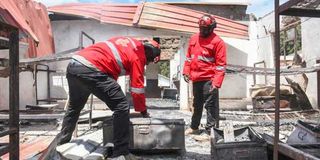
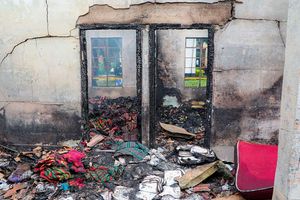
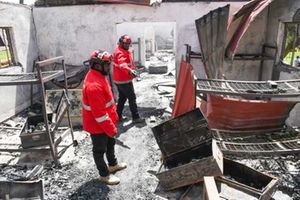
The recent Utumishi Girls Senior School fire tragedy took me back to the day I walked into the Naivasha Maximum Security Prison. My next subject on the popular crime and investigations series, Case Files , was Moses Maina. He was the only suspect convicted for the murder of four fellow students, all prefects, including the school captain of Nyeri High School.
Moses was accused alongside three others of masterminding an arson attack by purchasing petrol, a padlock, and matchboxes, which they used to lock, douse, and set ablaze a cubicle that housed the four prefects. None of them made it out alive.
“I have never killed,” he asserted. The man, then 31, had not yet grown a beard.
Maina was shy. He broke the ice with a nervous yawn before we settled in for a short but very revealing interview. He claimed that he was not involved in the arson attack and that he was framed because he was a “Nairobi kid” loosely translated as a “city” born-and-raised student. “Watu wa Nairobi walikuwa wanaonewa ,” (students from the capital city were always used as scapegoats) he told me. The law had shut its doors to him for life. “Did you have a girlfriend? Did you plan to marry after school?” The answer was no to all these questions. To be honest, for once in my journey as a journalist, it got me thinking.
How can a young man’s life, with such innocence, such naivety, turn so tragic? This was it for him.
“I’m a lifer” – a term for convicts on death row whose sentences were commuted from death to life imprisonment following a Supreme Court petition – “I have applied for parole but I don’t know if I will be pardoned by the president,” he told me.
As I sat there, it also occurred to me that Maina had taken young lives, human beings who had their entire future ahead of them. “Who died most cruelly?” I wondered.
Two of his colleagues featured prominently during the trial, but they were let off the hook. Why? The presiding judge ruled that they were tortured during trial. I’m not one to cast aspersions on court outcomes, but suspects who in the past have alleged torture and even proved it all ended up jailed. The two boys were lucky; they are out somewhere living their life.
I have covered the Nyeri, St Kizito, Kyanguli, Endarasha, and Bombolulu school tragedies.
The July 13, 1991, St Kizito High School massacre remains the most disturbing and heart-wrenching story I have covered. Why would young boys turn so brutal and visit such violence on their female colleagues?
It was a day out for the school, a beautiful Sunday. Everyone was back in school by dusk. Unknown to the female colleagues, the boys had planned to go on a rampage. When the girls refused to join in the strike, the boys stormed their dormitory.
In the ensuing violence, 71 schoolgirls were raped while 19 of them lost their lives, mostly due to suffocation after being tightly packed into a corner during the attack.
When I arrived in Meru to cover the story, tracing the victims of the barbaric attack was not difficult. The school was local as well as national. Most of the students’ homes were only a few kilometres away.
“They turned on us, it was like some spirit had taken over their souls; they were deranged animals,” a survivor of the Sunday night attack told me before breaking down.
I sat there for a long time as she cried her heart out, prompting the husband to approach. He stood at some distance with an expression on his face of a man who knew what his wife had gone through in the hands of the boys.
“They are out here. If you walk down to the market, you will find some of them. They are drunkards and some have turned mad,” he remarked.
“I haven’t cried this much for more than twenty years,” the victim told me. She had not healed. The pain of the horror she had gone through was visible in her eyes, her trembling voice betraying her long-held trauma.
St Kizito’s trial was a mockery of justice. Sixty-seven students were arrested. Some of the parents of the accused worked the system, and almost all the student suspects were let off the hook.
I met some of the boys then, now men. Drunkards. Wasted. Roaming the streets of the local village. I tried interviewing some of them but to no avail; they were too drunk to notice the TV camera in front of them let alone a stretched hand holding a sound microphone.
I have had a chance to visit several schools after various fire incidents across the country. Some of them are reputable institutions of learning but they lack essential basics. Fire drills. Fire assembly points. Properly marked exit routes. The elephant in the room is a lack of proper parenting before these children show up in school.
There was a pattern in the incidents that I covered as a journalist. Majority of those arrested had either been expelled from their previous schools, suspended for indiscipline, or were running small cartels in schools.
Most of them had aliases; Maina was known as Roho (heart) to his colleagues. Others were nicknamed nugu, mradi, connector etc… Names they had acquired through horned skills outside normal studies.
The enrolment numbers in public institutions have also become overwhelming for teachers who just want to “see” these students through school, rarely taking the time to understand what kind of students they are teaching and seldom noticing unbecoming behaviours.
Just like in the past when parents bribed the police, the judges, and the prosecutors, this habit has not escaped a changing criminal justice system. To defeat justice in the past, the prosecution would line up more than 60 witnesses, seek trial adjournments, and declare a mistrial, rendering an otherwise watertight criminal case weak.
The 2001 Kyanguli fire tragedy that claimed the lives of 67 students left a lump in my throat. Two 16-year-olds were arrested and charged with murder. The trial was so problematic. The judge handling the matter resigned in 2006 amid corruption-related allegations. It is not clear if his resignation was linked to the trial of suspects involved in torching a dormitory that claimed the lives of 67 students. A new judge declared the court matter a mistrial.
I took my time with the file, and it was clear that someone had done everything to make sure the two boys escaped justice. I tracked one down to an office in the CBD. He is somewhere out here.
Teachers have said that children with parents of high status influence how schools are run. At times parents also do not ask questions.
I recall visiting a school where the administration had turned a hall into a dormitory housing hundreds of students. The hall was massive but it was just a hall without exit routes clearly marked in case of an emergency. The size of the hall created an illusion of a massive field but in reality, the arrangement of the beds made movement problematic and, in the event of a stampede or fire, virtually impossible.
Some schools do not allow parents access to the dormitories at times for good measure but I believe it is important for parents to know where their children are putting up months on end.
If the prosecution proves that those arrested were involved in the Utumishi Fire tragedy, it will be the end of freedom for them.
Dennis Onsarigo, a former journalist, currently works as a political consultant.