Mrima Hill has not been licensed for mining. Here is what happens next
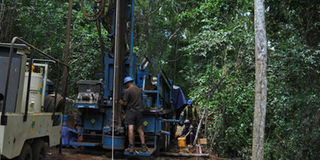
Cortec workers at the Mrima Hill niobium mining site in Kwale.

Who owns the minerals under Mrima Hill? Under the Mining Act, the Republic of Kenya does. That was true before the tender, and it is true now. Yet the hill is back at the centre of a political fight. Recent remarks by former Deputy President Rigathi Gachagua have revived two claims. One is that the deposits have effectively been handed to foreign interests. The other is that decisions are being made without the people of Kwale.
Those concerns deserve clear answers.
What has been missed by some is that the current tender does not award a mine wholesale. Nor does it award a licence – technically, what is granted is a Prospecting Licence. This gives the winner the right to apply, with all of the stipulations that process entails. The bidding falls under Kenya’s procurement laws; prospecting falls under the Mining Act. Where one ends, the other begins.


Once the tender concludes, the winning consortium lodges its licence applications and is then formally introduced to the local community. At this stage, public participation, environmental and social impacts and other required engagements kick in – with government support. If requirements are met, the Prospecting Licences are expected to be granted within a couple of months of application.
A Prospecting Licence lets a company study the ground. It can verify the resource and test whether a project is viable. It does not transfer the minerals or the land, and it does not permit commercial mining.
Radiation safety
The tender puts community issues up front: bidders must explain how they will hire and train Kenyans and buy locally. They must deal with cultural heritage, radiation safety and environmental risks. Each bid needs a Local Content Plan and a framework for a future Community Development Agreement. Several of these points are materially scored. And, above all, bidders must also show a meaningful track record of engaging communities throughout the process.
Prospecting is a deliberately lengthy and regulated process - its purpose is to find out precisely what is in the ground and at what grade. The work also sets environmental and radiation baselines, tests how processing could work, and only then determines whether the economics make sense: it must show who would be affected, and how.
There are several consent and approval points. The Mining Act sets requirements for private and community land. The tender bans prospecting or ground disturbance within 500 metres of a gazetted kaya. The exception is prior written consent from the National Museums of Kenya and the relevant Kaya elders. Environmental assessment and public participation are built into the process, not as a ‘nice to have’, but as core principles.
Prospecting does not create an automatic right to mine; it is merely the first hurdle in a – rightly – lengthy process. A Mining Licence needs a separate application. It also needs further environmental, social and regulatory work. If mining ever goes ahead, the RFP requires ore to be processed in Kenya, preferably in Kwale or on the coast. By law, royalties are to be shared between the national government, Kwale County and the host community.
This economic potential is significant - mining and quarrying made up only 0.8 per cent of Kenya's GDP in 2025, according to the Kenya National Bureau of Statistics. Mrima Hill could be significant if the expected resource is confirmed and value addition happens in Kenya.
Feasibility work
In-country processing is a focus of the Government of Kenya, as refined products capture more local value than raw material exports would. One working estimate suggests a mature project processing niobium and rare earths in Kenya could generate US$1.5 billion to US$4 billion in annual product sales. In scale, that is roughly one to three per cent of Kenya's current GDP. It does not mean GDP would rise by that amount. The outcome depends on prospecting and feasibility work, notwithstanding pricing and final design.
Kenya is not developing these ‘homegrown’ resources alone on the continent. Rare-earth and related projects are advancing elsewhere across Africa. Malawi, Angola and Tanzania are among them.
That makes transparency and participation more important. The public should know who wins the tender and what commitments were made. It should also know when formal consultation and consent stages begin. Communities need clear ways to scrutinise the work and raise concerns. They need to see those concerns addressed.
People can disagree about what should happen at Mrima Hill. But the debate should start from an accurate picture of where the project stands. A tender award is not a Licence. Prospecting is not mining. The framework puts the community inside the process from the start – which is as it should be, and ultimately, is an essential factor in long-term success.
The writer is a mechanical engineer and a private consultant
Follow our WhatsApp channel for breaking news updates and more stories like this.


