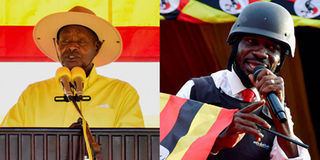
Uganda will go to the polls today. While eight candidates are standing, the contest is between two: former entertainer turned politician, Robert Kyagulanyi Ssentamu (43), famously known by his stage name, Bobi Wine, who is running on the National Unity Platform (NUP) ticket, and former guerrilla fighter, Yoweri Museveni (82), who has been president for the last 39 years.
Museveni’s party is called the National Resistance Movement (NRM). This will be the seventh election since the end of the guerrilla war that brought Museveni to power in 1986.
He has contested in all the elections and won. Or, has been declared the winner in all of them. If Museveni wins the 2026 election — which is highly likely — he will have been in power for 40 years.
The NRM party’s slogan is: “Protecting the gains”, which is often ridiculed by opponents as “Protecting their gains,” that is, what holders of power, their friends, and kindred have accumulated. On the other hand, it has been a struggle for Bobi Wine’s slogan, “The Protest Vote,” to rhyme with public sentiment. Compared to the 2021 slogan, “We are removing a dictator,” the “Protest Vote” has required an immense amount of explaining. It is easier to make sense of Museveni’s slogan.
By all estimates — from public infrastructure, public service delivery, poverty levels, business environment, public education, corruption, unemployment, public health, among others — Uganda ranks way behind her regional peers; Kenya, Zambia, Ethiopia, Tanzania, and Sudan (before the war). Yet after having continuity of leadership — 39 years under one man — Uganda is least expected to be punching in the same division as the countries mentioned above. Sadly, Uganda is in the ranks of South Sudan, Malawi, and Burundi —Rwanda even ranks above it, sometimes. Thus, the question, after 39 years of a singular leadership, which gains and whose gains are Museveni’s government protecting?
Is this a generational clash? Seventy-five per cent of Ugandans are below the age of 35, and would prefer a much young president. A section of voters feels that Museveni and his peers are old and exhausted. And young people are growing wary of mass unemployment, difficult and extortionist banking regimes (oftentimes, 40 per cent interest rates), load shedding, high cost of living, poor public healthcare, poor public infrastructure, massive cases of land grabbing, egregious corruption where entire institutions are “eaten” to the ground, and tribal politics.
Most of the people who hold key positions in the government come from one part of the country. In addition, there is concern about the gross abuse of human and individual rights, abductions of opposition-leaning individuals, and random people who do not necessarily have a clear political affiliation.
Leading Ugandan opposition figure Dr Kizza Besigye and his associate, Hajji Obeid Lutale, were abducted in Nairobi. They remain in lawful custody in Uganda for more than a year after being tried by a military court. Despite a Supreme Court ruling on the illegality of the military court, the two are still behind bars. NUP executives and supporters, including Waiswa Mufumbiro, Eddie Mutwe, and Olivia Lutaaya, are also in jail.
Museveni’s victory is all but certain. This has nothing to do with his record or advanced age. But because he has absolute control over the electoral process and the military. He is the one who appoints the chairperson of the electoral commission and senior commissioners, who can be sacked at will. Museveni sacked four senior electoral commission officials in the course of the 2021 election.
On the other hand, the Commander of Defence Forces, General Muhoozi Kainerugaba, is Museveni’s son. The military has been deeply involved in the election to the point that The Observer newspaper asked if Bobi Wine was running against the security forces. There is, therefore, no way that Museveni’s son will be saluting another president. He has often publicly ridiculed Bobi Wine as unworthy.
Additionally, Museveni remains a darling of the Western World. He has not only left the door open for Western capitalists to enjoy Uganda, but has also become the quintessential colonial comprador overseeing and protecting Euro-American interests: He still has troops in Somalia; props up the Salva Kiir government in South Sudan, builds roads in the Democratic Republic of Congo, and has an open refugee policy.
With about two million, Uganda has the largest number of refugees in the region. The conditions that refugees enjoy in Uganda reduce pressure on Europe. This has earned Uganda the label of “refugee paradise” and endeared Museveni to the West.
Former British Prime Minister Boris Johnson said in his memoir, Unleashed, that there was “that ancient bushfighter who is so important for the peace of the region, from Somalia to Congo to Sudan” — acknowledging his work.
To this end, it is not the outcome of the vote that has put the country on the edge. With the election largely seen as a pre-determined ritual and carefully protected for the incumbent, it is the aftermath of the poll that has put the country under a great deal of tension.
The fear is not that Bobi Wine could call nationwide protests should he be dissatisfied with the outcome, but that some of his more radical supporters — by far the majority — might force this onto him to protest and demand “his stolen victory”. There have been several incidents of (military) violence inflicted on supporters of Bobi Wine in various parts of the country. The idea is to remind these, mostly young people, to go to court if they feel aggrieved by the election outcome.
As I write, at least 2,000 people, who are close to Bobi Wine, have been picked up and jailed over trumped-up charges, some since the 2021 campaigns.
It is the entire spectrum of pre-determined elections and an opposition simply banking on the energy and fluidity of polling that has conspired to bring the country to the edge. The country appears to see violence on the horizon, but people are burying their heads in the sand.
The government has started running campaigns dubbed “I choose Peace.” Columns of fully-armed UPDF soldiers walking on the streets of Kampala has become a common feature. Armoured cars mounted with heavy machine guns can be seen doing the rounds in Kampala. The aim might be to ensure peace and security, but one cannot miss the intention of intimidation against would-be protesters.
Yusuf Serunkuma is an anthropologist based at Makerere University, and a columnist with The Observer newspaper in Uganda.