On this Human Rights Day, Africa must commit to ending coups
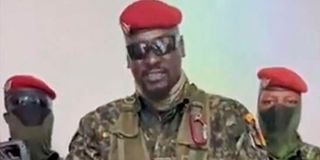
A screengrab taken from footage sent to AFP by a military source on September 5, 2021 shows Guinean Colonel Doumbouya delivering a speech following the capture of the President Alpha Condé and the dissolution of the government during a coup d'etat in Conakry on September 5, 2021.

Every year on 10 December, the world marks International Human Rights Day, commemorating the day in 1948 when the United Nations General Assembly adopted the Universal Declaration of Human Rights (UDHR). Born from the ashes of World War II, the declaration affirmed for the first time that every human being, everywhere, is entitled to fundamental rights and freedoms, without distinction of nationality, race, gender, religion or any other status. Two years later, in 1950, the UN invited all states to celebrate 10 December as Human Rights Day, a yearly reminder that human rights are the foundation of freedom, justice, and peace—not a luxury reserved for “stable” countries.
On this Human Rights Day 2025, we must be brutally honest: coups—whether with guns or with pens—are crimes against democracy, and therefore crimes against the human rights of millions of Africans. Africa must finally shut the door on them. What follows is a roadmap to defend democracy as a human right and to protect civic space across the continent.
Coups are human rights violations and must not stand


On November 23, 2025, the people of Guinea-Bissau went to the polls to choose their president and parliament. Days later, generals seized power, arrested authorities, and installed a “transitional” government before the results were officially declared. On December 7, 2025, soldiers in Benin attacked the president’s residence, seized the national broadcaster, and appeared on state television to announce that the government was dissolved and the constitution suspended. Loyal forces, backed by regional solidarity, pushed them back and foiled the attempt, but not without casualties.
In Tanzania, the October 29, 2025, elections were marked by the exclusion of key opposition leaders, violence, and an almost total victory for the incumbent, triggering the country’s largest protests since independence. The authorities answered with live bullets, mass arrests, disappearances, and an information blackout. Africa, its regional organisations, and international partners must therefore treat every coup, whether classic or disguised, as what it is: an unconstitutional change of government and a grave human-rights violation. No recognition. No normalisation. No polite “dialogues” that quietly legitimise the coup leaders. Any authority born from a coup is born outside the law and outside the human-rights framework.
Put victims, truth and justice at the centre
Behind most coups or attempted coups are victims whose rights are shattered: families of those killed or injured, activists hunted down, journalists detained, and entire communities living under curfew or emergency rule. Africa cannot continue to move on from these crises with convenient amnesia. In places like Guinea-Bissau and in the failed coup in Benin, we need independent, time-bound commissions of inquiry with strong mandates to identify all those responsible, in uniform, in suits and abroad; follow the money and the weapons; protect witnesses and whistle-blowers; and recommend real pathways to justice in national, regional or, if needed, international courts. Impunity is oxygen for the next coup leader. Turning these crises into rigorous truth-seeking and accountability processes is the only way to cut that oxygen off.
Use Africa’s own norms and enforce them without double standards
The AU Constitutive Act, the Lomé Declaration, and the African Charter on Democracy, Elections and Governance (ACDEG) already say clearly that unconstitutional changes of government are unacceptable and that citizens have the right to participate freely in the political life of their countries. The problem is not the law; it is the selective enforcement. In some crises, sanctions are swift and firm. In others, geopolitical convenience or economic interests produce a soft, ambiguous response. Coup plotters read that inconsistency very well.
On Human Rights Day, African leaders should recommit to a simple principle: the same rules must apply to everyone, whether they wear khaki or tailored suits, whether they speak the language of “security,” “stability,” or “reform.”
Sanctions that hit perpetrators, not citizens
To deter coups and systematic repression, sanctions must be smart, targeted, and personal, aimed at those who confiscate rights, not at the populations already suffering. That implies travel bans across Africa and globally for coup leaders, their families, and civilian sponsors, so there are no quiet medical trips or shopping sprees while citizens are silenced at home. Asset freezes should be applied to bank accounts, companies, and properties linked to coup networks, including shell companies and proxies. Firms, lobbyists, and political consultants who knowingly help entrench coup regimes or benefit from plundered resources should also be sanctioned. These measures should be automatic once an unconstitutional change of government is established, activated within days, not negotiated over months. A standard “sanctions toolkit” must become part of Africa’s human-rights defence system, not a case-by-case bargaining chip.
Make coups and grave repression crimes with no expiry date
A coup is not a policy disagreement; it is an organised attack on the constitutional order and on the rights of millions. The same is true of systematic repression: ordering live fire on peaceful protesters, orchestrating mass arbitrary arrests, or shutting down independent media and the internet to cling to power. Africa should therefore explicitly recognise the orchestration or support of coups and large-scale repression as serious crimes under national and regional law, remove statutes of limitation for such crimes so perpetrators remain liable even decades later, and strictly limit amnesties while requiring continental scrutiny for any deal that shields coup leaders and rights abusers from justice. The message must be unambiguous: there is no safe retirement, no comfortable exile, and no guaranteed impunity for those who destroy democracy and trample human rights.
Defend civic space as the first line of prevention
Coups do not emerge from nowhere. They germinate where civic space is already shrinking: opposition harassed, journalists attacked, human-rights defenders smeared, constitution manipulated, courts captured, social media throttled whenever citizens mobilise. If we are serious about preventing military takeovers, Africa must treat freedom of expression, association, and peaceful assembly not as optional extras, but as essential early-warning and prevention tools. Journalists, bloggers, and whistle-blowers who expose corruption, abuse, and coup plotting must be protected. The safety and independence of human-rights commissions, bar associations, judges, and constitutional courts must be guaranteed. Blanket internet shutdowns and social-media blackouts during elections and protests must be prohibited. Security forces must be trained and commanded to respect the rights of protesters, not to view them as enemies. When citizens can speak, organise, and hold leaders accountable, it becomes much harder for conspirators in uniforms or in offices to overturn the people’s will in silence.
Constitutional manipulation is also a coup
We must confront a dangerous hypocrisy. On one side, there is loud condemnation of soldiers who overthrow governments. On the other hand, there is often silence when civilian leaders rewrite constitutions, abolish term limits, or rig institutions and elections so that alternation becomes practically impossible. The African Charter on Democracy, Elections and Governance is clear: changing the rules to prevent democratic change of power is itself an unconstitutional change of government.
In plain language, when incumbents extend mandates indefinitely, when courts are packed to rubber-stamp abusive reforms, and when electoral commissions are captured, and opposition parties harassed out of existence, these too are a form of coup—a constitutional coup. The same consequences we demand for military coup leaders should apply to those who mutilate constitutions and shut the door on alternation in power. Otherwise, we send a disastrous message: that the man who breaks democracy with a gun is punished, but the one who strangles it slowly with legal tricks is rewarded.
On this International Human Rights Day, Africa needs more than statements. We need a continental pact for freedom that treats democracy, free expression, and civic space as non-negotiable rights, refuses to legitimise any authority born from coups—military or constitutional, makes impunity impossible and accountability inevitable, and guarantees protection for those who defend rights, expose abuses, and keep the democratic flame alive. If Africa stands firm now, we can send a simple, powerful message to every potential coup plotter and constitutional tinkerer: the age of playing games with the people’s rights should be over.
Désiré Assogbavi is an Advocacy Advisor at the Open Society Foundations