Some years back a journalist shot an accusing question at President Paul Kagame of Rwanda about not allowing the opposition to thrive. Kagame retorted that nowhere in the rubric with which he was sworn in was he required to empower the opposition.
Down south in Zimbabwe while Robert Mugabe ruled, came a blameful enquiry from a journalist whether he would provide a level playing ground to all candidates in the election and old Bob minced no words: "Of course the ground cannot be level, I am the President, so how can the ground be level?" Mugabe went on ruling. In Kenya, old Jomo often warned his opponents: Ukileta nyokonyoko, nitakusaga kama unga (Should you attempt to cause trouble, I will grind you into flour). Mzee Kenyatta ruled for life.
Kenya currently has a post-2010 Constitution and President William Ruto must be more guarded in the way he responds to public questioning. He would slip every now and then and would rush to moderate any communication that paints him as unpresidentially abrasive.
However, incumbency has undoubtable potency in the hold to power, especially in Africa and some Middle East, Eastern Europe, Asian and South America countries. In Africa, mostly during the one-party rule, we have had Julius Nyerere (Tanzania), Mobutu Seseseko (Zaire/Congo), Yahya Jammeh (the Gambia) Daniel Moi (Kenya), Museveni (Uganda) and Paul Kagame (Rwanda) among others. The last two are still ruling after decades in power.
In Syria Bashar al-Assad ruled with an iron fist since inheriting power from his father in 2000 until he was forced to flee to Russia; Saddam Hussein of Iraq ruled until the US claimed that he had weapons of mass destruction as an excuse to militarily topple him and Muammar Gaddafi of Libya had his long rule until he had his date with the US military.
Then there was Nicolas Maduro like his predecessor, Hugo Chavez, who manipulated Venezuelan affairs and was set to perpetuate his stay in power had US president Donald Trump not rudely interrupted his tenure. In Cuba, Fidel Castro ruled Cuba for life, Mugabe was Zimbabwe’s President until he was overthrown as a frail old man while in Russia Vladimir Putin is the master manipulator of incumbency and there is no end to his rule in sight.
Ruling presidents have displayed the ability to extend either their own rule or, when constrained by the Constitution, through the use of proxies. In Uganda, which held elections in January this year, it is highly speculated that Museveni is grooming his son Muhoozi Kainerugaba to replace him. When Castro left the stage, he had preset the takeover by his brother Raul.
The Zimbabwean case of a purge against Emmerson Mnangagwa was meant to clear the way for Mugabe’s wife, Grace, to rule the country. In Russia Putin became president then moved to taste the premiership and made Dmitry Medvedev the president then returned to the presidency, all at will.
In Kenya, since the advent of multiparty politics, a different trend and tradition, has gained ground. Presidents hand over power after their terms end and a new one is elected.
In the Kenyan scenario, therefore, the big question is: Can the opposition navigate a win in the 2027 Presidential election and stop Ruto getting a second term?
There is no precedent but the 2002 scenario offers some insights. The opposition thrashed an establishment candidate, Uhuru Kenyatta, who was supported by outgoing President Moi, and Mwai Kibaki, against all odds, became the third head of state. Likewise, in 2022 Dr Ruto, in a yet to be fully fathomed streak, won the Presidential election against Raila Odinga, who had the backing of a sitting President. In the Kibaki win, it was proven without a doubt that if the tribal vulture is bound Kenyans can elect an opposition candidate.
Antonymously, in the Ruto win the tribal vulture was unbound but on looking at the retinue of available prey it turned its beak on itself and went into a suicidal twist to stop a Raila Presidency — and it did. Rigathi Gachagua led Mt. Kenya to sacrifice its own lamb, Uhuru Kenyatta, to evade the calamity whose approach from the Lake had long been prophesied. Supporters, however, also credit the bottom-up/hustler narrative.
Be it as it may, it is possible for the opposition to dislodge a ruling party from power. One can argue that from the examples cited, a ruling party can be outmaneuvered but no sitting President is yet to be sent packing in Kenya.
The 2007 Presidential election in which Kibaki stayed in power with a real threat to national security goes all the way to illustrate the potency of incumbency.
The tribal vulture is still hovering ever so menacingly as we approach the 2027 Presidential election. It is still demanding more and this time round it is threatening the sacrificial Priest himself. Therefore, the Priest has had to urgently identify a new lamb and it has been earmarked: it is from a market in Sugoi. At the shrine the spiritual chant is ‘Wantam’.
In October 2024, Gachagua was impeached as Deputy President and many MPs from Mt Kenya region who voted for the impeachment were perceived as traitors — with some facing the wrath of their constituents. Then the ousted Deputy President exploded and began a concerted, messy campaign against his former boss.
In Gachagua’s own words, Mt. Kenya alone had massively supported Ruto’s election to the tune of 4.7 million votes. Ruto got 7,176,141 votes which means Gachagua was leaving Ruto with a paltry 2,476,141 support base, going by his calculations.
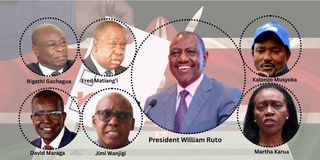
The chronicler’s ink is hardly dry on the Gen Z uprising of 2024 and Jubilee Party is worrying Ruto’s UDA with a Fred Matiang’i candidacy. Further, Kalonzo Musyoka is threatening to marshal all oppositionists into a mega voting machine against Ruto. Former Chief Justice Maraga is also limbering at the touchline, should Kenyans require a wise and moralistic Solomon for a President. Add to these the financial muscle that is in the opposition through the Uhuru-backed Jubilee, Gachagua’s DCP and a number of billionaires and the odds faced by a Ruto win in 2027 become quite existential. Piece all these with scandals here and scandals there with an enthused press and social media ready to foreground them and Wantam really takes shape.
The Presidential election of 1992 illustrates the missteps that would lead to the loss by the opposition. In that election the factors that threatened to end Moi’s rule were weighty. He was already viewed as a dictator, the economy was in doldrums, the international community expressed dissatisfaction by many aspects of governance, the opposition had twisted Moi’s arms into relenting on changing the constitution to reintroduce multipartysm and all-round the powers that be looked cornered.
Then the tribal vulture descended on the opposition and devoured them individually. Political folklore has that some tribal agents flew to London by night to get Kenneth Matiba out of a hospital bed ostensibly to return and save Kenya.
Indeed, he came and tore opposition party Ford from Jaramogi Oginga Odinga and started his Ford Asili. Kibaki had long been branded a coward by the Matiba camp so he remained in the Democratic Party and the two split Mt Kenya votes. From the spoils of the infighting in the opposition, Moi got a whole meal of the Presidential election. The opposition lost with 3,399,080 votes letting Moi win with only 1,962,866 votes.
The 1997 Presidential election had Kibaki, Raila, Wamalwa Kijana and Charity Ngilu losing to Moi. On the ballot were other candidates that farther split the opposition chances. They were Paul Muite, Kimani wa Nyoike, Martin Shikuku and George Anyona. The opposition controversially lost again in 2007 (ended up with a Prime Minister’s post), in 2013, and again in 2017 (lost in a repeat Presidential election).
These references to past loses of the opposition contextualises the political scenario playing out towards 2027. Just months into the election year the historical ethno-selfishness that characterised the loses of yesteryears seems to be a stubborn tag on the opposition. There is Gachagua, Kalonzo Musyoka, Matiang’i, George Natembea and Eugene Wamalwa, among others. Another conclave is forming around Babu Owino, Edwin Sifuna, Winnie Odinga, Ndindi Nyoro and Godfrey Osotsi among others.
There are other odds. ODM that would have offered critical support to the opposition is now in a recovery mode after entering into some truce with Ruto’s government and soon after came the sad demise of their anchor, Raila Odinga. It appears likely to join forces with the President.
The emphasis on the rights and entitlements of a certain subgroup of Kenyans by DCP party leader has also repelled quite large number of people, including some members of the subgroup itself, from the opposition. Revolutions can never be about a group against another or others. They are normally couched in appeals for the good of all.
Another blot is the results of the recent by-elections that were by all accounts demoralizing to opposition enthusiasts. It gave an indication of the gods not being overly pleased by the opposition.
The narrative laid out here is of an incumbent who may end up benefiting from the omissions and commissions of an opposition with divisive ethno-ambitions.