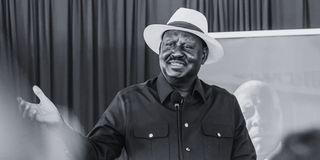
Not until Raila Odinga was dead and buried a year ago today did he receive the State’s fullest embrace as a Kenyan hero, crowned posthumously with the Chief of the Order of the Golden Heart.
In life, he had been many things: patriot to his followers, troublemaker to his detractors, political prisoner to admirers of his democratic struggle, opportunist to those who questioned his compromises.
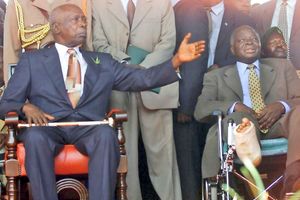
Former Prime Minister the late Raila Odinga.
Photo credit: Pool | Nation Media Group
He could be celebrated as a champion of multiparty democracy and accused of betrayal; hailed as a defender of the people and dismissed as an impediment to progress. Death simplifies inconvenient lives. It permits the living to claim the dead without accommodating their contradictions or capacity to unsettle the order. Those who contested Raila’s place in the nation now queue to celebrate him.
Kenya makes heroes and traitors out of the same people, often without changing the evidence—only the political circumstances. Mashujaa Day invites a question: whose sacrifices define independence, and whose contributions become footnotes?
Kenyan freedom fighter, the late Achieng’ Oneko.
Photo credit: File | Nation Media Group
Jomo Kenyatta became the father of the nation. Yet the struggle was never his alone. Chief Koinange wa Mbiyu occupied a place in the colonial order and nationalist movement. Achieng’ Oneko, one of the Kapenguria Six, spent years in detention before breaking with Kenyatta’s government.
Tom Mboya.
Photo credit: File | Nation Media Group
Tom Mboya, a trade unionist and independence organiser, rose to the centre of the postcolonial State before his assassination in 1969. Their places in national memory show how power shapes recognition.
Women have had to contend with the assumption that nation-making is principally a male affair. Mekatilili wa Menza, the Giriama leader who resisted colonial rule and defended her people’s land, was arrested and sent to Kisii, hundreds of kilometres from the Coast. She escaped and made the journey home. Her place in national memory has taken generations to approach the scale of her defiance.
A statue of Mekatilili wa Menza in Malindi, Kilifi County. Mekatilili is credited with the year-long Giriama Uprising and is still celebrated today for her heroic deeds.
Photo credit: Alex Kalama I Nation Media Group
When Harry Thuku was arrested in March 1922, Mary Muthoni Nyanjiru helped lead the crowd demanding his release. Colonial forces opened fire, killing scores of Africans, including Nyanjiru. Thuku’s name entered the history of early nationalism; her leadership has had to be recovered from its margins.
Domestic political authority
Wangari Maathai’s life exposes another contradiction. A trailblazer in academia, environmental conservation and women’s leadership, she endured a humiliating divorce proceeding. After criticising the judgment, she was convicted of contempt of court and sentenced to six months in prison, though released after three days. In 1997, her presidential candidacy attracted only 4,133 votes; five years later, Tetu elected her to Parliament overwhelmingly. Even after the Nobel Peace Prize in 2004, she remained an assistant minister under a full minister. Global acclaim did not translate neatly into domestic political authority.
Other lives have had to be excavated from official indifference. Makhan Singh, the trade unionist who demanded Uhuru Sasa—freedom now—spent more than a decade in colonial detention. Pio Gama Pinto, the journalist and socialist, was assassinated in 1965. Bildad Kaggia challenged Kenyatta over land and inequality, insisting independence mean more than the Africanisation of privilege. Bishop Alexander Muge, a critic of abuses of power, died in a road accident in 1990 amid controversy. Constitutional scholar Crispin Odhiambo Mbai was assassinated in 2003; the Truth, Justice and Reconciliation Commission later linked his killing to his views on devolution.
Raila was not alone in the political weather of his time. Mwandawiro Mghangha, Katama Mkangi, Kamoji Wachira, Shadrack Gutto, Maina wa Kinyatti and Willy Mutunga belong to that story of dissent and intellectual resistance. So does Ngũgĩ wa Thiong’o, detained without trial and driven into exile. His books travelled the world while his relationship with Kenya remained troubled.
Raila’s elevation raises an awkward question: by what measure does one dissident become a national hero while others remain footnotes? Not everyone who suffered at the hands of the State deserves the same decoration. But does the country have a coherent account of the sacrifices and achievements it honours?
Mutula Kilonzo complicates the question. For more than 20 years he was Daniel Moi’s lawyer, within a political order that used the law to contain opponents. Later, as Minister for Justice, he helped shepherd constitutional review towards the 2010 settlement. His later contribution was substantial; but it does not erase the earlier history, nor should that history blind the country to what he helped achieve.
A national memory that accommodates only saints and villains will struggle to tell the truth about either. The colonial government called freedom fighters terrorists; the postcolonial State called critics disloyal, subversive or enemies of development. Yesterday’s dissident could become today’s minister; yesterday’s president, tomorrow’s rebel leader. Labels travel with the fortunes of those applying them.
Raila’s journey followed this unsettled pattern. He endured detention and helped sustain the struggle for multiparty democracy, then negotiated with governments he had opposed in 2008 and 2018. To some, these were acts of statesmanship; to others, compromises that weakened the opposition.
The dead can be decorated without risk. The living dissident remains a problem. A country’s commitment to its heroes is measured not by posthumous honours, but by its freedom to let the living challenge the order they inherit.
The writer is a board member of KHRC and writes in his individual capacity. @kwamchetsi; [email protected]