Raila’s unfinished revolution: The republic he fought for still unbuilt
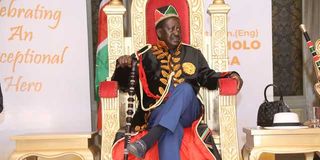
Former Orange Democratic Movement (ODM) party leader, the late Raila Odinga.

The death of former Prime Minister and Orange Democratic Movement (ODM) leader Raila Amolo Odinga did not bury the questions that defined his political life.
It merely transferred them to a generation that must now make a decision on whether the struggle was about one man’s ambition or the unfinished business of a nation.
Odinga’s greatest political significance was never simply his pursuit of Kenya’s presidency. It was his place in the country’s long struggle to dismantle authoritarianism, expand democratic space and renegotiate the relationship between the citizen and the state.


The tragedy of his legacy is that some of the battles he fought remain unresolved, while others have acquired new urgency.
Consider the Constitution promulgated on August 27, 2010. Kenya gave itself one of Africa’s most progressive constitutional frameworks, promising accountable government, devolved power, independent institutions and enforceable socio-economic rights.
As witnessed in the years of devolution, a constitution can be promulgated without being fully implemented. We have constitutional text but the struggle now is to make constitutional practice.
Article 43 of the Constitution promises economic and social rights while Article 10 demands public participation, equity, integrity and accountability.
These are not decorative clauses for presidential speeches or election manifestos. They are obligations of the republic. When citizens cannot afford healthcare, decent housing, food or education, constitutional democracy remains an unfinished project.
Kenya’s third liberation must, therefore, be economic. Political independence without economic dignity leaves freedom incomplete. A young Kenyan who has the right to vote but no credible opportunity to work, build a business or live with dignity possesses political citizenship without its full material substance.
The question is no longer merely who occupies State House, but what the state does for the citizen.
Then there is electoral justice. Kenya’s democratic history is inseparable from disputes over the ballot, the credibility of institutions and the peaceful transfer of power.
The vote must be sovereign, not ceremonial. The Independent Electoral and Boundaries Commission (IEBC) must command public confidence; and political competition must never become a licence for intimidation.
Democracy cannot survive where citizens suspect that their votes matter less than the machinery deployed to count them.
Joshua and Moses
Odinga also fought in a country where political dissent could carry the price of detention, persecution, violence, enforced disappearance and even death.
That history makes the protection of civil liberties an unfinished obligation.
Freedom of expression, peaceful assembly and association cannot depend on whether the government finds the message convenient.
A republic that tolerates criticism only when it is harmless to power is democratic in appearance, not in substance.
Devolution, too, remains unfinished. The transfer of power to counties was intended to bring government closer to the people and correct historical marginalisation.
However, fiscal dependence, weak accountability and political contests over resources continue to test that promise. Devolution must mean more than 47 governors presiding over local administrations. It must mean citizens exercising meaningful power over their development.
None of this requires the romanticisation of the former premier. His political record included compromises, coalition bargains and choices that disappointed sections of his constituency.
Historical seriousness demands that we examine his contribution and contradictions. No individual should become too sacred for scrutiny, particularly in a struggle that was supposedly founded on accountability.
Neither should Odinga’s legacy be reduced to the offices he never occupied or the alliances he entered. The more consequential question is whether this country will complete the reforms for which generations paid a heavy price.
Unfinished revolution
The unfinished revolution demands a constitutional republic that works, an economy that opens doors and a government that answers to its citizens.
It demands institutions stronger than personalities, rights stronger than political patronage and a national identity larger than ethnic or regional arithmetic.
The generation of Odinga challenged the old order. The responsibility now is to build a better one.
Odinga also left behind an academy called ODM. For many years, it schooled a generation in the politics of resistance, popular mobilisation and the struggle for democratic change.
Today, many of its graduates have found a new home in Linda Mwananchi.
In Nairobi Senator Edwin Sifuna is an echo of the biblical Joshua, left to lead a people towards a promise their Moses did not live to see fulfilled.
History is rarely generous enough to let one generation complete the work of liberation. Sometimes its greatest leaders leave behind a mission, a people and a successor.
The man is gone but the struggle remains. The baton has passed.
The revolution was never supposed to end with the revolutionary. It was supposed to transform the republic.
Follow our WhatsApp channel for breaking news updates and more stories like this.
Maliba Arnold Nyajayi is the Executive Director, Open Future Hub (OFH). X: @MalibaArnold.


