Speed guns won’t end carnage on our roads
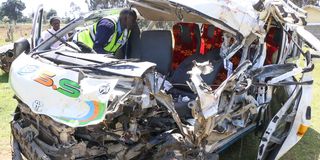
Traffic police assess the wreckage of an 11-seater Toyota matatu that was involved in a grisly road accident at Twin Bridge and claimed the lives of five passengers on the spot.
Twenty-two days. That is all that separated two of the deadliest crashes on the Nairobi–Mombasa highway this month.
On the morning of October 3, a matatu full of pilgrims from Mombasa set off for National Prayer Day at the Subukia shrine. They never got past Mlima Kiu in Salama. Seventeen people died: the matatu driver and 12 of his passengers. Then, on Sunday October 25, at around 7am, a bus carrying mourners home from a burial met a lorry head-on at Kanga, near Mtito Andei. Twenty-four people died.
After Mtito Andei, the Ministry of Roads and Transport promised tougher enforcement against speeding and reckless overtaking, and the National Transport and Safety Authority (NTSA) rolled out a day-and-night crackdown, breathalysers and all. Enforcement has its place. I’m not against it. But we’ve watched this film before: a tragedy, a crackdown, a few weeks of headlines, then business as usual until the next crash. It’s another knee-jerk reaction that tiptoes around the elephant in the room.


When I was a young boy visiting the village, I saw what I can only call a miracle. Every so often a chick would collapse, from illness or whatever it is that ails chickens, and just lie there, all but dead. Shaking it rarely helped. So, the elders had a trick. They’d put the chick under a tub or a sufuria and bang on it loudly for a few seconds, sometimes a few minutes. Then they’d lift the tub and behold, there it was, on its feet, as though nothing had happened. Honestly, I still can’t explain why it worked. But I’ve thought about that sufuria a lot this month.
Our road safety agencies seem to have collapsed in much the same way, and gentle shaking clearly isn’t reviving them. We’ve tried task forces. Press statements. Condolence messages after every tragedy. Maybe it’s time we found a big enough tub and banged it, loudly, until the people responsible for keeping us safe wake up to what’s really killing us on our roads.
Speed checks
In Nairobi lately, you barely leave your gate before you meet a van tucked by the roadside, speed gun pointed your way, even though the crash that set off the crackdown happened more than 200 kilometres away. Drive to western Kenya on a Friday, or back to Nairobi on a Sunday, and you’ll likely be stopped more than twice, mostly for speed checks, on whichever side of the road the holiday traffic is flowing. Go the other way, or travel midweek, and the roadblocks thin out. Is that road safety? Or is it just fishing where the catch is easiest? It’s changing how people travel, too. I know friends who now leave home at 3am, when the roads are empty, but when visibility is at its lowest, just to avoid the roadblocks and speedguns.
NTSA recorded 3,995 road deaths between January 1 and October 4 this year. That’s about 14 people every single day, plus more than 9,000 serious injuries. In 2025, 4,458 people were killed. Pedestrians made up the largest group at 1,685, followed by motorcyclists (1,148), passengers (723), pillion passengers (432) and drivers (403). NTSA puts the cost to our economy at about Sh450 billion a year.
Two things jump out. First, most of the dead are not the motorists being chased by speed guns. They are people on foot and on boda bodas, the road users our roads were never really designed to protect. Second, passengers in public service vehicles are dying in growing numbers. NTSA’s July 2026 report showed passenger deaths up 85 per cent on July 2025, from 47 to 87. No other group rose as sharply.
NTSA blames crashes on a mix of driver behaviour, vehicle condition and poor road infrastructure. That last one deserves far more attention than it gets. Kenya has more than 270 identified black spots, and 199 of them sit on the Mombasa-Malaba Northern Corridor, the same highway that has just claimed 41 lives. Salama itself is flagged as a design-related risk. And Mlima Kiu has buried people before, in June, seven died and 27 were injured in a pile-up on the very same stretch. You can’t fix a badly designed road with a speed gun.
Public service vehicles
The last major works I could trace on the roughly 100-kilometre Voi–Mtito Andei section was a Sh1.04 billion rehabilitation and maintenance contract meant to wrap up in March 2022, mostly a resurfacing job rather than a rebuild. The real culprits are years of neglect and a single carriageway road carrying far more heavy freight than it was built for, with trucks from the port of Mombasa feeding much of East Africa.
Burst tyres and wrecked suspensions are the least of it. Potholes force drivers to swerve into oncoming traffic, and on a two-lane highway, that’s exactly how head-on collisions happen. Yet these are the places where you will rarely see a black spot warning sign or a speed check. The speed guns sit on the best open stretches instead, where your foot naturally gets heavy on the pedal, and the officers are waiting just ahead. Which is why our efforts should centre on protecting passengers, especially those in public service vehicles. Most of those who died at Salama and Mtito Andei were passengers. People who had handed their safety to someone else and had no say in how that vehicle overtook.
NTSA has asked the government to declare road crashes a national disaster. I would welcome that, but only if it brings money, coordination and accountability, not another round of roadblocks. Every black spot and every crash investigation should come with a public report, a named agency and a deadline.
Follow our WhatsApp channel for breaking news updates and more stories like this.
Abraham Mariita is a media development practitioner.