Kenya experiences tremor from Tanzania earthquake
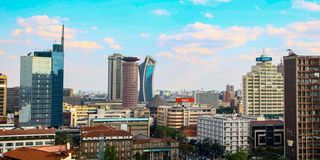
An aerial shot of Nairobi Skyline, taken on August 17, 2024. WILFRED NYANGARESI|NATION

Parts of Kenya experienced a tremor that briefly shook some buildings on Thursday, November 5, 2026.
The ground movement was also recorded in neighbouring Tanzania.
While it originated in Tanzania, its effects were reportedly felt in parts of Kenya, although the intensity varied depending on the location.


According to the Euro-Mediterranean Seismological Centre (EMSC), a magnitude 5.1 earthquake struck the Lake Victoria region of Tanzania at 12.22pm local time.
The earthquake occurred at a depth of 10 kilometres, with its epicentre located at latitude -3.424 and longitude 32.191.
The epicentre was approximately 128 kilometres south-southwest of Mwanza and 26 kilometres east-northeast of Ushirombo.
The EMSC noted that the source parameters had been reviewed by a seismologist, meaning the recorded figures were not merely automatic preliminary estimates.
Speaking to the Nation, Prof Maina Gichaba, the Chairperson of Earth and Climate Sciences at the University of Nairobi explains that Kenya has an established network of seismographs capable of detecting ground movements, although the country is still working to improve the system's effectiveness.
"We have quite an elaborate network of seismographs in Kenya,” he said. “Actually, we get this data in some of our stations, which are local.”
While some Kenyans reported experiencing the tremor, others did not notice any movement, raising questions about whether the earthquake had affected only particular areas.
Prof Gichaba explained that the magnitude of an earthquake is one of the factors determining whether people will feel it, noting that smaller seismic movements occur regularly but often go unnoticed.
"There are many other smaller tremors that happen in our region, particularly in Kenya. But we don't feel them. But they do occur," he said.
He explained that the magnitude of an earthquake determines the amount of energy released, although the distance between the epicentre and the affected location also influences how strongly the ground movement is experienced.
In the case of the Tanzania earthquake, the distance from the epicentre meant that its effects in Kenya were considerably reduced, making it feel more like a tremor than a major earthquake.
Gichaba said seismic movements are generally noticeable when their magnitude rises above approximately 4.2, although the experience can vary depending on how far someone is from the source.
"When it is slightly more than 4.2, you can feel that,” he explained. “But since, again, the distance for us, the impact may be quite diminished. It may appear like a tremor.”
The distinction between an earthquake and a tremor, he explained, is largely associated with the magnitude and intensity of the ground movement rather than the occurrence of two entirely different geological processes.
Both result from the release of energy beneath the Earth's surface.
According to Prof Gichaba, earthquakes occur when adjustments take place underground, involving movements along fractures, cracks and geological structures.
"Earthquakes will always occur when there is a release of energy,” he said.
These movements release energy, which travels through the Earth in the form of seismic waves and can eventually be experienced as ground shaking.
“The release of energy with respect to the Earth will come about as a matter of some adjustment," he explained.
He added that such adjustments can involve slight movements along geological fractures and other structures beneath the Earth's surface.
“Movement along geological folds and cracks beneath the Earth's surface releases energy, which is eventually felt as a tremor,” he said.
Kenya's position within an active geological region makes the need for continuous monitoring particularly important.
Prof Gichaba pointed to the Rift Valley, where geothermal activity, steam movements and extensive fractures form part of the geological processes taking place beneath the surface.
He said the region has extensive fractures running from north to south within the Rift Valley, alongside geothermal activity that contributes to its complex geological environment.
"This is a very active region," he noted.
The country has equipment that can record seismic activity through local monitoring stations and international networks, but some of its capacity remains underutilised.
“The country is in the process of upgrading its monitoring capacity,” he noted, “to ensure that seismic activity occurring within Kenya and neighbouring countries can be identified and analysed more effectively.”
The objective is to establish not only where an earthquake has occurred but also its magnitude, depth and the direction in which seismic waves are travelling.
“This information is important in understanding the possible effects of an earthquake,” he explained, “and determining the areas likely to experience ground shaking.”
However, Prof Gichaba acknowledged that Kenya has faced challenges in putting some of its available monitoring equipment into operation, despite having acquired it several years ago.
"We have had some equipment here for the recent years,” he said, “and we have not installed it because of some challenges.”
The delay in installing the equipment raises questions about the country's ability to make full use of its existing infrastructure, particularly in a region where seismic activity can occur without warning.
Gichaba said Kenya needs a functional and coordinated monitoring network that can provide information as soon as an earthquake occurs, rather than relying on reports from members of the public or information generated by monitoring centres outside the country.
Mr Gichaba said he was working to revive the equipment and ensure that the country's network of monitoring stations could function together and provide reliable information.
"Right now, as a person in charge, I am making sure that we are able to, we are in the process of reviving it," he said.
Follow our WhatsApp channel for breaking news updates and more stories like this.