The different shades of Raila Odinga: Rebel and statesman
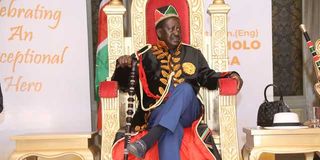
Former Orange Democratic Movement (ODM) party leader, the late Raila Odinga.

As a high school boy, I became aware of a courageous, unyielding resistance leader willing to sacrifice everything for constitutional democracy – a man who endured detention without trial during the Moi era, when few dared speak against a deeply repressive regime.
By the time I graduated from university, I had witnessed from afar his transformation from militant warrior to consensus-building political leader, still fighting for constitutional reforms to deepen multiparty democracy and introduce devolution. He had added institutional reform and transformation to his agenda.
I had met him briefly at a trade show when he was Minister for Roads, Public Works and Housing, but our first real encounter came by chance in November 2007, during a business trip to Kampala to launch East African Cables’ subsidiary. At breakfast at the newly opened Kampala Serena Hotel, my team and I noticed Raila at a nearby table.


At my colleagues’ urging, I introduced myself as CEO of East African Cables, then the Nairobi Securities Exchange’s fastest-growing company. He invited us to join him. Our conversation turned to women in Kenyan politics, revealing an insight and empathy that stayed with me.
Cultural expectations
He explained how cultural expectations disadvantaged women seeking office. Expected to marry and move to their husbands’ homes, women often lost the local roots and networks that gave men an advantage. Running in their new homes left them competing against male rivals with established connections and name recognition.
In the aftermath of the contentious 2007 elections, I witnessed Raila’s fierce opposition to injustice and deep empathy. During the post-election violence in January 2008, I was part of a Kenya Private Sector Alliance (KEPSA) team shuttling between Mwai Kibaki and Raila. Asked whether he would split the proverbial baby in two, he expressed his sense of injustice but remained the statesman he would prove to be.
I worked most closely with him as Prime Minister at Vision 2030, where his energy, determination and conscientiousness stood out. Unlike some ministers who disappeared during official trips, he remained diligent.
In Tokyo, engagements with Toyota produced a Vision 2030–Toyota memorandum of understanding covering geothermal power, desalination plants and the Bellevue Training Centre. I also spent a quiet evening in his suite watching an Arsenal match as he unwound. In Singapore, I felt the motorcade was preventing him from experiencing the city-state as I had hoped. I suggested he join Dr Julius Muia, then National Economic and Social Council (NESC) secretary; the late Dr Geoffrey Mwau, then Economic Secretary; Dr Victor Koh, our Singapore-based NESC and Vision 2030 adviser; and me for a walk along Orchard Road.
We rode the MRT, ate at busy fast-food restaurants and watched ordinary Singaporeans in their orderly society, reflecting on how Kenya could offer its citizens similar opportunities.
On our walk back to the hotel, I bought several copies of a DVD about Singapore’s founding Prime Minister, Lee Kuan Yew, and gave one to Raila, affectionately known as Jakom. By the visit’s end, we had signed a government-to-government memorandum of understanding covering an electronic single-window system for the Port of Mombasa, special economic zones, affordable housing and pension schemes.
In New York and St Petersburg, we secured investment agreements for Vision 2030 projects. At the St Petersburg International Economic Forum in June 2012, hosted by President Vladimir Putin, Raila’s curiosity was evident. Interested in three concurrent breakout sessions, he proposed that Dr Chris Kiptoo, then his economic adviser, and I split up to attend all three and compare notes afterwards.
He had shed the trappings of the premiership, becoming simply a fellow participant eager to learn and exchange ideas. It was refreshing.
Back home, he tirelessly advanced the Vision 2030 agenda. A few of his interventions illustrate his values and commitment to fellow citizens.
50 Cabinet ministers
When the World Bank withdrew from the Lake Turkana Wind Power project in 2012, then the continent’s largest planned wind farm, valued at about US$700 million, Raila lobbied the African Development Bank to save it. He similarly championed private-sector investments, including Tatu City. On a personal level, he gave me a moment preserved in an accidental photograph I treasure. At the LAPSSET project groundbreaking ceremony in Lamu in March 2012, logistics were a nightmare, with the heads of state and government of Kenya, Ethiopia and South Sudan, their cabinets and senior officials attending.
With so many dignitaries present, Kenyan permanent secretaries and chief executives, myself included, had been relegated to a tent away from the three countries’ Cabinet officials. The welcoming line-up comprised about 50 Cabinet ministers.
Suddenly, Raila’s security detail approached me with instructions to report to the Prime Minister. He ushered me to stand beside him, insisting that those who had “done the work” should not be pushed to the back on such an occasion. President Kibaki arrived at that moment. In an astonishing turn of events, I received him immediately after Raila, ahead of the assembled ministers. Ethiopia’s Prime Minister Meles Zenawi and South Sudan’s President Salva Kiir followed. Raila’s sense of justice was instinctive; he simply could not help himself.
Less than two years later, when President Uhuru Kenyatta appointed Ambassador Francis Muthaura chairman of the LAPSSET Corridor Development Authority, the decision triggered a public outcry. Raila, by then opposition leader and Uhuru’s chief political rival, unexpectedly issued a statement strongly defending Muthaura, who had played a central role in LAPSSET’s development.
Looking back on Raila’s evolution, I believe he possessed a rare ability and desire to turn the causes of his rebellion into national reforms benefiting the very citizens on whose behalf he fought. He was a rebel with a cause, determined to see it fulfilled.
Like South Africa’s Nelson Mandela, he fought courageously against an oppressive system but could also become a pragmatic reformer, building national consensus around constitutional change, particularly the 2010 Constitution, and driving the implementation of transformative projects.
Like the rest of Kenya, I miss him dearly. As we mark the first anniversary of his passing on October 15, I am honoured to have been invited by his family to serve on the national steering committee for the anniversary celebrations. It is a small way of giving back to a man who gave so much to his country and to me.
He was truly one of a kind.
Follow our WhatsApp channel for breaking news updates and more stories like this.
Mugo Kibati is a business leader who served as Director-General of Vision 2030 and worked with Raila Odinga during his tenure as Prime Minister. He has held senior leadership roles in Kenya’s private and public sectors.


