The missing link in Africa’s projected $1trn agriculture
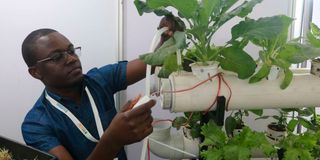
Youthful agripreneur Derick Mugodo, the founder of AgriPlant Kenya, switches on power for water to be pumped into an automated vertical hydroponic system for urban farming.

Agriculture is one of Africa’s biggest economic opportunities. More than half of the working population in sub-Saharan Africa depends on agriculture for a living, a sector that accounts for a quarter of the region's economy. The African Development Bank projects that the continent's agribusiness sector could be worth $1 trillion by 2030.
But that future won’t come to pass on its own. Sub-Saharan Africa has tapped just one per cent of its irrigation potential, mostly because the pumps that could unlock it are too costly for most smallholder farmers. The region also loses an estimated $4 billion every year to post-harvest waste, largely because of limited cold storage to stop food from spoiling before it gets to the shops. Efficient appliances and equipment can address these issues and unlock a $50 billion market.
This week, world leaders are gathered in Kigali for the Africa Food Systems Forum, and the conversation is predictably about money. Big, exciting numbers pledged on stage to fix Africa’s food systems. The real question is whether that money turns into higher productivity, more income, and more jobs.


But money is not the only thing standing between African agriculture and real economic growth. What is missing is access to efficient equipment and appliances. When agricultural businesses can turn energy into productivity, the gains show up everywhere. Harvests are better, incomes are steadier, and jobs are created. Unfortunately, that’s a side conversation at this year’s Forum, when it should be the headline. Why? Because the stakes are high.
Ask anyone you know who works in agriculture. Business is getting harder by the day. The land itself is changing because desertification is spreading fast. Rainfall is unpredictable, arriving when it shouldn’t, or not falling at all. For 95 per cent of African farmers who depend on rain-fed agriculture, this is a crisis. They are doing all they can to adapt and sustain operations but are facing new challenges faster than they can solve them.
My grandparents were farmers. My parents farmed. Mine is an agrarian family, and I have watched and listened to them all my life. Add to that the thousands of other agripreneurs I have come across over the course of my career. Drought, markets, and finance always get the blame. But an equally big issue rears its head every time, the lack of productive efficient agricultural appliances to grow and sustain the businesses.
The case for expanding access to efficient appliances across the agriculture sector has never been more urgent. The World Food Programme warns that the oncoming El Niño, expected to peak between September and December this year, could push millions into acute food insecurity by the end of 2027, exposing already vulnerable communities to more risk.
That’s why this year’s forum matters. Delegates in Kigali are discussing "nourishing nations, growing jobs, and building resilience,” but none of that actually happens without the essential infrastructure that turns energy into productivity. Like a solar water pump that helps crops grow and a solar-powered refrigerator that keeps the harvest fresh. What the sector needs is investment models where this infrastructure is built in from the start.
The data backs this up. More than 16,000 solar refrigerators, water pumps, and milling equipment were delivered to 58,000 households in Africa. The result? Farmers producing more, losing less, and earning more. This July, a second $1.5 million round expanded that work to 3,800 more appliances and over 3,000 jobs. This is what growing jobs, building resilience, and adding value actually looks like.
So, this is my challenge to leaders in Kigali. Treat efficient appliances as what they are, essential economic infrastructure that turns energy into jobs, productivity, and growth. Every investment and policy announced this week should be able to answer one question. How will it help farmers and agribusinesses access that infrastructure? Get that right, and AFS 2026 will be remembered as the moment Africa’s $1 trillion agriculture opportunity became a reality.
Follow ourWhatsApp channel for breaking news updates and more stories like this.
The writer is a Senior Director, Africa, at CLASP