The New Delhi Declaration
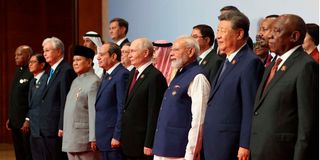
Indian Prime Minister Narendra Modi, Russian President Vladimir Putin, Chinese President Xi Jinping, South Africa's President Cyril Ramaphosa, Egyptian President Abdel Fattah el-Sisi, Indonesian President Prabowo Subianto, Kazakh President Kassym-Jomart Tokayev, Philippine President Ferdinand Marcos Jr, Vice President of Nigeria Kashim Shettima, Ethiopia's Prime Minister Abiy Ahmed, Saudi Foreign Minister Prince Faisal bin Farhan Al-Saud and other leaders attend day two of the BRICS Summit in New Delhi, India, September 13, 2026.

At a time when multilateralism and international cooperation face formidable challenges, bringing countries together around a common agenda is an achievement of lasting significance.
The 18th BRICS Summit, which marked its 20th anniversary, held in New Delhi on September 12–13, 2026, demonstrated a people-centric and humanity-first approach in international relations by making ‘Resilience, Innovation, Cooperation and Sustainability’ its key priorities.
The summit’s most consequential achievement was the unanimous adoption of the New Delhi Declaration. With conflicts continuing in Ukraine and West Asia, geopolitical tensions and trade restrictions placing international relationships under strain, agreement could hardly be taken for granted.


BRICS brings together countries with different political systems, economic strengths, security concerns and external partnerships. Finding common ground among them required considerable diplomatic effort. The declaration demonstrated the value of India’s approach—sustained engagement, respect for different perspectives and a determined search for consensus.
The high-level participation of BRICS members, partner countries and special invitees reinforced the summit’s significance. Alongside Prime Minister Narendra Modi, participants included presidents Xi Jinping of China, Vladimir Putin of Russia, Masoud Pezeshkian of Iran, Prabowo Subianto of Indonesia, Abdel Fattah el-Sisi of Egypt and Cyril Ramaphosa of South Africa; Prime Minister Abiy Ahmed of Ethiopia; Sheikh Khaled bin Mohamed bin Zayed Al Nahyan, Crown Prince of Abu Dhabi, representing the UAE; and Foreign Minister Mauro Vieira, representing Brazil. Egypt and Ethiopia’s membership alongside South Africa has strengthened Africa’s voice within BRICS.
Ten partner countries—Belarus, Cuba, Kazakhstan, Malaysia, Nigeria, Thailand, Uganda, Uzbekistan, Bolivia and Vietnam—also participated. Special invitees Bahrain, Burundi, the Philippines, Saudi Arabia and Uruguay extended the summit’s outreach to the wider Global South. UN Secretary-General António Guterres and the heads of the World Health Organization, World Trade Organization, New Development Bank and Asian Infrastructure Investment Bank further enriched the deliberations.
Purchasing power parity
Today, BRICS represents nearly half the world’s population and around 40 per cent of global output measured at purchasing power parity. Its deliberations therefore carry considerable weight for the direction of the world economy.
The New Delhi Declaration carries several significant messages for the international community. It made a clarion call for global governance reform, including reform of the United Nations Security Council and international financial institutions, and recognised Africa’s legitimate aspirations in this regard. In the words of Indian Prime Minister Narendra Modi, “the Global South is today in the front row of global crises, but in the back row of decision-making. We must transform this “pyramid of privilege” into a “platform of partnership, where every country has a voice, every member has a stake, and the advancement of humanity remains at the heart of every endeavour.”
An international system that gives developing countries greater influence over decisions is therefore an economic necessity. For Africa, meaningful representation must bring a greater ability to shape the policies that affect its development. Prime Minister Modi expressed this aspiration through his call for the Global South to move from “rule-takers” to “rule-shapers”. He proposed a reform roadmap centred on representation, responsiveness and participation in making international rules. The underlying principle is compelling: countries affected by global decisions must have a meaningful role in shaping them. For entrepreneurs, researchers and young professionals, this has particular relevance as rules governing artificial intelligence and other emerging technologies take shape. Developing countries should contribute their own priorities, expertise and solutions. Cooperation should help them build capabilities, create employment and expand access to technology.
On international and regional peace and security, it expressed concern about ongoing conflicts in many parts of the world and the current state of polarisation and fragmentation in the international order, and highlighted the importance of preventive diplomacy as a key tool to avoid crises and prevent their escalation.
An unequivocal assertion of the New Delhi declaration was a strong condemnation of any acts of terrorism, including the April 2025 attack in Jammu and Kashmir, and a commitment to combat terrorism in all its forms and manifestations, including the cross-border movements of terrorists, terrorism financing and safe-havens.
The summit also advanced practical initiatives. Prime Minister Modi highlighted an integrated early warning system for infectious diseases, a logistics supply-chain cooperation framework, a proposed startup innovation fund, and centres of excellence in agro-ecology and energy storage. These address challenges familiar across the Global South: detecting health threats early, keeping essential goods moving, supporting enterprise and strengthening sustainable production.
Digital agriculture
The accompanying emphasis on digital agriculture, including the application of artificial intelligence and geospatial technologies, offers another promising direction. So does the focus on skills, small enterprises, women and young people. These priorities suggest useful areas for future exchanges between Indian and Kenyan institutions: better information for farmers, technology that improves productivity, and innovation that reaches communities beyond major cities.
Innovation was also visible at the summit itself. The Bharat Innovates Exposition showcased 37 technologies, including AI-enabled cancer screening, floating solar systems and maternal-health monitoring. Held alongside the BRICS Business Forum, it connected research and enterprise with opportunities for international collaboration. For developing economies, such exchanges can help turn promising ideas into affordable products and services.
Delivery will ultimately determine the summit’s legacy. Prime Minister Modi’s proposed BRICS Continuity and Implementation Mechanism, supported by successive chairs and a digital record of responsibilities, timelines and progress, addresses this requirement. Sustained follow-through can help ensure that commitments retain momentum as chairships change.
The New Delhi BRICS Declaration has provided a strong foundation. It brought diverse countries together, secured a substantive consensus and advanced cooperation around the everyday concerns of developing societies. India will continue to work with partners across the Global South to carry that spirit forward. Our shared ambition must be an international order in which every country can contribute, every society can benefit, and the promise of cooperation is measured in better lives.
Follow our WhatsApp channel for breaking news updates and more stories like this.
Dr Adarsh Swaika, High Commissioner of India to Kenya