Premium
Trends that will shape Kenya’s foreign and diplomatic affairs
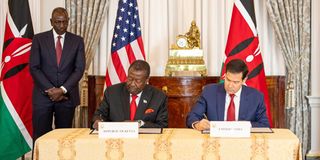
US Secretary of State Marco Rubio and Kenyan Foreign Cabinet Secretary Musalia Mudavadi sign the US-Kenya health pact as President William Ruto looks on.
Foreign policy analysts often prioritise domestic or internal factors as quite significant in making sense of a country’s foreign policy in action. Granted, external factors possess the power to cause or constrain domestic foreign policy.
In 2025, for instance, the foreign policy decisions of the US prompted reactions, responses, and calculations from Nairobi. Equally, the international financial architecture had a sizeable bearing on Kenya’s foreign and domestic policy options.
Here is the point of departure in focusing on the domestic base of Kenya’s foreign policy. This is the domain of foreign policy-making where President William Ruto and the Ministry of Foreign and Diaspora Affairs officials have exclusivity, sovereignty, and legitimacy.


Other State entities – for instance, Parliament – also have a role and the leeway to contribute to the decision-making. This is evident when analysing proprietary perspectives, patterns, and trends on Kenya’s foreign policy in 2025.
The foremost trend was the Parliament’s ratification of Sessional Paper No.1 of 2025. This development in January bestowed legal force on the Kenya Foreign Policy 2024. Shortly afterwards, the Cabinet approved the integration of the Ministry of Foreign and Diaspora Affairs into the Security Sector Working Group.
It was a positive shift as it portended better coordination between external security issues and foreign policy interests, along with higher-level budgetary allocations. The new policy promised open and democratic approaches. In a statement in May, the Foreign Affairs CS Musalia Mudavadi stated that all treaties and agreements would be transparently accessible. An initiative dubbed Foreign Policy Mashinani (a devolved foreign policy dissemination initiative) was launched in October, first in Kisumu, with a follow-up event in Mombasa.
Foreign missions
The second noteworthy trend was the establishment of foreign missions in six countries – Morocco (Rabat), the Vatican City, Denmark (Copenhagen), and Vietnam (Hanoi) – as well as consulates in China (Guangzhou) and Saudi Arabia (Jeddah). Related to the category of diplomatic expansion was the opening of an immigration office in Garissa, on Kenya’s frontier with Somalia, in February.
The opening of the embassy in Rabat was a decisive, if controversial, action. Morocco and the Sahrawi Arab Democratic Republic (SADR) have been engaged in a long-standing sovereignty dispute. Kenya had often sided with the SADR, which Morocco considers a breakaway province. This was until President Ruto assumed power in August 2022, when Kenya’s foreign policy shifted, with an eye on economic gains from Morocco.
The expansion of Kenya’s diplomatic footprint is laudable as it extends representation and boosts the pursuit of Kenya’s interests farther afield. Reports of the dilapidated state of diplomatic facilities, however, sully this otherwise progressive move. Collectively, the offices of the Auditor-General and the Controller of Budget issued reports about the poor state of diplomatic infrastructure in Abuja, Berlin, Paris, New York, Mogadishu, Dar es Salaam, Dodoma, Addis Ababa, London, and Washington, DC. This raised questions about the viability of opening new missions when existing ones need refurbishment. There is a contradiction between the expanding diplomatic footprint vis-à-vis the poor physical infrastructure in an increasing number of diplomatic stations.
The third trend compares to the second, diplomatic affairs issue, as well as fidelity to the new foreign policy framework. This is all about the appointment of ambassadors. As early as January, Parliament took a critical stance on the diplomatic appointments, pointing out problems with the designation of ambassadors, high commissioners, and consuls general. Among these were using diplomatic postings to reward the Ruto administration’s failed political allies while overlooking key competencies.
The nomination of politicians and non-career civil servants in March was presented as evidence of the misuse of diplomatic postings. In April, Mr Mudavadi, proposed a 70-30 per cent ratio for career diplomats versus political appointees, respectively. The October 2025 diplomatic changes struck a professional-political balance in ambassadorial appointments.
In November, the Foreign Ministry presented a bill proposing an amendment to the Foreign Service Act in parliament, seeking to entrench the 70-30 ratio principle. If this is implemented, it would be a correction to the decades of complaints by career diplomats over their stagnation in foreign service positions with no hope for upward mobility. More importantly, attaining a healthy balance of competent political appointees at a lower level than that of career diplomats would boost Kenyan Foreign Policy objectives.
Regional conflicts
The fourth trend is based on perceptions that Kenya is increasingly becoming a meddler rather than a peacemaker in regional conflicts. A key development was Nairobi’s hosting of a consequential meeting of Rapid Support Forces, a combatant in the Sudanese civil war. This soured relations with the Sudan Armed Forces (SAF), which tenuously claims legitimacy to the Sudanese state. In the DR Congo-Rwanda conflict, which escalated in January, Kenya's image was dented via the claim that it aligned with the Congo River Alliance movement, the political arm of the Rwanda-aligned M23 rebels, upsetting relations with Kinshasa.
In relations with Tanzania and Uganda, Kenyan diplomacy had to balance citizens' interests while avoiding schisms with the leadership in both countries. Kenya was seen as aligning with emerging illiberalism in the East African region. These and other developments were deemed negations of the new foreign policy framework. While commentators censured President Ruto for flouting the government’s own peace-building and conflict resolution elements of the policy, top government officials insisted that the president had the right to make foreign policy decisions.
The fifth trend is about the diplomacy of Kenyan county governments. The county governments continue to play a visible diplomatic role since early 2010s. This level of diplomacy continued to be a source of misuse and wastage of resources. In March 2025, the Controller of Budget reported a Sh6.6 billion expenditure on foreign trips by officials, governors, and MCAs from the previous year. In June, an additional Sh1 billion in foreign travel was reported.
By September, the travel expenditure was reported at Shs16.2 billion for the year ending June 2025. The report in December was equally damning in foreign travel expenditures by county government officials. The destination countries were listed as France, UAE, Netherlands, Singapore, Spain, UK, USA, Qatar, Canada, Uganda, Tanzania, South Africa, and Egypt. The trips by county officials were assessed as contributing little or nothing to Kenya’s foreign policy objectives.
Follow our WhatsApp channel for breaking news updates and more stories like this.
Dr Wekesa is Director, African Centre for the Study of the United States, University of the Witwatersrand, [email protected]