Premium
Trumpian calculus, ghosts of ‘Mafia House’
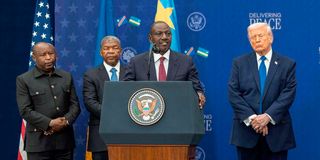
President William Ruto delivers his speech during the historic signing of a peace deal between President Donald Trump, President Félix Tshisekedi of the DRC and President Paul Kagame of Rwanda in Washington DC on December 05, 2025.

In the high‑stakes theatre of global diplomacy, timing is destiny. To stride into the Oval Office and clasp the hand of a man who has built an empire on the ruthless pruning of waste is one performance. To return home only to watch billions evaporate into the digital cloud of the Social Health Authority (SHA) is quite another.
It is less governance than a tragicomedy of self‑inflicted wounds, a masterclass in geopolitical self‑sabotage. The recent disclosure that Kenyans lost an alarming Sh11 billion to fraud through the now-infamous SHA between October 2024 and April 2025 has emerged at a particularly inopportune time, occurring merely weeks after the sealing of a massive Sh221 billion ($1.7 billion) health agreement with President Donald Trump’s administration at the White House.
Losing Sh11 billion in six months is a heist written in broad daylight. To Washington’s skeptical gaze, and to a Kenyan public long trained to expect disappointment, the SHA was meant to herald the dawn of Universal Health Coverage. Instead, it resembles yet another Trojan Horse wheeled in by familiar hands. The Kenya-US agreement is designed to combat infectious diseases, with similar partnerships anticipated to be implemented in other African nations aligned with Trump’s broader foreign policy objectives.


Upon taking office, President Trump announced an immediate freeze on foreign aid as part of a fiscal review, initiated the dismantling of the US Agency for International Development (USAid), and repositioned billions in aid for economically disadvantaged countries. By September, the administration unveiled an America First Global Health Strategy, conditioning aid on strict negotiations to curb waste and advance US interests.
In light of the current politically charged atmosphere in Washington, wherein the Republican administration emphasises the “America First” policy, it is imprudent for any leader within the Global South to irk the Oval Office with such egregious malfeasance, despite the ministry's inclination to attribute blame to private healthcare institutions. Ultimately, the accountability resides with Health Cabinet Secretary Aden Duale.
His candid admission of rampant corruption only deepens the despair of taxpayers already crushed by debt and the inefficiencies of a public health system that limps from crisis to crisis. Hospitals remain understaffed, doctors and nurses strike with ritual regularity, and the very institutions meant to heal the nation are themselves in critical condition.
Over the years, the term “Mafia House”, as the minister openly branded it, has become emblematic of a troubling financial conduit for public officials, influencers, and tenderpreneurs. Successive governments have failed to adequately address the corruption for myriad reasons.
Like a hydra, it grows new heads each time one is severed. This phenomenon has become synonymous with graft, and irrespective of the distressing and sensational headlines produced by the media, these unscrupulous individuals continue to devise new schemes to exploit public resources.
A review of notable past scandals evokes a sense of outrage. They read like chapters in a national epic of plunder. The Sh7 billion CT scanner fiasco of 2016; the Sh38 billion hospital equipment saga that Parliament could not fully audit; the Auditor‑General’s revelations of IFMIS manipulation; the Sh515 million siphoned from the National Aids Control Programme; the Sh889 million meant for free maternity care that vanished; the Sh10 billion NHIF hemorrhage; and the Sh260 billion Covid‑19 funds lost in the fog of a global emergency.
If the government cannot secure its own vaults, it cannot expect the world to keep filling them. Corruption in healthcare is a biological one. Every shilling diverted is a life shortened, a surgery delayed, or a mother turned away from a delivery room.
The tragedy of “Mafia House” is that it has become an institution of its own, more hopeless than the hospitals it is supposed to support.
Until “America First” meets a credible “Kenya First” accountability, the Sh11 billion will be yet another entry in the long, sorrowful list of national loss, and a warning that nations, like people, can bleed out slowly long before they fall.
Corruption has transitioned from a vice to a predator. It stalks maternity wards, prowls through procurement offices, and feasts on the futures of children who will never see the inside of a functioning hospital. It is a silent epidemic more lethal than any virus, because it kills without needing a microscope, only a signature.
A country cannot heal when its healers are thieves. Corruption has become the termite colony gnawing at the beams of the nation. If the country does not confront this rot, then the next scandal will simply confirm what Kenyans already know — that corruption has become Kenya’s most stable institution.
Follow our WhatsApp channel for breaking news updates and more stories like this.