From completed estates waiting for occupants to construction sites slowed by delayed payments, Kenya’s affordable housing drive is entering a decisive stretch. The government has launched a Rapid Results Initiative to complete at least 45,000 units by the end of the year, but a Sunday Nation spot-check across several regions found a programme advancing at sharply different speeds.
The State Department for Housing and Urban Development says more than 20 projects have passed 70 per cent completion stage and should be ready for occupation within four months.
PS Charles Hinga said that 220,536 units are under development, while more than 1.31 million Kenyans have registered on the Boma Yangu portal.
So far, 14,219 units have been allocated. Another 10,107 homes are due for allocation. The government targets to deliver 45,000 units by December.
“The housing programme has created over 640,442 jobs since 2022, with the number of workers expected to rise beyond one million. Young people below 35 account for nearly half of all workers employed under the programme,” said Mr Hinga.
He said the project has also taken on 5,211 graduate interns, while 2,540 artisans, including 231 women, have been certified through the Recognition of Prior Learning programme.
Housing Principal Secretary Charles Hinga.
Photo credit: Francis Nderitu | Nation Media Group
Mr Hinga said the government has ring-fenced Sh61 billion for jua kali artisans, micro, small and medium-sized enterprises, and suppliers of locally manufactured construction materials. It is also building 23,690 units for disciplined forces and civil servants, and 38,545 student housing units expected to provide 134,907 beds. Yet there are contrasting local experiences. There is strong demand at some estates, delays in allocation at others, and concerns over affordability, water, waste disposal and access by the lowest-income households.
Across the Coast, 15,063 units are under construction. Mombasa accounts for 6,280. Others are Kilifi (6,448), Taita Taveta (1,674), Tana River (798), Lamu (596) and Kwale (367). At VOK Estate in Nyali, Mombasa, 14 residential blocks are planned, offering studios and two- and three-bedroom apartments under affordable and market-price categories.
Coast Regional Director of Housing John Karanja said construction was 74 per cent complete, with the first units expected by December.
“At VOK Boma Yangu Nyali, we have already sold 85 per cent of the units. This is positive for us and we hope the numbers will increase before we launch the first units in December this year,” said Mr Karanja.
He said the development will also include a kindergarten, secondary school, Level Four hospital, market, clubhouse and swimming pool.
Prospective buyer Gordon Ogutu said the Nyali site’s proximity to the Mombasa-Malindi highway and the planned amenities appealed to him.
“Even though the cheaper units are small, what I have seen and what people are saying out there are two different things. I hope to get myself a house by the end of this year,” said Mr Ogutu.
Other residents said prices remained beyond the reach of people without stable incomes, despite the programme’s focus on households moving from informal settlements.
Mr Hinga said the tenant-purchase arrangement allowed buyers to pay from about Sh4,000 a month for a studio to Sh23,000 for a three-bedroom unit, over periods of up to 30 years. Buyers who complete payment are to receive sectional title deeds.
In the South Rift, many projects are complete or nearing completion, but occupation has been slowed by water shortages, inadequate waste-disposal sites and missing amenities.
In Nakuru, over 300 families have moved into the Sh2 billion Bondeni project. Most of its 605 one-, two- and three-bedroom units are occupied. Residents have individual utility meters, parking and water storage, while garbage is collected weekly. Security personnel control movement at the gate. Phase One of the Bahati project, with 220 units, was completed last year. Phase Two is expected to add more than 1,100 units by the end of this year. In Elburgon, another 220-unit development – comprising 60 studios, 20 one-bedroom, 120 two-bedroom and 20 three-bedroom homes – is nearing completion.
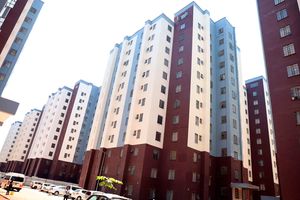
Complete government affordable units in Bahati Sub-county, Nakuru County on June 11, 2025.
Photo credit: Boniface Mwangi | Nation
In Bomet town, 220 units are ready and were expected to be opened during the President’s tour of the region. Electricity has been connected, but water remains a concern. The estate stands near a temporary county dumpsite and a land dispute between the Prisons department and the county has frustrated plans for a permanent waste facility. “Residents of Bomet town and the Bomet University students have opposed county plans to dump the waste at a site next to the university, St Michael’s Secondary School, the affordable housing units and Nyangores River,” said Mr Joseph Langat, a resident.
In Ol Kalou, Nyandarua County, 110 units built at a cost of Sh1.2 billion have remained unallocated for almost a year. A second phase of 420 homes is also close to completion.
Nyandarua Woman Rep Faith Gitau attributed the delay to the large number of applicants and a lengthy vetting process.
“The government wants to ensure the process is transparent and credible. We want to ensure all beneficiaries are deserving cases and from Nyandarua,” said Ms Gitau. “Vetting is on, and the allocation is expected in a few months. We would rather have a delayed allocation but have a credible exercise,” she said.
The delay has left many national and county civil servants commuting from Nyahururu, Nakuru, Gilgil and Naivasha. The government plans 2,500 units in Ol Kalou to address the county headquarters’ housing shortage.
The Ol Kalou estate, near the county assembly and county headquarters, includes plans for a kindergarten, guardhouse, garbage receptacle, commercial stalls, social hall, powerhouse and primary school.
In Nandi, Elgeyo Marakwet, Baringo, Trans Nzoia and Turkana, the programme ranges from occupied estates to sites that have barely moved beyond land allocation.
In Nandi, the 220-unit Emgwen estate has been operational since President William Ruto commissioned it on March 12, 2026. Property manager Elvis Kigen said more than half the homes were occupied, with strong demand for two- and three-bedroom units.
A section of the Kapsuswa Affordable Housing Project in Kidiwa, Eldoret City, Uasin Gishu County on October 02, 2024.
Photo credit: Jared Nyataya | Nation Media Group
“These houses are modern, clean and affordable. By now, over 50 per cent of the 220 units have been occupied, especially the two- and three-bedroom units,” he said.
Residents praised the houses but cited the absence of a children’s playground. An initial water supply problem has been addressed by the Nandi County Water Company. Some residents questioned whether the poorest households could afford them. They said salaried workers and civil servants appeared better placed to secure homes. Others raised concerns over bureaucracy, possible manipulation through multiple portal accounts and delays in handing over the estates.
In Kapsuswa, Uasin Gishu, completed homes remain locked as buyers await commissioning, expected ahead of Mashujaa Day celebrations in Eldoret. A site supervisor said most units had been booked and the necessary social amenities were in place.
In Elgeyo Marakwet, however, work on two phases is losing momentum. A site engineer said delayed government payments had brought construction close to stalling.
Baringo’s four projects are also progressing unevenly. County Housing Director Lawrence Mutisya said the 382-unit Marigat project was 21 per cent complete, while the 528-unit Mogotio and 484-unit Kabarnet projects were each at 10 per cent. Eldama Ravine, expected to deliver 220 homes, had recorded five percent progress. The four projects would provide 1,614 units if their targets are met. President Ruto, while laying the foundation stone for the Mogotio project in January, said the government was investing Sh15 billion in Baringo for 5,000 homes, 10 modern markets and hostels for up to 4,000 students.
In Trans Nzoia, the 1,035-unit Maili Tatu project in Saboti is under construction after an earlier delay. The county is also implementing a Sh400 million hostel project at Kitale National Polytechnic. A separate 2,000-unit development planned on Kitale Medium Prison land has faced constraints. Turkana has no completed affordable homes. The county has mapped 20 hectares in Lodwar, Kakuma and Lokichogio.
Loima MP Protus Akuja raised the issue with Dr Ruto during the Turkana Tourism and Cultural Festival in December, arguing the county was being left behind.
“We allocated Sh8 billion. We have advertised thrice, and no one is applying. MPs should help me get contractors as we advertise the fourth time,” the President said.
A Sh660 million hostel at Turkana University College is expected to provide over1,374 beds, while foundation works are progressing at Loima Vocational Training College. Markets are also being developed in Kalokol, Katilia, Lokichar and Kakuma.
In Nairobi, the New Mukuru Housing Project illustrates the scale of demand. The Affordable Housing Board received 20,426 applications for 4,342 social housing units, which is nearly five applicants for every home.
Of 16,084 unsuccessful applicants, 942 have selected units in other projects, leaving 15,142 yet to make new choices. Board CEO Joe Mutugu said all had been invited to explore other available social housing. “They were notified and invited to explore units available in other projects and to make new selections,” he said.
President William Ruto during the handover of 1,080 homes built under the Affordable Housing Programme in Mukuru, Nairobi on May 20, 2025.
Photo credit: PCS
Some Mukuru residents said they selected units and began saving, only to be told that the homes were no longer available. The board said selecting a unit and saving towards a deposit did not amount to allocation.
Applicants must first save five per cent of the purchase price, after which their documents and ability to meet payment obligations are assessed. Where demand exceeds supply, qualifying applications are handled in the order received through an electronic system that timestamps each application.
Applicants must first save five per cent of the purchase price, after which their documents and ability to meet payment obligations are assessed. Where demand exceeds supply, qualifying applications are handled in the order received through an electronic system that timestamps each application.
The board said unsuccessful applicants retain their savings and priority status, including priority for residents of informal settlements. They may transfer the savings to another project or withdraw them, with accrued interest and less administrative costs, after giving a 90-day written notice.
To expand supply, the Board said the 4,196-unit SEPU project and 579-unit Mariguini housing scheme were progressing, while it was seeking another 70 acres in Mukuru for the next phase.
The Mukuru Affordable Housing project in Nairobi on August 28, 2026.
Photo credit: Bonface Bogita | Nation Media Group
The board said the Affordable Housing Programme has three income bands, with social housing units targeting households earning below Sh20,000 per month; affordable housing for those earning between Sh20,000 and Sh149,000; and affordable middle-class housing for those earning above Sh149,000.
An applicant can apply for a unit in another category, but the board said allocation would depend on whether their income falls within the relevant band and their ability to meet the associated payment obligations.
Reporting by Barnabas Bii, Kevin Mutai, Mercy Koskei, Joseph Openda, Vitalis Kimutai, Titus Ominde, Florah Koech, Sammy Lutta, Evans Jaola and Mercy Simiyu