Two-thirds rule hurts rather than help cause of women's liberation
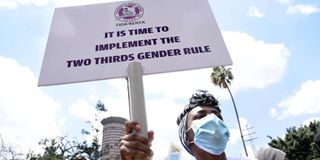
A woman holds a placard during a peaceful demonstration in support of Chief Justice David Maraga's advisory to President Uhuru Kenyatta to dissolve Parliament over failure to pass two thirds gender rule.
The principle requires that no more than two-thirds of officials in an elective body are to be of the same gender.
The fact that there are special woman-only seats, not open to fair competition, delegitimises the mandate of women elected on these reserved seats.
Reserved seats for women suggest a parity in terms of how they are divided regionally.
Chief Justice David Maraga’s advisory opinion to President Uhuru Kenyatta to dissolve Parliament for its failure to legislate on the two-thirds gender rule reinforced my scepticism about applying gender-based formulas in society broadly but in national legislatures in particular.
Reserving seats for women in Parliament appears to be a good thing. However, since the implementation of the 2010 Constitution, the formation of reserved seats for women in the National Assembly has had several unintended consequences of holding back the advancement of women’s rights rather than advancing them.