Use of goons an admission of intellectual bankruptcy
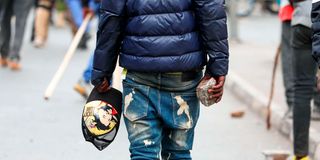
A goon carrying a stone along Moi Avenue in Nairobi on June 17, 2025.

What you need to know:
- We are remarkably hospitable to the world, yet we still haven’t quite learned how to be hospitable to each other.
- Every politician, regardless of party affiliation, must be free to traverse every square inch of this republic and sell their vision.
Kenya has always had a flair for the performative. We carry ourselves with the swagger of a regional hegemon, convinced that our tech hubs and skyscrapers make us the undisputed adult in the room of East Africa.
We are a nation that prides itself in being an open sanctuary for all Africans, a place where global commerce meets continental hospitality. But as the 2027 General Election approaches, a familiar, unsightly crack is appearing in our sophisticated veneer. We are remarkably hospitable to the world, yet we still haven’t quite learned how to be hospitable to each other.
If you want a glimpse of what political adulthood actually looks like, look no further than the recent scenes in Kisumu. Traditionally branded by lazy pundits as a flashpoint for volatility, the city recently offered the rest of the nation a masterclass in democratic etiquette. When the Linda Mwananchi ODM camp rolled into town, they were not met with stones or barricades; they were met with open arms and the kind of spirited engagement that fuels a healthy republic.


It was a refreshing departure from the tired script of Kenyan provincialism. In Kisumu, we saw a glimpse of a future where a politician’s safety is guaranteed by the civic maturity of the citizenry rather than a phalanx of bodyguards.
But progress in Kenya rarely moves in a straight line. For every step forward, there remains a stubborn urge to retreat into the shadows. The unfortunate attack on Vihiga Senator Godfrey Osotsi is a cold bucket of water over our democratic ambitions. Such incidents are relics of a Big Man era that should have been buried alongside other artefacts of political immaturity that the country has spent decades trying to outgrow.
Acts of political intimidation
The deployment of hired muscle, whether State-sponsored or privately funded, is the ultimate admission of intellectual bankruptcy. When you cannot defeat an opponent with the weight of your ideas, you resort to the weight of a club. It is thuggery dressed up as territorial protection, and it is a direct insult to a nation that markets itself as a beacon of stability in a region too often defined by authoritarianism and institutional collapse. Every act of political intimidation chips away at Kenya’s standing abroad while doing its most lasting damage at home, in the communities where ordinary people are simply trying to be heard.
There is also the inconvenient matter of ego. Kenya enjoys being the big brother of East Africa. It boasts about its GDP, its infrastructure and the glittering Nairobi skyline that appears in international investment brochures. But as any parent will tell you, being big is not the same as being grown up.
While we bicker over rallies and intimidate senators, our neighbours are not standing still. Ethiopia, despite its own internal hurdles, is a demographic and industrial titan-in-waiting that would happily snatch the crown of regional leadership while we are busy burning tyres on the highway.
Investors are notoriously allergic to the sound of breaking glass. Every time a political rally tips into chaos, the national economy registers a shiver. Kenya cannot credibly position itself as an open, welcoming nation for all Africans while remaining incapable of welcoming a dissenting voice to a podium in Vihiga or a town hall in Eldoret.
Every politician, regardless of party affiliation or ethnic background, must be free to traverse every square inch of this republic and sell their vision to its people. A democracy where certain zones are effectively off-limits to certain ideas is not a democracy at all; it is a collection of fiefdoms.
Politics of ideas
The 2027 election is still more than a year away, yet the temperature is already reaching a simmer. The Linda Mwananchi rally in Kisumu should be the blueprint, not the exception. We need to transition from a politics of identity to a politics of ideas. Instead of debating which ethnic kingpin has betrayed another, the conversation should be centred on how we stabilise the cost of living, the viability of our national debt, the expansion of democratic space for the youth and climate resilience in our agricultural heartlands.
These are debates that require a suit and a microphone; not a mask and a stone. The maturity shown in the lakeside city proves that the Kenyan voter is ready for this direction. It is the political class that needs to catch up.
Kenya must decide if it wants to be a modern state or a collection of warring interests. We have the institutions, we have the Constitution, and we certainly have the wit. What we need now is the discipline to use them.
The dark days of State-sponsored goons and political thuggery must be treated like an old, ill-fitting suit—discarded and forgotten. We should emulate the warmth of Kisumu and strengthen our democratic ideals. If we can welcome the world to our shores with a smile, surely we can welcome a dissenting voice to our hometown with a handshake.
It is time to behave like the regional leaders we claim to be. In the race toward 2027, the winner shouldn’t be the one who shouts the loudest or hits the hardest, but the one who respects the Kenyan people enough to treat them like the sophisticated, mature voters they have become. Let’s leave the thuggery to history books.
Mr Gachahi is a former public health officer in Kenya and now a businessman in Washington, US. [email protected]