Why IEBC should not be afraid of its own
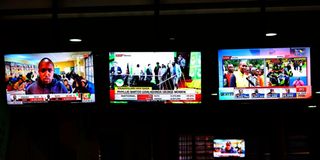
Screens displaying provisional results of the 2022 Kenyan presidential election by different TV stations at the Nation Centre.

The debate over the Elections (Amendment) Bill has exposed a larger problem than a disagreement over electoral procedure. It has revealed how fragile public trust remains in Kenya’s electoral institutions, and how easily that trust can be undermined.
The Bill seeks to amend the provisions of the Elections Act that require the Independent Electoral and Boundaries Commission (IEBC) to establish a mechanism for livestreaming polling station results for public information. Critics have interpreted the proposal as an attempt to roll back one of the transparency safeguards introduced after years of electoral controversy.
To its credit, the IEBC has sought to calm public fears. The Commission insists the proposal has been misunderstood. According to the IEBC, the amendment is intended to accommodate alternative transmission methods in areas where internet connectivity remains poor. It also maintains that livestreamed results are informational only and cannot legally form the basis for declaring election outcomes. The law would still require verification using the original Forms 34A and other established procedures.


These clarifications deserve to be taken seriously. Yet they do not fully address the concern. The issue is not merely what the amendment does. It is what it signals.
At a time when Kenya needs greater confidence in electoral institutions, not less, the suggestion to weaken livestreaming requirements creates unnecessary anxiety. The conversation should be about expanding transparency and access to information, not introducing ambiguities around one of the few electoral reforms that enjoys broad public support.
Verified results
Supporters argue that livestreaming may contribute to misinformation because preliminary figures are not the same as verified results.
That is true. But it does not follow that fewer people should see those figures. The answer to misinformation is not less information. It is more information.
Across advanced democracies, media organisations, political parties, academics, civil society groups and election observers routinely publish projections long before official certification. Official authorities retain exclusive power to certify winners. Yet no democratic society attempts to prohibit public discussion of emerging results. Kenya will be no different. Political parties will conduct their own tallies. Journalists will aggregate constituency returns. Civil society organisations will continue parallel vote tabulations. Citizens will publish numbers online. There is no realistic legal mechanism for preventing speculation without infringing upon fundamental democratic freedoms.
The real choice is not between speculation and no speculation. It is between informed speculation and uninformed speculation. When official information is available, inaccurate claims can be tested against reliable data. When official information becomes less visible, rumours become more powerful because citizens lack a trusted benchmark against which to judge them.
For that reason, Parliament should reject the false choice between transparency and practicality.
If the IEBC’s concern is genuinely about connectivity in remote areas, the law can permit alternative methods of transmission where network coverage is inadequate while explicitly preserving the requirement that polling station results be published publicly and immediately upon receipt. Kenya can accommodate technological realities without creating the impression that transparency itself is the problem.
Indeed, Parliament should go further. Rather than weakening livestreaming requirements, it should strengthen public access to election data by requiring a permanent online portal where every Form 34A is uploaded as it arrives, complete with timestamps, polling station identifiers, transmission records and any subsequent corrections. If trust is the objective, more visibility is the answer, not less.
The IEBC should be especially sensitive to this issue because it enters the 2027 election carrying considerable historical baggage. Fairly or unfairly, many Kenyans already view the Commission through a political lens. The memory of disputed elections remains strong, while public remarks by some commissioners have contributed to perceptions among sections of the electorate that the institution is not entirely detached from the incumbent administration.
Whether such perceptions are justified is ultimately less important than the fact that they exist. In electoral politics, legitimacy depends not only on legal authority but also on public confidence. An institution confronting questions about its impartiality should be looking for every opportunity to increase transparency. It should not place itself in the position of supporting, or appearing to support, measures that can be interpreted as reducing it.
Information controls
The IEBC’s strongest asset is not its constitutional mandate. It is its credibility. That credibility cannot be legislated into existence or protected through information controls. It can only be earned through transparency, professionalism and unwavering political neutrality.
The Commission is correct that livestreamed results are not the legal basis for declaring winners. Official declarations must continue to rest on verified statutory forms, established procedures and the legal framework governing elections.
But that raises an obvious question: if livestreamed results do not determine electoral outcomes, why is there any urgency to amend the law governing them?
If the problem is connectivity, address connectivity. If the problem is verification, strengthen verification. But neither challenge requires weakening a transparency mechanism that has helped reassure the public that election results are visible and open to scrutiny.
Livestreamed results serve a different purpose. They allow citizens to observe democracy counting itself. They reassure voters that nothing is hidden from public scrutiny. They strengthen confidence in outcomes regardless of who wins. Kenya does not need fewer windows into the electoral process. It needs more.
Follow our WhatsApp channel for breaking news updates and more stories like this.
The writer is Professor of English and Comparative Literature at Northwestern University, US, where he is also the Melville J. Herskovits Professor of African Affairs. Email: [email protected].