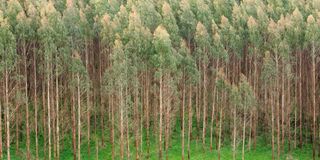
The eucalyptus, or blue gum, is branded the ‘thirsty tree’ for absorbing loads of water.
But any thought of its annihilation is extremist and oblivious of existential evidence of its impact on the environment or economy. Thus the proposal by Imenti Central MP Moses Kirima to uproot the tree should not go unchallenged.
First, the existing policy framework suffices to control the sustainable economic exploitation of the tree. The law prohibits the growing of eucalyptus species in wetlands and riparian areas.
In February 2020, then-Environment Minister Keriako Tobiko called for such trees to be uprooted.
Kenya Forest Service (KFS), the forest management agency, has a eucalyptus farming guide which prohibits the growing of the genus in wetlands, marshy areas and on irrigated farmland, including near lakes, ponds or any other bodies of still water.
On environmental impact, Kenya Forestry Research Institute (Kefri) says “Few studies have been carried out in Kenya on water use by eucalyptus”.
That means most of the conclusions may be preposterous and subject to imperial evidence. For instance, in western Kenya, the tree accounts for at least half of the forest cover.
Yet it is this part of the country that receives plenty of rainfall all year round with minimal interruptions between December and February and June to August. County governments, such as Vihiga, have measures guiding farmers on the planting of eucalyptus in line with KFS guidelines on proximity to riparian lands.
On the economic front, the actual and potential gains of growth and utilisation of eucalyptus far outweighs any setbacks that may arise from its growth. The Kenya Vision 2030 national development blueprint underscores local industrialisation as an enabler to economic development—among them value addition and agro-processing.
The value addition to the tree comes in several ways: Processing treated poles for fencing and electrification; lumbering to produce timber for construction and furniture; production of energy briquettes from sawdust by-product of lumbering; and a novel potential venture in the utilisation of the barks to produce tannin for leather processing.
With such raw material, it is not prudent to propose its wholesale destruction. It is an understatement to say that Kenya needs to explore how eucalyptus can be more sustainably grown, especially as the economy needs radical approaches to revive it.
Destroying eucalyptus is tantamount to throwing the economy of entire regions (western and Rift Valley, where it is vastly grown) under the bus yet there are far much better ways of combating climate change—such as stopping desertification in arid and semi-arid areas through irrigation and subsequent afforestation and agro-forestry.
Why can’t we desalinate Indian Ocean water, pump it to the neighbouring dry counties and grow more eucalyptus and other trees, like the jatropha oil trees, as we inter-crop with grain crops on large scale?
Mr Butiko is an industrial and environmental chemistry lecturer at the Eldoret National Polytechnic. [email protected] .