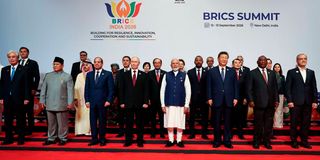
The 2026 BRICS Summit recently concluded in India, marking two decades of self-reliance, solidarity, and practical collaboration.
As the global political and economic architecture undergoes its most profound transformation in a century, this historic gathering underscored how the grouping has evolved from an informal diplomatic dialogue into the most influential platform for emerging markets and developing countries worldwide.
For decades, the Global South operated within the strictures of a unipolar order—one dominated by institutions and financial mechanisms designed in the mid-20th century that frequently failed to reflect the needs, sovereign choices, or developmental realities of emerging nations. Today, that legacy is being challenged by a powerful counterweight: the BRICS alignment.
The appeal of BRICS is not rooted in rhetoric or ideological posturing, but in a shared demand for structural equity, economic modernisation, and genuine multilateralism. As highlighted in the landmark BRICS New Delhi Declaration, the bloc’s strategic vision centres on Building for Resilience, Innovation, Cooperation and Sustainability . For developing regions, particularly across Africa, BRICS represents a pragmatic blueprint for economic sovereignty, offering access to development finance, technological cooperation, and equitable global governance without the coercive conditions that historically accompanied traditional Western aid.
Through tangible frameworks, BRICS has provided real infrastructure financing, capacity-building programs, and trade integration mechanisms. The emphasis on strengthening the voice of Emerging Markets and Developing Countries (EMDCs) from Africa, Asia, and Latin America, within global decision-making structures is no longer optional; it is the cornerstone of a fairer world order. By prioritising industrialisation, digital transition, supply-chain resilience, and agricultural growth, BRICS has transformed into a reliable engine of shared prosperity.
Central to the growth, vitality, and expanding influence of BRICS is the unique and pivotal role played by the People's Republic of China. Often described as the anchor of BRICS cooperation, China has consistently injected fresh impetus into the mechanism, driving its transition from a diplomatic dialogue into a multifaceted driver of global development.
For the African continent, and dynamic economies like Kenya, the expansion and deepening of BRICS cooperation comes at a crucial moment. Africa is home to the world's youngest population, vast natural resources, and immense agricultural and technological potential. Yet, the continent continues to face significant deficits in physical infrastructure, energy access, digital connectivity, and affordable capital.
Aligning closely with the BRICS platform offers Kenya and its African neighbours transformative avenues for national growth across several key domains.
Through institutions aligned with BRICS such as the New Development Bank (NDB); African countries can secure capital for critical infrastructure, including renewable energy grids, transport corridors, and port modernization. Kenya, as East Africa's economic hub, can leverage these financial frameworks to fund infrastructure projects that enhance regional integration under the African Continental Free Trade Area.
Foreign exchange volatility
China’s proposal for AI-empowered new industrialisation and digital industry cooperation creates an extraordinary channel for African youth and tech entrepreneurs. By partnering with BRICS frameworks, Kenya can fast-track its digital economy, scale intelligent manufacturing, improve agricultural productivity through precision technology, and build robust local tech ecosystems.
Additionally, African nations can utilise BRICS market access to export processed agricultural products and manufactured goods, shifting from raw material supply to higher-value participation in global value chains. Furthermore, local currency settlement initiatives advocated within BRICS help shield vulnerable developing economies from foreign exchange volatility.
The rise of BRICS is not about creating new geopolitical divides; it is about building a more balanced, inclusive, and democratic global order where no nation is left behind. As the mechanism enters its third golden decade, its commitment to openness, innovation, and mutual benefit stands as a beacon of hope for the Global South.
For Kenya and the broader African continent, the rise of BRICS offers an unprecedented opportunity to move from the margins of global decision-making to the centre of global development. By embracing innovation, championing multilateralism, and deepening practical partnerships with BRICS and China, Africa can secure the infrastructure, technology, and strategic autonomy needed to write the next chapter of its economic transformation.
The writer is a scholar of international relations with a focus on China-Africa development cooperation. X: @Cavinceworld