Why we’re stuck in the exam hamster wheel
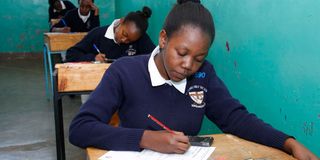
Form Four candidates at St Clare Girls Secondary School in Elburgon, Nakuru County, take Chemistry Paper One during the first day of the Kenya Certificate of Secondary Education examinations on December 2, 2022.

The release of the Kenya Junior School Education Assessment confirms that Kenya’s old exam mentality is still firmly intact. Despite repeated promises of reform, examinations continue to be treated as national spectacles rather than tools for understanding learning.
A critical look at both the former 8-4-4 system and the current Competency Based Education model reveals why exam results remain glorified while deeper inequalities are ignored.
For decades, the 8-4-4 curriculum revolved around high-stakes national examinations. KCPE and KCSE were not merely assessments but annual national events marked by anxiety, celebration and performance. Schools organised elaborate ceremonies, invited television crews and paraded their top achievers for public consumption.


These displays created powerful illusions of success. Few Kenyans questioned how results were produced or whether they reflected genuine learning.
Behind the scenes, examination outcomes were often shaped by manipulation.
Some schools quietly eliminated weaker candidates long before registration. Others relied on excessive drilling, selective admissions or, in extreme cases, examination irregularities. Grade inflation became a marketing tool, especially among private schools competing for prestige and enrolment.
Urban schools
Predictably, well-resourced urban schools consistently outperformed rural and marginalised ones, exposing a system that reproduced inequality while projecting fairness.
The psychological cost to learners under 8-4-4 system was enormous. Children were reduced to exam machines, their self-worth tied to a single result. Anxiety, burnout and shame became common experiences. The curriculum grew overloaded and detached from real life, while exam leakages, commercial mock papers and holiday tuition turned assessment into a thriving industry. By the time 8-4-4 was abolished, it was already collapsing under its own contradictions.
CBE was introduced to correct these failures. It promised to reduce reliance on one final examination, promote continuous assessment, recognise diverse talents and prioritise practical learning. In theory, learners would no longer be defined by a single test, and education would nurture creativity, problem-solving, and real-world skills.
In practice, however, CBE faces serious structural challenges. While designed to democratise learning, it assumes levels of parental involvement and access to resources that many families do not have. Continuous assessment often favours households with financial stability, internet access and time to supervise schoolwork. In many schools, teachers bypass the spirit of assessment by downloading ready-made tasks, revising them in class and submitting inflated scores online. Learners from low-income backgrounds therefore, face new but less visible forms of disadvantage.
Teacher preparedness
CBE has also shifted significant costs to parents. Projects, materials and research tasks have made education more expensive than anticipated. Teacher preparedness remains uneven. The retooling programme was rushed and inconsistently implemented, forcing many teachers to interpret CBE using an 8-4-4 mindset. Participation by private schools in teacher retooling has also been limited.
While the curriculum has changed on paper, classroom practice has lagged behind.
The public excitement surrounding KJSEA results demonstrates that Kenya has not escaped the culture of performance inherited from 8-4-4. Media coverage, front page celebrations of top performers, school festivities and political speeches all mirror familiar patterns. The curriculum may be new, but the spectacle of exam success remains unchanged.
Critical theory helps explain why exam results continue to dominate the public imagination.
In Kenya, examinations symbolise opportunity, dignity and social mobility. Even when the systems behind them are unequal, their symbolic power persists. The media reinforces this by turning exam releases into national ceremonies.
Schools carefully curate their public image, highlighting exceptional performers while concealing exclusion and inequality. The public is shown success stories, not systemic failures.
Ultimately, Kenya’s problem is not merely the choice between 8-4-4 and CBE. The deeper issue is a national obsession with performance. Schools compete for prestige, parents pursue grades, and policymakers measure success through statistics. As long as this mindset prevails, curriculum reform alone will not transform education.
For CBE to fulfil its promise, Kenya must confront the culture that celebrates exam outcomes more than meaningful learning. This requires stronger investment in public education, better teacher preparation, equitable resourcing and honest public engagement on assessment. Only then can the country move from an exam driven culture to a learner centred education system that serves all children fairly.
Follow our WhatsApp channel for breaking news updates and more stories like this.
The writer is an educationist