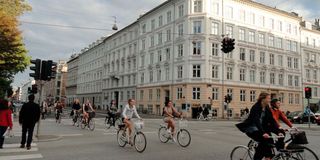
Copenhagen residents ride bicycles to work.

I recently had an invitation to visit Denmark, and I jumped at the chance. This was more out of curiosity to feel the politics on Greenland between Denmark and the USA. President Trump's threats to take over Greenland in the most audacious manner piqued my interest even more.
Greenland is an overseas territory of the Kingdom of Denmark situated between the Arctic and the Atlantic Ocean. According to President Trump, the USA is better placed to control Greenland given the shifting political situation between Europe and Russia.
The jury is still out on that!
I parked Greenland politics and decided on the tour of the capital city, Copenhagen, instead, starting with an evening stroll around the Christmas markets. Despite the dark clouds, something usual for Denmark apparently during winter months, and the drizzle, the city sparkled from beautiful light shows and well-lit markets adorned with all manner of Christmas decorations.
The streets were heaving with thousands of people jostling for space as they enjoyed drinks, food and ice skating. The buzz in the city was infectious to say the least. Being a Sunday, it meant more people had the time to enjoy the best the city had to offer. Majority were tourists like us.
Walking around the streets of Copenhagen at night, I was struck by how safe it felt. I was even puzzled by the fact that the lights stayed on for the whole duration of our time in the city. There was nothing like man-made, monkey business power cuts that is common in Kenya, including the capital Nairobi. The streets were spotless. I thought this was only in the centre of Copenhagen to appease visitors, but it was in fact the same even in the suburbs.
Automated transport system
The roads were orderly with pedestrians, cyclists and cars having their spaces to move effortlessly. The metro (underground system) I was impressed to learn about is a 24/7 automated transport system that moves driverless and has done so for yonks. No beba beba here driving passengers crazy!
The Queen of Denmak’s visit to Dandora dumpsite last week must have been a shock to her to see that amount of garbage in a landfill, and I bet stinking to high heavens. Whoever thought of taking her to visit Dandora Dumpsite must be jailed if not ‘shot’. Queen Mary must have gone back to Denmark traumatised after seeing the dumpsite, a non-existent phenomenon in Denmark.
It is one country that has taken waste management to an advanced level, where waste is turned into energy. By burning non-recyclable trash, Denmark has managed to produce clean electricity and reduced over-reliance on landfills. The Copenhill (Amager Bakke) incinerator plant is also used to integrate public spaces on its roof such as ski slopes, climbing walls and hiking trails.
The power generated from the waste-to-energy model is also used to power thousands of homes. The integration of the Amager Bakke incinerator as part of urban design that includes recreational facilities is a first in the world for Denmark. Unless you are told, you won’t notice that you are in a recreational area where trash is being incinerated just metres below you. I was sceptical about the smoke billowing from the massive chimneys, but I was reassured it was all clean air, and it was safe to ski on its slope and play away.
Eyesore
The Dandora dumpsite has been an eyesore for decades and it surely will benefit from Denmark’s approach of turning waste into the energy that Kenya desperately needs. The environmental impact on local communities in Dandora and its environs cannot be overemphasised. It is a public hazard of gargantuan proportions.
The Dandora dumpsite will continue to expand as the city expands. It is unsustainable in the long run. Garbage collection and processing is not a priority for many of our cities despite service charges being paid. This is something that now needs to change and, hopefully, Denmark’s model will provide food for thought for our policy makers.
The driverless metro in Denmark is a perfect example of how to run a 24-hour economy. Keeping a city moving smoothly with minimal hassle is truly inspiring. In a major capital like Nairobi, the transport system should be part of public service, not left under the control of the matatu mafia. Kenya needs to rethink how to keep its cities functioning efficiently if it is serious about catching up with larger economies.
Simply admiring successful systems from afar while failing to invest in the right infrastructure amounts to economic suicide. Too often, our towns and cities are designed to serve tourists or visitors, rather than the citizens who live there. That is why diplomatic zones and tourist hubs never lack basic services, while ordinary citizens are left wanting. Our politics, as I have said before, is inward-looking and rarely patriotic.
Denmark and Singapore thrive because patriotism and a sense of civic duty are part of their DNA—a trait too often missing in Kenya. It is time for our systems to serve everyone equally, not just a privileged few.
Follow our WhatsApp channel for breaking news updates and more stories like this.
Ms Guyo is a legal researcher, [email protected], @kdiguyo