Wisdom of the field: Lessons from fertilisation and harvest
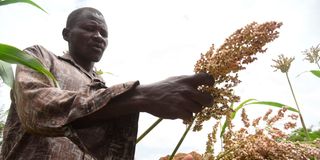
A farmer harvests sorghum at Napool Irrigation Scheme in Turkwel, Turkana County, on February 14, 2026.
In the third and final part of this opinion series on how agriculture mirrors other aspects of life, Kevin Kamau explains that harvests are not merely about yield but about recognising the ecosystem that makes it possible.
By the time fertilisation begins, much of the hard work is already behind you. The land has been prepared, seeds planted, and weeds removed. What remains is to nourish, protect, and patiently wait for maturity. This final stage, which is often overlooked, is where discipline meets gratitude.
I consider this a sacred season.


I am a product of grace and community. By community, I mean family, friends, colleagues, and stakeholders who have, at various points in my life, stepped in with guidance, opportunity, or simple kindness. Looking back across different seasons, there has almost always been someone who opened a door, offered perspective, or illuminated a safer path forward.
While some of this can be attributed to good fortune, I also believe it reflects what one puts into the world, how one treats people, how one shows up, and how one responds when circumstances do not go as planned. Even in moments of failure, I have tried to learn, to pivot, and to remain gracious in defeat. That, too, is a form of fertilisation.
Earlier in this series, I alluded to having gone through a particularly difficult year in 2025. It was the first time my body experienced a serious physical downturn. What began as persistent soreness during workouts gradually became impossible to ignore. Like many products of the 8-4-4 education system, where perseverance was often confused with endurance at all costs, and where “kukaa ngumu” was the modus operandi, I chose to push through the pain.
Eventually, pragmatism prevailed.
A medical check-up at the Nairobi Hospital, where my life began four decades earlier, led to a diagnosis that was both unexpected and sobering: I would require a double hip replacement due to avascular necrosis, a condition caused by reduced blood supply to the hip joints. In my mind, hip replacements were reserved for people of advanced age. That assumption, like many others we carry through life, proved misplaced.
The journey that followed involved multiple medical opinions, research, and ultimately surgery abroad. While the precise cause remains inconclusive, the experience itself was transformative. It forced me to slow down, reassess priorities, and accept help, something many high-functioning adults struggle to do.
This is where the parallel with farming becomes most instructive.
A crop does not reach harvest through preparation alone. It must be nourished consistently. Fertiliser strengthens the plant, supports grain formation, and ensures that earlier efforts are not wasted. Equally important is protection, guarding the field against pests, disease, and other late-stage risks that can undo months of hard work.
My recovery would not have been possible without the people around me. Staff carried extra responsibilities, family and friends offered emotional and logistical support, and partners showed patience. They poured into my cup when I needed it most. That collective effort mirrored the way a well-managed field is supported in its final stretch toward harvest.
And harvest does come.
When it does, it is important to remember how one arrived there. In agriculture, gratitude has always been part of the cycle. In the Old Testament, three major feasts marked the agricultural calendar: the Feast of First Fruits, where the initial harvest was dedicated; the Feast of Weeks, signalling the transition from barley to wheat harvest; and the Feast of Ingathering, celebrating the collection of fruits, olives, and grapes.
In Kenya, traditional communities have long observed rituals to bless and mark the harvest. These practices recognise a fundamental truth: no harvest is truly self-made.
In business and life, the same principle applies. Behind every success are stakeholders: the agrovet who extended inputs on credit, the bank officer who approved an overdraft, and the colleague who encouraged persistence when momentum was low. Gratitude is not sentimentality; it is an acknowledgement of interconnectedness.
As I reflect on this final season, my belief is simple. Preparation matters. Discipline matters. But so does nourishment, protection, and humility. Harvest is not merely about yield; it is about recognising the ecosystem that made it possible.
May your fields and your seasons be abundant, and may you always remember how you got there.
Kevin Kamau is a Kenyan agripreneur and the Founder and Managing Director of Tukalime Ventures Ltd, an agricultural enterprise focused on transforming idle and underutilised land into productive, commercially viable farms.