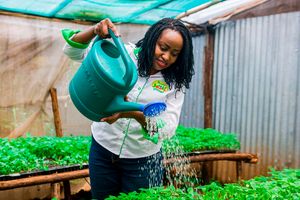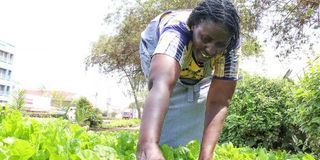
Grace Muthoni weeds her spinach seedlings at her garden near Odeon in Nakuru City on July 22, 2025.
In Part 2 of our three-part expert opinion series on agriculture, Kevin Kamau writes about weeding - a crucial stage in farming - and the important lessons it holds.
In the first part of this series, we explored new beginnings, bold intentions, and the optimism that fuels fresh starts.
But optimism alone does not produce results. Once seed meets soil, the next critical phase begins: weeding.
In agriculture, weeding is not optional. Before ploughing or harrowing, unwanted grasses must be eliminated because they compete aggressively for nutrients, moisture, and space.
Left unchecked, they will choke the crop before it has a chance to establish itself.
Farmers typically weed at least twice: pre-emergence and post-emergence. One removes threats before they appear; the other confronts them after growth has begun.
Life follows the same pattern.
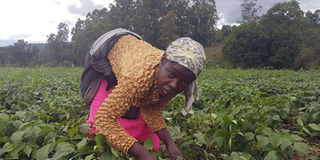
A farmer attends to her bean crops in a farm.
In agriculture, we typically weed twice — and sometimes a third time if the pressure is severe. There is pre-emergence weeding and post-emergence weeding.
Schools of thought
There are, of course, different schools of thought and methodologies around this, but this is my article; the other tree-huggers like myself can write their own. Spicy, I know.
Growing up, our parents warned us constantly about bad company.
For some of us, the fear of going wayward was so real that we were sent to boarding school as early as Class Six — a strategic move designed to shield us from influences in the city that might derail our futures.
Looking back, that was pre-emergence weeding.
As adults, we sometimes critique decisions our parents made on our behalf. But I choose grace. As my mother often said, “Haù nì hùù ùgì wìtù ùkììnyìte” — that is as far as our wisdom had reached.
They meant well. And, by God’s favour, their actions allowed many of us to blossom into responsible men and women who have navigated different seasons of life with a measure of success.
Yet, just as a young crop begins to grow, weeds inevitably emerge. This is post-emergence weeding. The seed has germinated, but it is still vulnerable — at risk of being choked out by fast-growing, aggressive competitors.
Life is no different.
Negative influences do not disappear simply because you have made a good start. In fact, they often become more subtle and more destructive as you grow. If you are not ruthless about removing distractions, toxic relationships, the probability is that unfavourable outcomes will keep repeating themselves.
You are, quite literally, the company you keep.
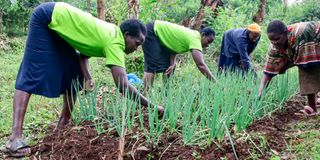
Members of Anding’o Support Group weeding onions.
There are other compelling reasons farmers weed their fields. One is to ensure that nutrients applied are absorbed wholly by the desired crop. Another is pest and disease control. Weeds act as reservoirs for pathogens — harbouring fungi, viruses and bacteria — often causing yield losses of up to 80 per cent.
The same principle applies to life and business. While we are all born into different circumstances, each of us arrives with a world of potential. Some, like crops in semi-arid areas, must work harder to survive and that is simply life. But even a child raised in leafy suburbs, if surrounded by poor counsel and troubling influences, can falter spectacularly. We do not have to look far for examples.
Clear goals
What I am attempting to illustrate, perhaps clumsily, is this: ambition alone is not enough. You may have clear goals and strong drive, but if your world is dotted with “weeds”, you will expend far more energy just to stay afloat.
We have all had bad influences. Personally, I picked up smoking by watching older boys who seemed impossibly cool at the time. I thought it was the greatest thing since FUBU — millennials will understand. What began as imitation became habit, and habit became dependency. Quitting took far more willpower than starting ever did. That was a weed I should have removed much earlier. Farming is hard. Let no one lie to you. It is one of the most unforgiving pursuits if you are ill-prepared or half-committed. If your heart is not in it, my honest advice is: do not proceed.
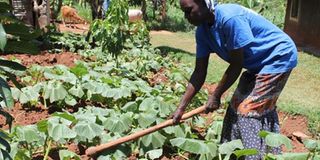
Josephine Nyanweso of Ebukhaya village in Vihiga county on her farm weeding her indigenous vegetables that she planted using organic fertilizer . PHOTO | ISAAC WALE |
And yet, every major economy in the world has agriculture to thank for its progress. Before an industrial revolution, an agrarian revolution must take place. That is not sentiment — it is historical fact. Whether in fields, boardrooms or personal lives, growth demands preparation, discipline, and the courage to weed relentlessly. Without it, potential remains just that — potential.
Follow our WhatsApp channel for breaking news updates and more stories like this.
Kevin Kamau is a Kenyan Agripreneur and the Founder and Managing Director of Tukalime Ventures Ltd, an agricultural enterprise focused on transforming idle and underutilized land into productive, commercially viable farms.