Women economic empowerment is key

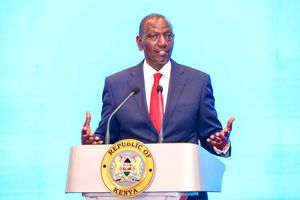
Deputy President Kithure Kindiki acknowledges greetings from residents and leaders during an economic empowerment engagement in support of women and youth groups in Katangi in Yatta Constituency, Machakos County on June 14,2025.
Women are at the heart of Kenya’s economy. From farms and markets to boardrooms and digital platforms, women contribute significantly to economic productivity and household welfare.
Yet despite their central role, many women remain excluded from the full benefits of economic growth.
Strengthening Women’s Economic Empowerment (WEE) is therefore not only a matter of social justice but also a strategic pathway to inclusive and sustainable development. Across Kenya, women contribute enormously to the economy—whether through agriculture, entrepreneurship, wage employment, or unpaid care and domestic work.


The Constitution of Kenya and the country’s long-term development blueprint, Kenya Vision 2030, both recognise that equitable distribution of economic gains requires deliberate investment in women’s economic empowerment.
The Constitution provides for women’s access to and control over productive resources and economic opportunities. These include decent employment, financial services, property ownership, skills development, and access to market information.
Such provisions are essential for ensuring that women can participate meaningfully in economic activities and benefit from national development. However, structural inequalities continue to limit women’s full participation in the economy.
Women are disproportionately affected by poverty, discrimination, and exploitation. Gender-based barriers often confine them to insecure and low-paying jobs, restrict access to financial resources and assets, and limit their influence in shaping economic policies and programs.
Women-focused funds
Recent national data reflect these challenges. The Economic Survey 2025 indicates a sharp decline in financial support for key women-focused funds, including the Women Enterprise Fund and the National Government Affirmative Action Fund. Budget cuts have resulted in fewer women benefiting from these programmes.
Although initiatives such as Access to Government Procurement Opportunities (AGPO) and the Uwezo Fund continue to promote inclusion, financial and structural barriers still prevent many women from fully participating in the economy. Low levels of financial inclusion among women further exacerbate these challenges. Without access to credit, training, and networks, women entrepreneurs often struggle to scale their businesses or transition into higher-value economic sectors.
Recognising these challenges, the government has taken significant steps to create a more coordinated and effective framework for women’s economic empowerment. The recently approved National Policy on Women’s Economic Empowerment (NPWEE) represents a major milestone in this effort.
The policy provides a comprehensive national framework aimed at accelerating women’s participation in economic activities and lifting more of them out of poverty. It also seeks to harmonise existing initiatives, strengthen policy coordination, and ensure that interventions are aligned with women’s diverse needs.
Implementation of the policy will be led by the State Department for Gender and Affirmative Action, in collaboration with other government institutions, county governments, the private sector, civil society organisations, and development partners.
Complementing the NPWEE is the National Care Policy, which seeks to address one of the most overlooked barriers to women’s economic participation: the disproportionate burden of unpaid care and domestic work. By strengthening childcare systems and care infrastructure, the policy aims to free up time for women to pursue education, employment, and entrepreneurship.
Effective implementation of these policies requires strong evidence, coordination, and accountability mechanisms. This is where institutions such as the Kenya Institute for Public Policy Research and Analysis (KIPPRA) play a critical role.
Through a Women’s Economic Empowerment project supported by the Gates Foundation, KIPPRA is working closely with the State Departments for Gender and Affirmative Action and Labour and other partners to strengthen evidence-based policymaking and support the implementation of the NPWEE and the National Care Policy.
The project focuses on translating research into actionable policy insights, strengthening monitoring systems, and building institutional capacity across national and county governments.
It targets five priority sectors that hold significant potential for women’s economic advancement: trade and entrepreneurship, manufacturing—particularly textiles and apparel—ICT and the digital economy, the creative economy, agricultural value chains and food security, and business services.
Follow our WhatsApp channel for breaking news updates and more stories like this.
Mr Duba is Senior Communications Officer and Dr Nafula is Ag. Deputy Director, Governance Department at KIPPRA