Youth can transform Africa’s agriculture
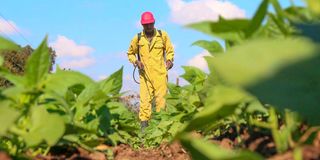
A beans farmer in Sobea, Nakuru County sprays his crop with pesticides to control Aphids and other cereal-feeding pests on October 18, 2025.

What you need to know:
- According to UN’s Food and Agricultural Organisation (FAO), the average age of a farmer in Africa is 60 years.
- Young people in Africa do not go into agriculture because they find it unattractive form of unemployment.
If Africa is to make real progress, governments and partners must make efforts and accelerate actions to enable young people to get involved in agriculture.
According to UN’s Food and Agricultural Organisation (FAO), the average age of a farmer in Africa is 60 years. Despite its vital role to the economy, the sector struggles to attract youth due to arrange of barriers.
Young people in Africa do not go into agriculture because they find it unattractive form of unemployment. Also, youth face multiple hurdles when engaging along the food-value chains including limited access to finance, inadequate technical skills, weak market linkages and often unfavourable policy environment.


In addition, agriculture is frequently perceived as less attractive career path by youth. Africa is a youthful continent with young people under the age of 25 years accounting for over 60 per cent of its estimated 1.2 billion people. Also, youth unemployment is a big burden in many countries in Africa.
Untapped potential of youth
Agriculture is one of the most important sectors that can provide employment. Yet, a majority of the youth are moving away from the sector to fast growing non-agricultural sectors in urban areas. African youth have shown little involvement in the agricultural sector.
At a recent East African Youth in Agri-Food Systems Expo in Nairobi, under the auspices of the Alliance for a Green Revolution in Africa (AGRA), connections between youth innovators, policymakers, private sector actors, financial institutions and development partners were emphasised as key in unlocking opportunities for youth-led agribusiness ventures, strengthening value chains, and accelerating economic growth.
There is need to harness untapped potential of youth required to drive agricultural transformation and sustainable development. At the same time, more should be done to nurture, support and scale up youth-led solutions in agri-food systems.
More should be done to foster partnerships, expand networks, and influence policies that will better support youth entrepreneurship and leadership, contributing to sustainable development and food security.
Mr Obonyo is a Public Policy Analyst. Email: [email protected]