Premium
Lesson for East African leaders from woes in Tanzania
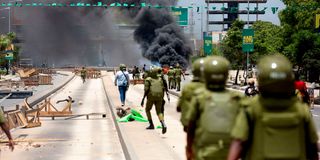
Tanzanian riot police disperse demonstrators during violent protests that marred the election following the disqualification of the two leading opposition candidates in Dar es Salaam, Tanzania, October 29, 2025.
The lesson for African leaders in the Tanzania political tiff is that people’s power is malleable and versatile. One can shape it into the desired shape and form, but one should be wary of the elastic strength and its breaking point.
I have been to Tanzania many times, and I can attest that some of the gentle souls in the globe inhabit the East African country. People who are so welcoming shun controversy and disagreements. Since the days of their first President, Julius Nyerere, Tanzanians have been very loyal to the subsequent regimes.
Around 2009, during the time of Jakaya Kikwete’s campaign for a second term, I visited Tanzania. This was the first time I noticed something was a miss. The news bulletin was three-quarters about the Chama Cha Mapinduzi (CCM) leadership and brainwashing news.


On the streets, almost all the advertisement spots were splattered with CCM campaign materials. When I tried to engage some of my hosts, they seemed dazed and only said that was how things ought to be. A sign of hopelessness.
The CCM leadership had been taking advantage of the meekness of the people of Tanzania to the point that they had turned cold and very submissive. As an interested and curious fellow on governance, especially in Africa, I have constantly surveyed the happenings in Tanzania and only knew that it was a matter of time before the bubble in which the CCM hid in would burst.
Tanzania’s mess begins from two fronts- the first being that the people have lived over the years in a social environment that taught them cohesiveness to a fault. This means that the people of Tanzania would rather live in harmony even when they were hurting. Secondly, Tanzania’s civic and political ideology of Ujamaa. The subsequent leadership of Tanzania, instead of learning from Mwalimu Nyerere not to force social and political issues on people, chose to coerce people into submission.
In Africa, leadership has been glorified, with some subjects almost assuming god-goddess status. Samia Suluhu Hassan had all the time to see and hear the cry of her subjects, but chose pride and highhandedness; may her counterparts, she fondly calls jirani (neighbours), not pursue that route.
Lucas Kimanthi, Nairobi