Live update: Senators discuss governors snubbing summons
Premium
Dangerous silence as women political mobilisers bear the brunt of violence
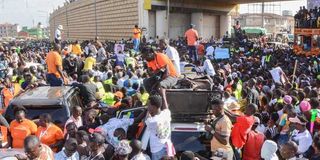
ODM party chairman Gladys Wanga addresses s political rally at Kondele in Kisumu County, on January 24.

In the current political contestation between ‘Wantam’ and ‘Tutam’, one ugly truth is being swept under the carpet - the violence being meted out on women political party grassroots mobilisers. While most media reports on the violent confrontations focus on the big names- mostly men, and the general category of citizens, they tend to ignore the fact that the biggest grassroots mobilisers for political party events are women.
These women only show up in clips, struggling to escape from the violence and jumping over fences. They remain nameless and voiceless. The media focuses on the politicians and the crowds.
A recent eye-opening conversation with the Fixing the Nation crew, Ms Bina Maseno, a human rights advocate with Badili Africa, shed some light on the role of women political party mobilisers in Kenya. The organisation has produced a film on the theme, The Women King Makers, Unseen Faces, Unheard Voices.


Political parties and their owners, who are mainly men, rely on women to mobilise at the grassroots and get people to not only turn up for their meetings, but to also vote for them. Some of the known mobilisers boast of having thousands of members whom they influence.
What emerges from the conversation on Fixing the Nation, and the film is that politics is a very dangerous space for women.
In political rallies, women mobilisers and aspirants suffer physical, sexual, and verbal violence. Political rallies are described as “groping festivals” where women are assaulted by both the gangs hired by rival parties and the goons hired by their own parties.
The violence is happening at all levels of the campaign structure, from the national to the ward. The women do the donkey work and are left to suffer the donkey’s life. It is both exploitative and extractive.
The women go for political events fearing rape and assault. They are forced to pay young men to escort them out of violent political events.
Because the women remain in the shadows, their issues never come to the surface. The media sees them, but fails to notice them.
Their party leaders see them, but treat them as if their plight is an inconvenience. The public labels them and gloats at their plight.
Kenya’s laws envisage an inclusive society where both men and women are free to participate in party and elective politics. As the country heads to the 2027 General Election, we must ask the crucial question: How do we make politics and rallies safe for everyone, especially women?
If public participation amounts to bodily harm and sexual harassment, what society are we building? These are questions the media must ask, so as to arouse the consciousness of the men who go to those gatherings, as well as the political leadership. The young men who commit these crimes must be reminded of the fact that the women they are violating are their mothers, sisters, and wives.
Otherwise, politics will remain a place where women go to be humiliated and violated.
When the media calls on party leaders and the law enforcement agencies to account, it never breaks down what that entails. It never gives the women involved in organising these events a chance to speak to explain what transpired. It does not quantify the physical and emotional damage suffered by these women mobilisers.
Tension is beginning to build up ahead of next year’s elections, especially in the informal settlements, and the conversation around violence must become more nuanced.
The media must tell the stories of the individual women mobilisers and demand accountability for them.
The media must make the political space safe, not just for women candidates, but for all those involved in the political activities.
Follow our WhatsApp channel for breaking news updates and more stories like this.
Contact the Public Editor to raise ethical concerns or request a review of published material. Reach out: Email: [email protected]. Mobile number: 0741978786.