Dangote oil refinery: Leave some room for journalistic scepticism
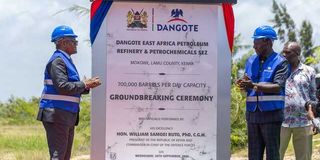
President William Ruto (right) and President of the Dangote Group Aliko Dangote during the groundbreaking ceremony for the Dangote East African Refinery in Lamu County, Kenya.

What you need to know:
- Supposing the project fails the environmental impact assessment, what will happen? Will Dangote Group simply pack up and leave?
- And what is the fate of the protesting residents who fear they could be displaced, but who say they have not been engaged at all?
During training, journalists are advised to acquire journalistic skepticism – the practice of questioning information and looking at the other side of the coin. The example commonly used is that if your mother says she loves you, check again. Without journalistic scepticism, reporters can be reduced to stenographers, and media content to a regurgitation of speeches and niceties, especially from public officials.
This concept came to mind this week as we reviewed the massive airtime and numerous pages given to the launch of the Dangote East Africa Petroleum Refinery and Petrochemicals Special Economic Zone in Lamu County, particularly by the Daily Nation platforms. The subject has been the running highlight of NTV news and the leading Page One story for the Daily Nation, Business Daily and even Taifa Leo.
Sample the Daily Nation headlines over four consecutive days: Monday’s headline was “Dangote’s Sh2 trillion refinery bet”, announcing the project’s approaching takeoff. On Tuesday, the headline “Lamu refinery’s crude question” discussed the challenge of sourcing crude oil for a plant with a capacity of 700,000 barrels per day. On Wednesday, the newspaper, in a one-liner, proclaimed “Kenya’s oil leap”, followed by five pages of stories. Thursday’s headline, “Game changer”, and four pages of reporting, marked the peak of the mainly celebratory coverage.


The Dangote refinery deserves the media attention it has received, by its sheer magnitude, level of investment and the impact it is expected to have on the country’s and region’s economy. Specifically, the promise of thousands of jobs, spin-off industries and businesses, and, hopefully, cheaper oil for Kenyans is enough reason for everyone to pay attention to it. There is also an opportunity for Kenya and Kenyans to invest in the project. The positives are immense, and more will unravel in due course. It is indeed an uplifting moment for the country, and the Nation team justifiably captured the buoyant mood in its coverage.
Important questions
However, a project of this scale and impact also raises important questions that the Daily Nation should look into going forward. For example, what is the deal? Speaking during the launch, President William Ruto described the project as “government-enabled, private sector-driven”. He explained: “The government provides policy certainty, coordination, infrastructure and regulation... Private enterprise mobilises capital, technical expertise and carries the commercial obligations of management”.
What exactly does this statement mean? Could it be broken down in simple language so that all Kenyans understand what is being committed on their behalf?
The president also revealed that an agreement between Dangote Group and the government had been signed on Tuesday, a day before the ground-breaking event. According to him, the agreement “gives an assurance that land matters will be handled lawfully and fairly, while environmental and social impacts will be assessed rigorously”.
Again, what does this mean, especially with machinery on site and the ground already broken? What does the law say? Supposing the project fails the environmental impact assessment, what will happen? Will Dangote Group simply pack up and leave? And what is the fate of the protesting residents who fear they could be displaced, but who say they have not been engaged at all? Will they be bulldozed out of their homes? Do they have any rights, and is anyone explaining the law to them? Has the land been demarcated?
Geopolitical deals
Do Kenyans deserve to know what else is in the agreement, or should they be satisfied with what the government shares? Additionally, has the project met all the legal requirements? The Daily Nation could tap some legal minds and conservationists for answers and contextualisation.
There is also the question of Lamu’s status as a UNESCO World Heritage Site, as the best-preserved Swahili settlement in East Africa. What are the implications of this project for this?
Kenyans continue to raise questions about this project. A Business Daily reader posed these, among others, on the LinkedIn account: What logistical and geopolitical deals have been made to obtain the crude oil from Uganda and South Sudan? Who bears the financial risk if the project overruns or fails to achieve the projected output? Has Mr Aliko Dangote been given any tax holidays or exemptions? If so, what are they, and are they public? Does Kenya have a minimum purchase obligation?
The value of a credible media house like the Nation Media Group is to find the answers for such discerning readers from those who possess the information. Its Editorial teams must also allow balanced discussion of the project by accommodating both supporting and opposing views.
Contact the Public Editor to raise ethical concerns or request a review of published material. Reach out: Email: [email protected]. Mobile number: 0741978786.