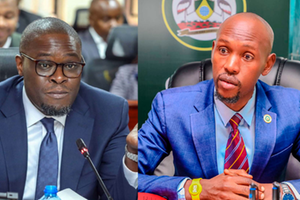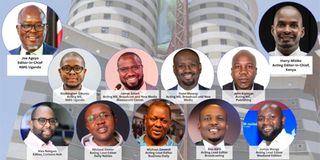

Nation Media Group’s announcement on Wednesday that the Editor-in-Chief and two Managing Editors would move to Uganda and Tanzania, and a new team would lead in Kenya, drew considerable interest, heated exchanges and loud murmurs on social media.
Why the heated exchanges and murmurs? Because change always attracts reactions, mostly mixed. People congratulated the new team taking up leadership of the editorial function in Kenya, but some also raised questions and protested the changes, particularly the transfer of the three senior-most editorial leaders.
The murmurs centred mainly on two issues: The first is the recent change in ownership of a controlling stake in the company and its possible link to the changes, and the second is the male-filled leadership line-up.
Observers on social media noted that, with the changes coming soon after Tanzanian businessman Rostam Azizi’s acquisition of a controlling stake in the firm from the Aga Khan Fund for Economic Development (AKFED), the management could be doing the bidding of the new majority shareholder, or appointing editorial leaders to do so.
Media acquisitions sometimes come with upheavals for both the staff and the business. The fate of the Washington Post, which was acquired by Jeff Bezos in 2013, is a study in this.
However, if Mr Azizi’s position during the announcement of the acquisition remains the same, then the concerns could be misplaced. On March 11, when Mr Azizi announced that his Taarifa Limited was buying NMG, he spoke glowingly about the Nation’s journalism, paid tribute to the company’s founder, the Aga Khan, and promised to invest more in the firm’s future.
“This partnership brings together Taarifa Limited and Nation Media Group in a shared commitment to strengthening East Africa’s media ecosystem and supporting the continued growth of trusted journalism and African storytelling across our region,” he said.
Praising the Aga Khan and AKFED for building and supporting independent media institutions, he said: “Through their stewardship, Nation Media Group has grown into one of the most respected journalistic institutions on our continent. The values that have guided that stewardship: professionalism, independence, and public service deserve recognition and respect.”
He reminded his audience that he sold his Mwananchi Communications Limited in Tanzania to the Aga Khan more than 20 years ago: “More than two decades ago we worked together to build a strong media institution. Today, we continue with the same journey, guided by the same belief that credible and independent journalism is essential for development in our societies.”
Mr Azizi went on to acknowledge the central role played by NMG in informing citizens, strengthening public dialogue and supporting democratic accountability across the region. “Institutions like these are not mere companies: They are guardians of public knowledge and platforms for civic dialogue,” he said.
Commitment to editorial professionalism and institutional credibility does not come stronger than this.
The second issue that drew the wrath of the audiences is the gender disparity reflected in the shameless line-up of 11 men for top leadership roles, and not a single woman or young person.
The Public Editor has received several calls and messages from Kenyan men and women, as well as a global organisation working towards gender equality in the media, lamenting the glaring lack of representation of women in the editorial top leadership. A young woman from the NMG newsroom expressed her disappointment with the situation. The young women doing the heavy lifting from the bottom of the pyramid feel unseen, unheard and unrecognised.
This issue matters a lot, particularly for a media house that established a Gender Desk to promote equity in society seven years ago. It matters a lot because it is not only a case of social justice and equal opportunities, but it is also an important business conversation. Studies have shown that media houses are leaving millions of shillings on the table by locking women out of decision-making roles and carrying content decided by men, for men, consequently missing out on the money from female consumers.
Regrettably, the diversity question has dogged NMG for a long time. Most of the men in the line-up were already in positions of leadership and were only moved a step higher. This shows that the women are too far back in the leadership pipeline. It calls for urgent redress.
Back to the new line-up. What are the audiences’ anxieties and expectations? From the hundreds of comments across channels, audiences are yearning for an assurance that the changes will not dilute what the insiders call the “Nation Journalism”. It is about credibility, objectivity, fairness and independence. It seeks to transform society through public interest stories, supporting human rights, free markets and accountability.
“Nation Journalism” has survived several editorial leadership transitions over the years. This is thanks to a robust Editorial Policy that ensures that irrespective of who is steering the ship, the editorial values and objectives remain constant. At the heart of the policy is independence. Successive editors have tended to ensure the Nation platforms remain independent, even in the face of political pressure and persecution, particularly during election cycles.
Kenyans’ eyes are on the new editorial leadership. Unlike doctors who bury their errors, journalists put their mistakes and biases out there for all to see. The content on the platforms under the new leadership will speak for itself, and the audiences will be the judges.
The Public Editor wishes the new team leading Editorial in Kenya success. Our best wishes too to the editors moving to Uganda and Tanzania.
Follow ourWhatsApp channel for breaking news updates and more stories like this.
Contact the Public Editor to raise ethical concerns or request a review of published material. Reach out: Email: [email protected]. Mobile number: 0741978786.