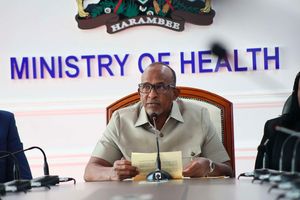
On June 3, Aden Duale stood before Parliament and said, without apparent discomfort, that the government does not need to consult Kenyans before establishing Ebola quarantine facilities in their neighbourhoods.
"We are not going to consult citizens," he said. "This epidemic does not require any consultation."
A Cabinet Secretary, exercising constitutional power derived from the citizens of this republic, informing them that they are owed no explanation for decisions that place a haemorrhagic fever facility within a kilometre of where their children sleep.
Before engaging with the arrogance of that position, consider the basic epidemiological absurdity on which it rests. In the entire recorded history of infectious disease containment, the protocol has been very consistent: you contain the pathogen where it is. You do not fly it 2,000km away to a different ecosystem, and a country with zero prior cases, and call it containment.
Ebola has never set foot in Kenya. It has no history here, no existing response infrastructure, no trained clinical memory. The correct response to an Ebola exposure in Central or West Africa is to contain it in a well-resourced facility close to where it occurred, not to load the patient onto an aircraft and transport active risk across borders into a population that has no experience managing it. This is not even a radical public health position. It is the foundational logic behind why containment exists in the first plave.
The chosen location sharpens the concern considerably. Laikipia Air Base sits within reach of Nanyuki's denser residential neighbourhoods, with Teachers Estate effectively in the shadow of the proposed site. Around it lies one of Kenya's most significant wildlife corridors, the Ol Pejeta Conservancy, home to the world's last two Northern White Rhinos, chimpanzee sanctuaries, and an ecosystem that does not respect the fences of a military base. If Ebola were to escape the facility and make contact with wildlife in that corridor, there is no quarantine protocol on earth designed for that scenario. You cannot trace, isolate, or contact-trace a buffalo. The geographic recklessness of this location is not a secondary concern either.
Then there is the matter of the High Court. On June 2, a court of law issued a temporary order halting the construction of any Ebola facility under this arrangement. The government's response, per Bloomberg, was to announce it would press ahead regardless. Not to appeal the order. Not to seek a stay. It was to simply ignore it. A Cabinet Secretary who has already told Parliament that citizens require no consultation, presiding over a ministry that has decided court orders are optional. This is our government’s posture. It is a government that has concluded, apparently without much deliberation, that the law applies to it selectively and at its convenience.
This brings us to the constitutional question that Duale's arrogance makes unavoidable. Article 1 of the Constitution of Kenya is unambiguous: all sovereign power belongs to the people. Not the president, or his cabinet, or a minister and his ministry. Not even the terms of any agreement signed with a foreign government in the dark. Every instrument of state authority, every act of a Cabinet Secretary, every executive decision, every foreign arrangement, derives its legitimacy from the people it governs.
When Duale says he does not need to consult citizens, he is rejecting the foundational premise of the constitutional order he was appointed to serve.
The obvious question that follows is that if sovereign power belongs to the people and their consent is explicitly unnecessary, by whose authority is any of this happening? By whose authority is Duale speaking?
The answer, the government, is basically a practical one. They do what they do because they can. Because the institutions meant to check this behaviour have been weakened, captured, or completely dismantled. Because a court order can be declared inconvenient and construction continues anyway. Because Parliament was informed, rather than consulted, and informed only after the agreement was already in motion.
This is what the collapse of accountability looks like in practice. A Cabinet Secretary at a podium explaining, with bureaucratic calm, that the people are not stakeholders in decisions about what gets built next to their homes.
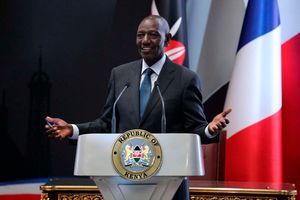
We are approaching 2027, and inevitable reality is that Ruto will, with almost absolute certainty, lose the elections. But waiting for an election is increasingly insufficient as a response to what is happening in real time. These are decisions being made, at pace, that carry consequences stretching well beyond any electoral cycle, and some of them, including the deliberate defiance of a court order, meet the constitutional threshold for something much more immediate.
Impeachment is not a radical option. It is a very constitutional one. Article 150 of Kenya's Constitution exists precisely for moments when the holder of executive office conducts themselves in a manner incompatible with the office, and against the interests of the people by whose power they exercise their authority.
There is nothing in our Constitution that instructs Kenyans to continue to tolerate a government whose actions are a daily risk to the basic right to life. A government that ignores court orders, bypasses parliamentary oversight, signs foreign arrangements without public knowledge, and then sends a minister to Parliament to tell the citizenry that their consent is irrelevant, that government has provided, in its own words and actions, a fairly detailed brief for the case against it.
Duale told Parliament that citizens do not need to be consulted. He is, constitutionally, profoundly wrong. And in a functioning republic, being that wrong at that level should always carry consequences.
Hon Caleb Amisi, you promised to introduce the impeachment motion in parliament. Do it. Leave the rest to us. We shall help you mobilise the MPs, hopefully without much fuss. And Kenyans… Well, Kenyans can, indeed, get quite fussy if need be.