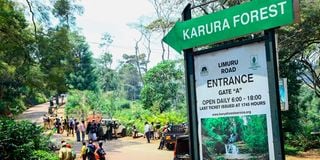
This past week, the Kenya Forest Service (KFS) announced a unilateral takeover of Karura Forest’s management.
It is an act that not only sidelines the Friends of Karura Forest (FKF), but also dishonours the very communities who have nurtured this green sanctuary with love, vigilance, and generational care.
This move was perplexing as The Forest Act 2005 enshrines the co-management of forests with adjacent communities.
It affirms that forest conservation is a shared responsibility rooted in trust, transparency, and partnership.
To ignore this is to violate the constitution itself. Why would a government agency betray the very laws it is sworn to uphold? Why dismantle a model of stewardship that has become a beacon of hope and created a sanctuary that welcomes up to 70,0000 people a month?
Still, I am inspired by the fact that residents of Nairobi, and beyond, are standing up for the Karura they love.
Let us be absolutely clear: this latest assault on Karura is not about gate collections or e-Citizen systems.
That is a distraction. What’s unfolding goes far deeper and strikes at the heart of government accountability. Our Constitution could not be clearer: all sovereign power belongs to the people. Not some. Not occasionally. All.
The management of our forests, our life support systems, our heritage and our hope are not a privilege granted by the state. It is a constitutional right of communities.
The government is not doing us a favour by “allowing” co-management of forests with FKF. It is actually obligated to uphold it.
To suggest otherwise is to erase decades of community stewardship, activism, and sacrifice. It is to betray the very spirit of participatory governance that Karura Forest has come to symbolize.
In the late 1990s, when land-grabbers descended on it, my mother, Professor Wangari Maathai, and countless Kenyans — students, grassroots women, clergy, diplomats, journalists — stood up and said No.
They were arrested, insulted, and beaten. But they never gave up. Because of them, Karura was saved from destruction and evolved into this green haven we have come to admire and love.
That victory was not only about saving a forest; it was about proving that community power could reshape governance. It set the stage for the Forests Act of 2005, which introduced co-management of forests, and the Forest Conservation and Management Act of 2016, which enshrined that principle in law.
It led to the establishment of the Community Forest Association in 2010, a model of joint management that became a beacon for the country and beyond.
But there is something uniquely powerful about Karura. It stands as one of the most defining legacies of our time because it showed that Kenyans could wrestle power back from vested interests, and, working together, create a sanctuary that benefits all.
Today, Karura is Nairobi’s lungs. It is where families picnic, children cycle, people jog, and communities breathe. It is where we reconnect with nature and remember that our wellbeing is bound to the wellbeing of our environment. And it did not get here by chance.
It got here because citizens invested their sweat and resources to keep it safe. Because ordinary people cared enough to protect it.
That is why the KFS’s unilateral action is so jarring. It threatens to undo what has been a rare and celebrated success story.
Nature lovers cycling in Karura Forest.
Photo credit: File | Nation Media Group
Around the world, Karura is cited as proof that participatory governance of natural resources works. It is aligned with the very principles of the Community-Led Forest Economies (CLFE) movement.
These are principles that recognise that forests and landscapes cannot be protected without the leadership, wisdom, and the participation of the people who live alongside them.
And here lies the second truth: participatory governance must mean real benefits for people. It is not enough to say communities “help manage” forests. They must see equitable returns like jobs, livelihoods, security, and dignity from these resources. That has always been the best part of the Karura story.
The modest entry fees collected over the years funded maintenance, created employment, and ensured that the forest remained safe and accessible. They made Karura not just a forest, but a community asset.
Which begs the question - Why would anyone interfere with a system that has delivered so much and deliberately dismantle one of the best examples we have of how to balance conservation, climate resilience, and community benefit?
If we are serious about confronting climate change, both its mitigation and adaptation challenges, then we must be serious about strengthening, not destroying the systems that make this possible.
We cannot simply watch as this legacy and our heritage are callously eroded. Joint management must be respected. Community benefits must be safeguarded. Access must remain affordable and inclusive.
We owe this not only to the memory of those who fought for this forest, but to the generations present and future who LOVE Karura. To lose Karura is to lose a piece of ourselves. This cannot be allowed, not on our watch.
Ms Mathai is the MD for Africa & Global Partnerships at the World Resources Institute and Chair of the Wangari Maathai Foundation