Kenya Forest Service (KFS) will be able to develop forests on private land or community land if Parliament approves new proposals aimed at expanding revenue streams for the State agency.
A proposed amendment to the Forest Conservation and Management Act of 2016 seeks to expand the functions of KFS to include the provision of “technical assistance to the county governments and individual owners of private land in the development of agroforestry and commercial forestry in private land and community land.”
This is set to provide an additional revenue stream for the forest conservation agency and aid efforts to boost the national forest cover amidst growing climate change threats in the country.
“The Bill proposes an amendment to Section 8 which seeks to provide for certain additional functions of [the] Service, including development of agroforestry and commercial forestry in private and community land in collaboration with respective county governments and the individual owners of private forests,” Kimani Ichung’wah, Majority Leader in the National Assembly said in a proposal.
National Assembly Majority Leader Kimani Ichung’wah.
Photo credit: File| Nation Media Group
KFS is traditionally restricted to managing and guarding nationally-owned forests, but the change, according to Mr Ichung’wah, is meant to align with “modern realities and contemporary global discourse on forest conservation and management.
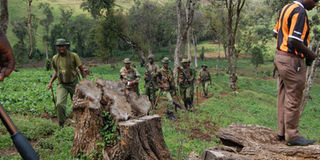
In addition to the powers to develop private forests, KFS officers will be more powerful as the Environment and Forestry Cabinet Secretary will be empowered to designate officers as uniformed and disciplined, a power formerly bestowed on the Interior CS.
Currently, only rangers of the KFS are designated as uniformed or disciplined officers, alongside the Kenya Defense Forces, the Police, the Prisons Service, and the Kenya Wildlife Service rangers.
As designated officers, they will undergo mandatory training and take an oath of office.
Further, private forests will also now fall under the protection of the law, with violators also now facing penalties and jail terms.
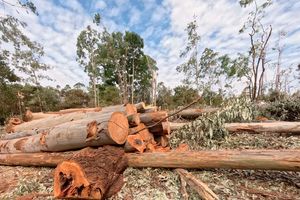
The punishment for violation of forests, including illegal or unauthorised logging, has also been raised from a fine of Sh100,000 or an imprisonment of at least six months to a fine of Sh1 million or a jail term of not less than a year.
The Bill is also introducing penalties, including imprisonment, for the importation or export of a prohibited forest product, with violators facing a 3-year jail term or a fine of at least Sh5 million.
Kenya had committed to increasing its forest cover from the current 7.2 million hectares to 10.6 million hectares in a deal with the International Monetary Fund (IMF), which saw it secure a Sh83 billion loan to build climate change resilience.
With a ban on logging in effect, KFS, which is charged with protecting Kenya’s forests, has remained cash-strapped, surviving primarily on exchequer funding and forest entry fees. With the changes, the organisation is to access an additional funding stream from private or community forest developers, helping its operations.