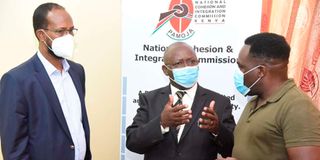
National Cohesion and Integration Commission’s Commissioners, Abdulaziz Farah (left) and Dr. Danvas Makori (right) together with Uasin Gishu County Commissioner, Stephen Kihara, during a press conference at a meeting with the commission’s peace actors in the county at Cicada Hotel in Eldoret town, Uasin Gishu County on June 10, 2021.
Politicians are allowed to hurl brickbats at their rivals whenever they can so long as they do not incite their supporters to hurl other more deadly missiles at their opponents.
Hate speech is the bane of our politics and it is time Kenyans started reminding themselves what it actually entails and how to prevent it from descending into dangerous territory.
This week, two prominent political personalities and their acolytes chose to trade accusations over who is more corrupt than the other. What should have been taken as ordinary politicking by two individuals who intend to vie for the country’s presidency next year – a quite legitimate pursuit – has turned into a volatile issue that may colour the events that will occur in 2022 and beyond. Whether these corruption charges will decide who becomes the country’s fifth president is another issue altogether, for in the past, it has never really mattered.
When ODM leader Raila Odinga recently said he will jail all implicated in grand corruption if elected president, he did not mention names. Yet that sweeping statement was taken to be a direct attack on Deputy President William Ruto, and apparently it stung so much that he and his followers immediately went on the warpath in a most maladroit manner: they started listing scandals in which Raila’s name has been mentioned in the past, only for the ODM leader’s followers to table a much longer list implicating the DP. This would have been the perfect time for the UDA crowd to keep quiet, but they opted to swallow the bait.