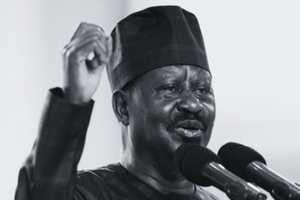
Raila Odinga was the man around whom the nation revolved—yet the presidency, like a distant star, always hovered just beyond his grasp. He was the ultimate dealmaker.
For more than half a century, this engineer-turned-insurrectionist-turned-statesman strode across Kenya’s political stage like colossus. His presence could reorder a room, his name alone could ignite a movement, and his longevity outlasted rivals, protégés, and coalitions. To his devotees, he was simply Baba—the father of the people. But the legend was never uncomplicated.
Raila Odinga wore the broker’s tag with ease, pivoting between outsider and insider with astonishing fluidity.
When he collapsed and died during a morning walk in Kerara, India, he breathed his last far from the people he had spent a lifetime trying to lead. By then, Raila Odinga was no longer just a man; he was an institution. He was the face of Odingaism.
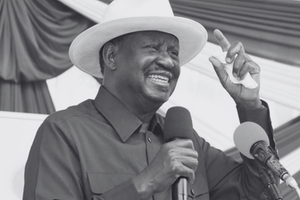
ODM party leader Raila Odinga during a delegates meeting at Golf Hotel in Kakamega County on July 25, 2025.
Photo credit: Isaac Wale | Nation Media Group
To follow Raila was to learn Kenya’s most elemental civic rhythms. Raila could conjure a crowd with a whisper, still a riot with a glance, and complicate a scandal with a perfectly timed sound bite. To some, he embodied the restless conscience of the republic; to others, he was the consummate tactician, forever transforming indignation into smoke-filled understandings. Either way, he made the country’s political blood run hot.
For decades, Raila carried the title of “opposition leader” like a fixed identity. But unlike others before him, he wore it loosely. He dismantled the label at will, crossing camps and dragging millions of supporters along, often without warning. He wore the broker’s tag with ease, pivoting between outsider and insider with astonishing fluidity.
His admirers called him flexible, shrewd, pragmatic. His critics called him a political chameleon—forever adjusting to the shifting landscape of power. His final act was no different. When the Gen Z uprising shook the foundations of President William Ruto’s government, it was Raila—not the youthful protesters—who reaped the spoils. He had not lit the spark, but he controlled the oxygen. In the aftermath, he brokered a deal to form a “broad-based government,” rescuing Ruto from political isolation and placing his own ODM allies in Cabinet. After decades of chasing the presidency, Raila seemed to arrive at a simple, hard-earned truth: in Kenya, opposition is not a fixed position. It is a fluid instrument, to be picked up and set down as needed.
Kenya's former Prime Minister and opposition leader Raila Odinga.
Photo credit: Reuters
Raila’s initiation into hard politics was forged in steel. In 1982, when a faction of the Kenya Air Force tried to topple President Moi, the state’s dragnet fell wide. Odinga was arrested, detained without trial, and delivered to Kamiti Maximum Prison where Kenya forges her dissidents. For six long years, he was in solitary confinement—and came out, not a broken man but a national martyr. In his life, Raila carried with him a potent mix of grievance and charisma. The second liberation—the long march to multiparty democracy—suddenly had a conductor by his ageing father’s side.
Born in 1945 at Maseno’s Church Missionary Society hospital to Jaramogi Oginga Odinga—Kenya’s first vice president—and Mary Juma, Raila grew up fluent in the language of high stakes. East Germany gave him a degree in mechanical engineering and an instinct for precision that would forever wrestle with his impulse for disruption.
Returning home, he taught at the University of Nairobi, founded a gas-cylinder company, and lobbied for a standards bureau. In a different universe, he might have spent his prime calibrating turbines instead of negotiating the turbulence of power. But history had other plans. In July 1970, barely 25, he faced his first press conference, pleading with the government to free his father from detention. Whether appointed or propelled by conviction, Raila stepped forward. In the battle between the house of Jomo and the house of Jaramogi, the elder Odinga had been silenced. The younger Odinga, unbowed, found his voice and never lost it.
With multiparty elections, Raila comfortably won the Lang'ata seat and in 1998 he tried to run for presidency. But after placing fourth in the presidential race, Raila made a move that shocked his own base. He crossed the aisle to join President Moi’s government—a calculated pivot that drew both outrage and admiration. His National Development Party (NDP), symbolised by the tinga (tractor), became the ballast Moi’s shaky parliamentary majority needed. The alliance baffled the opposition establishment. Kijana Wamalwa, Mwai Kibaki, and Charity Ngilu watched in disbelief as Raila threw his lot in with the very man who had detained him. But Raila understood something they didn’t: politics was not about moral lines in the sand. It was about leverage. And leverage required proximity to power.
In the power matrix in 2001, Moi handed Raila the powerful Ministry of Energy—a docket where deals were made, contracts written, and networks cemented. Raila also chaired the parliamentary committee on constitutional review, a strategic perch from which to shape Kenya’s political future. Around the same time, his business dealings came under scrutiny as Raila was thrown into the world of old money. Through Spectre International, the Odinga family acquired the state-owned Kisumu Molasses Plant at a price critics called suspiciously low. Then Starehe MP Maina Kamanda accused him of “grabbing” the facility; the Odingas insisted they paid Sh120 million. Soon after, Canadian-based Energem International—a firm with a controversial record in Africa’s mining belts—acquired a 55 percent stake. Kisumu residents, once central to the purchase, were left with just 5 percent. The Odingas held 40. The public conversation around Raila began to split: reformist hero to some, political capitalist to others.
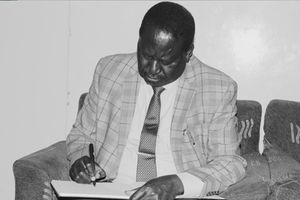
Former Prime Minister and ODM leader Raila Odinga during an interview at his home in Karen, Nairobi on July 19, 2025.
Photo credit: Wilfred Nyangaresi | Nation Media Group
Raila’s gamble on Moi had one intended prize: the presidency. But Moi, ever the tactician, chose another heir—Uhuru Kenyatta, the son of Kenya’s founding president. The betrayal was surgical. Raila’s response was swift. He stormed out of KANU, where he’d been secretary general, and returned to the opposition fold. There, he brokered yet another alliance, this time with Kibaki and Ngilu, helping to build the National Rainbow Coalition (NARC) that eventually ended KANU’s 40-year reign. The 2002 declaration—“Kibaki Tosha”—would go down as one of the most electrifying moments in Kenya’s political history. On that day at Uhuru Park, the mountain moved. Raila, the dealmaker, had delivered victory to someone else. But power rarely keeps its promises. After the election, Kibaki’s allies reneged on a secret MOU that would have made Raila prime minister. He was handed a ministry instead. Furious but calculating, Raila sowed dissent within NARC, destabilising Kibaki’s first term from inside the tent. The Kibaki men never forgave him.
The split led to the 2005 constitutional referendum fall out. Kibaki’s “Banana” camp went down in flames to Raila’s “Orange” movement—a populist juggernaut that gave birth to the Orange Democratic Movement (ODM). Two years later came the 2007 general election, arguably the most consequential of Raila’s career. ODM dominated Parliament. The presidential tally, however, dissolved into chaos. Raila claimed the election was stolen. The country burned. More than 1,000 people died, hundreds of thousands were displaced, and Kenya teetered on the edge. In the end, under international pressure led by Kofi Annan, Raila accepted a deal: he would become prime minister in a grand coalition with Mwai Kibaki. It was a power born of blood, not ballots.
ODM Party Leader Raila Odinga during the party's Parliamentary Group Meeting at Argyle Grand Hotel in Nairobi on September 22, 2025.
Photo credit: Evans Habil | Nation
The Grand Coalition was fragile from the start—a house of cards held up by uneasy handshakes. It wasn’t built on shared vision but on the rubble of a crisis. Raila brought energy to the office, but scandals trailed him like a shadow. A maize saga involving members of his circle erupted in Parliament. He called it “a bunch of nonsense.” Then came whispers about the Kazi kwa Vijana programme. Sh900 million had reportedly vanished. Raila admitted to an audit query of Sh308 million but dismissed the rest as manufactured outrage. And yet, within that uneasy coalition, Kenya achieved one of its most significant milestones since independence: the 2010 Constitution. Devolution, a bill of rights, and a re-empowered judiciary became fixtures of the state. The insurgent had learned to govern—and to bargain. The 2013 and 2017 presidential elections would be Raila’s most bruising. He lost both. In 2017, however, the Supreme Court—against expectation—annulled the presidential election, forcing a rerun. Raila boycotted, declared himself “People’s President,” and staged a symbolic oath ceremony. Then, in a move that blindsided allies and foes alike, he shook the hand of the man he had sworn to oppose—President Uhuru Kenyatta. The Handshake of March 2018 recalibrated Kenya’s politics overnight. Raila became the establishment’s favourite outsider. Uhuru, in turn, sidelined his deputy, William Ruto. The Building Bridges Initiative (BBI) emerged from this détente, promising a new constitutional order. Courts struck it down, but Raila had already achieved what he often did best: rearranging the chessboard.
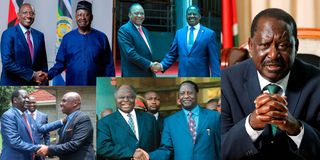
The famous handshake between President Uhuru Kenyatta and former Prime Minister Raila Odinga at Harambee House, Nairobi in 2018.
Photo credit: File | Nation
As the 2022 elections approached, Uhuru threw his weight behind Raila. Meanwhile, at Raila’s Capital Hill office, the handshake era had earned him another title: arbiter. As Uhuru cracked down on Ruto allies facing corruption charges, Raila’s allies seemed untouchable. Capital Hill became known as a “cleansing house”—a place where sins evaporated in the heat of political utility. Raila branded Ruto a thief. Ruto called Raila a mganga. Their supporters traded barbs like artillery and reconciliation seemed impossible.
Finally, William Ruto outmanoeuvered both, turning the race into a morality play between “dynasties” and “hustlers.” Ruto’s narrative stuck and Raila, for the fifth time, lost the presidency.
Then came the Gen Z uprising—youth-led, decentralized, leaderless, furious at a Finance Bill. It was a movement that existed outside Raila’s orbit. For the first time in decades, Kenya was protesting without him. But when the state turned to negotiate, it turned to the man who had made a career of negotiation. Raila seized the moment. Rigathi Gachagua, once the iron deputy, was politically isolated. Raila stepped into the vacuum, striking a deal that placed his allies inside Ruto’s government. It was the most unexpected alliance of his career—and perhaps the most strategic. By then, his ambitions had widened beyond State House. He wanted the chairmanship of the African Union Commission, a role he sought with Ruto’s blessing. To critics, it was capitulation. To loyalists, it was evolution.
The pivot came with risks. When Raila convened a press conference to champion the contentious bid of Indian tycoon Gautam Adani to manage Jomo Kenyatta International Airport and invest in the energy sector, he waded into treacherous waters. Kenya Kwanza was already reeling from corruption allegations; now Raila, once the face of opposition purity, stood shoulder to shoulder with the administration’s economic agenda. Since his “broad-based” alliance with Ruto, and the elevation of ODM allies to Cabinet, Raila had effectively become a defender of the very administration he once savaged. If he was dancing to Ruto’s rhythm, it was to remain politically relevant. Raila Odinga’s biography is inseparable from the story of modern Kenya. He was born in the furnace of liberation politics, came of age in the turbulence of one-party rule, and matured in the transactional swirl of multiparty democracy. He survived detention, betrayals, stolen elections, handshake politics, and internet-era protest movements. And through it all, he remained the country’s most persistent protagonist. He won Lang’ata in 1992. He placed third for president in 1997. The arc seemed destined to end in State House—until it kinked. But Raila was not built for quiet exits. He turned kinks into pivots, losses into leverage, defeats into deals.
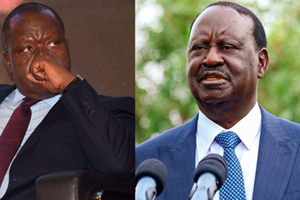
Raila Odinga's political deal with President William Ruto could leave him saddled with the government's failures. The move parallels his previous alliance with former president Uhuru Kenyatta.
Photo credit: File | Nation
He was many things: a symbol, a broker, a tactician, a reformer, a wheeler-dealer. He gave Kenya some of its loudest democratic victories and brokered some of its most delicate political truces. He normalised protest politics, then perfected boardroom bargaining. He fought for a Constitution and learned how to stretch it. He could stir the street with righteous fury and negotiate its quiet end with quiet precision. Raila Odinga did not deliver a perfect democracy. Few ever do. But he helped create a noisier, more assertive, more constitutional Kenya—a country whose citizens believe they have the right to question power. He forced the state to answer with more than a baton and a shrug. He taught a generation to turn anger into instruments. He also taught them that politics is not only about purity but about power, and that compromise—however bitter—can shape history.
Raila’s story ends not with a conquest but with a calculus. In the twilight of his life, he embraced the establishment he had once fought, pursuing continental ambitions even as his domestic star dimmed. He was still negotiating, still cutting deals, still leaning into history. The presidency eluded him, but Kenya did not. Behind the political theatre was a private life that paid the price of public power. His wife, Ida Odinga, stood beside him through detentions, betrayals, and campaigns. His children grew up learning that fatherhood in politics is an act of love—and a series of absences. His friendships were ironclad, his loyalties fierce, his humour dry. He could talk constitutional reform in the morning and Gor Mahia football by afternoon.
Raila Odinga’s life resists tidy conclusions. Was he a hero who bent the arc of democracy? A broker who traded ideals for deals? Or both? What is undeniable is the imprint. The 2010 Constitution carries his fingerprints. So does the street protest that forces the state to listen, the coalition that crosses tribes, and the citizen who walks into court with confidence. These are not monuments. They are habits. And perhaps that is his most enduring deal of all—not for himself, but for the republic.