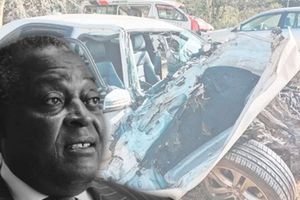
Former Member of Parliament for Lugari Constituency the late Cyrus Jirongo.

Acres of newsprint have already been expended on the life and times of Cyrus Jirongo, best known as the leader of the Youth for Kanu ’92 outfit, who tragically died in a road accident in the wee hours of Saturday morning.
Press reports, and countless messages of condolences from virtually everyone who matters in this country across the political spectrum, recall a man who rose from obscurity to dizzying heights as he helped secure President Daniel arap Moi’s survival with the return of multi-partyism in 1992.
Figures ranging from President William Ruto, his former bagman at the YK’92 outfit, to opposition leader Rigathi Gachagua and almost every other politician of note in between have united in tribute to Jirongo’s political impact, entrepreneurial drive, and his boundless warmth and generosity.
A lot has been written about how Jirongo’s cash-rich outfit influenced the 1992 elections. How his seemingly bottomless coffers doled out cash to all who came calling remains the stuff of legend. Labelling that as generosity and kindness, however, can only be an abuse of the principles.
Looting
Jirongo thrived in a system where looting and plunder of national coffers, land grabbing, and wanton stripping or bankrupting of venerable public institutions such as NSSF, Postbank Credit, National Bank, Kenya National Assurance Company, and others, was normalised.
It was a system where money stolen from the public was used to both enrich those who held the levers of power and also to buy the loyalties of spineless individuals who would sell their souls and dignity for the instant gratification of envelopes stuffed with cash.
That was not generosity, but an irredeemably corrupt system which operated on the principle that people must first be impoverished and forced into desperation before they could succumb to the lure of cash dangled in front of them.
Those were the basic governing principles of Moism, where political control was almost wholly dependent on control of the resources that would be deployed to buy and own individuals.
I can disclose here that in my career as a journalist on the beat, I interacted with Jirongo pretty closely. I can agree, without hesitation, that he was a warm, cheerful personality with a ready laugh and zest for life.
At his Anniversary Tower and Loita House offices, his Lavington home, or at The Coconut, his then regular watering hole in Nairobi’s Upper Hill suburbs where we shared many a late-night sojourn, I witnessed first-hand the parade of personalities ranging from powerful Cabinet ministers, permanent secretaries and security chiefs down to hard-up students and jobseekers lining up for favours.
We became friends, in a fashion, as he became an invaluable news source, always ready with leaks on goings-on in the corridors of power. But we also both implicitly knew, out of mutual respect, that I would not use his leaks without vigorous cross-checking.
Many of them were self-serving and designed towards driving his own political schemes. It was a delicate arrangement because he was more accustomed to journalists on his payroll, the ones who did his bidding without question.
Many of them eventually came to destroy their careers, either because they were exposed for being on the take or because they wrote stories based on patently false information that could not stand scrutiny.
Jirongo was a complex personality. For one with limited formal education, he was extremely sharp and well-informed, holding court with confidence on politics, business, banking and financial systems, and the complexities of property development and financing.
Over-confidence
It was that “native” intelligence which no doubt eased his way into the inner-sanctum of President Moi’s power-structure. But it was also overconfidence that saw him over-reach himself and get booted out soon after accomplishing his mission with Kanu’s retention in power with the first multi-party polls in 1992.
He bounced back many years later, even earning a Cabinet slot in the run-up to the 2002 elections as part of a constellation of youthful leaders, Ruto included, put together by President Moi’s son, Gideon, to deliver the Kanu succession baton to Uhuru Kenyatta.
Cyrus Jirongo represented the best and worst of Kenyan leadership. He was living proof that anybody could rise through sheer hard work, imagination, and street smarts. But he was also an exemplification of the dirty politics that will happily loot, plunder and destroy institutions.
His disciples rule today, and are following in his footsteps, seeing as to the rebirth of shadowy characters traipsing the country displaying and dishing out a bagful of cash, no doubt stolen from public coffers. The dubious spirit of YK’ 92 is alive and well.
Follow our WhatsApp channel for breaking news updates and more stories like this.
Mr Gaitho, an independent journalist, is former NMG Managing Editor for Special Projects. [email protected]