The firm delivering quality medical devices, and the bank behind its success
Sponsored by Co-operative Bank of Kenya
By Evans Ongwae
When discerning Kenyans peer at specific industries, they may identify market gaps and opportunities, and then proceed to develop likely solutions. This is common in the country, with many enterprises created every year. However, a good number do not survive, the common challenge being how to turn a brilliant idea into a successful business.
Mr Paul Githinji, a co-founder of Fullcare Surgical Limited, picks out financing as a key reason for many start-up failures: “In the finance sector, we are told that most of new businesses go down within one year because of lack of finances.”
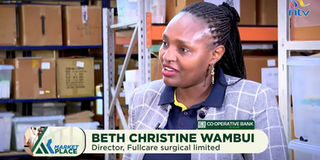
Mr Githinji teamed up with Ms Beth Christine Mumbi to establish Fullcare Surgical to import and distribute surgical and medical devices.
Unlike other firms that fall by the wayside in the first few months, Fullcare has thrived.
Mr Githinji, whose background is finance, and Ms Mumbi, a medical practitioner, combined their expertise to analyse the market.
He explains: “What made us start this business is because we realised there was a gap in the medical sector, with many hospitals struggling to get quality and affordable products. So, we realised we could do something to fill that gap.”
Chipping in, Ms Mumbi lists some of the products the company deals in. “We import and distribute to the local hospitals and also clinics, as well as to patients directly. We are in the space of products that can be used in the ICU (intensive care unit), in the theatre, and also advanced wound care, among other products,” she says.
Fullcare Surgical’s journey began in a small room in Westlands. Mr Githinji, Ms Mumbi and one employee, completed the team at that time. But, as Mr Githinji reveals, over time, the firm has grown steadily and now has 20 employees. “We moved from that single room to this place, which is over 5,000 square feet,” he says, referring to the firm’s current premises.”
As it grew, Fullcare Surgical also increased the range of products it supplies to health facilities. Mr Githinji acknowledges that the company’s major take-off occurred after Co-operative Bank agreed to provide financing. Since then, “it's been a growing trend, and we're still growing,” he says, and continues: “Initially, we started with just a few products. But over time, because of the financing, with Co-operative Bank offering us a credit line, it has been possible to import in bulk.”
He explains: “The bank gave Fullcare a letter of credit, which we give to our suppliers so that we can import goods. Once those goods come in, we are able to clear the debt. That is import duty financing. And then once the letter of credit matures, Co-operative Bank extends to us a facility that takes over from that point.”
He goes on: “For those suppliers who do not accept the letter of credit, the bank extends financing or stock financing to us to import and clear goods through the import duty financing. And this has enabled us to meet deadlines. We're able to ensure that we have products. We don't have stockouts.”
The majority of Fullcare’s customers always ask for credit. And the credit period ranges from 30 to 50 days. Some customers still delay in paying even after the 50 days have passed. Mr Githinji explains how Co-operative Bank enables the company to go around this challenge: “The bank extends to us some facilities – such as LPO financing. This enables us to buy goods and supply them to our customers. And then we repay the bank once the payment comes through from our customers.”
Co-op Bank also offers Fullcare invoice discounting. “When we have supplied those goods and it has taken a lot of time for us to be paid, we take those invoices to the bank for them to advance us funds,” Mr Githinji further explains.
On the firm’s overall relationship with the bank, he says: “Co-op Bank has been our partner from the time we started. It has fuelled our growth from the time we opened an account with them; from the time we introduced ourselves to the bank, all the way through.”
He points out that Fullcare enjoys several facilities from the bank. “We get performance bond guarantees, letters of credit, stock financing, and import duty financing. Also on the side, we have an overdraft.”
With this financing, Fullcare Surgical Ltd is able to import quality healthcare equipment and devices from Germany, India, Canada Malaysia, Turkey, and Egypt, for distribution locally.
Watch the full story below: