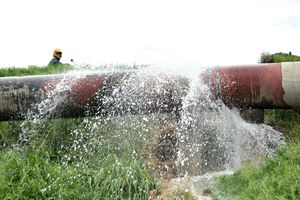
A sustainable water future is taking shape in the Coast region, and CWWDA is involved
Sponsored by Coast Water Works Development Agency
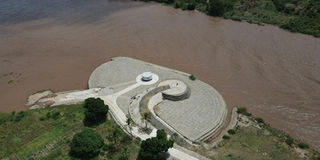
Baricho Well Field Protection Works, designed to safeguard water in the face of increasing climate change risks.
In the sun-kissed coastal expanse of Kenya, where azure waters meet golden shores, the promise of clean and reliable water is vital for thriving communities and sustainable development. The Coast Water Works Development Agency (CWWDA) stands at the forefront of this critical mission, playing a pivotal role in transforming the water and sanitation landscape across the six coastal counties of Mombasa, Kilifi, Kwale, Taita Taveta, Lamu, and Tana River.
CWWDA works in partnership with the national and county governments, development partners and local communities, to implement impactful projects that enhance water security, promote public health, and support socio-economic growth.
From the construction of large scale water supply and sanitation systems and rehabilitation of ageing infrastructure, to climate-resilient solutions like solar-powered boreholes and flood protection works, the Agency is committed to ensuring equitable and sustainable access to water as a fundamental human right.
Contribution to the water sector
CWWDA, a State Corporation under the Ministry of Water, Sanitation and Irrigation, was established through Gazette Notice No. 28 of April 26, 2019 under the Water Act 2016. Its mandate is to develop and maintain sustainable water and sanitation infrastructure within the Coast region, and it has made significant strides.
One of the key roles of the Agency is bulk water transmission. This involves development, maintenance and management of the cross-county public water works within its area of jurisdiction. The systems include Baricho Water Works, Mzima, Marere, Pemba dam and Tiwi boreholes.
Climate resilience and innovation
The Agency has also embraced the integration of climate-smart infrastructure and resource management to address water scarcity by adopting the use of solar panels in all the borehole projects for pumping and supplying water to the communities. Separately, the Baricho Protection Works in Langobaya have been implemented to secure vital water supply infrastructure from flooding, ensuring quality and long-term reliability of water delivery systems.
Water supply situation in the Coastal region and interventions by CWWDA
The Agency serves a population of approximately 5.7 million people. Currently, it supplies 220,913 cubic metres of water per day against an estimated daily demand of 578,805 cubic metres, resulting in a daily deficit of 357,892 cubic metres. This shortfall continues to strain water service delivery, especially in fast-growing urban and peri-urban areas. To address this supply-demand imbalance, CWWDA is implementing and supporting several high-impact water infrastructure projects in collaboration with the National government, development partners and county governments.
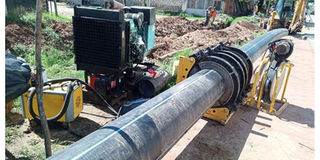
North Mainland Pipeline Distribution Works in Kisauni area. This project will benefit 40,000 households.
The Mwache Dam Project stands out as the Vision 2030 flagship intervention in this effort. The project is being implemented by the Ministry of Water, Sanitation and Irrigation, and is located in Kwale County. Once completed, the multipurpose dam will support both domestic water supply and irrigation, directly benefiting Mombasa and Kwale counties. It is currently under construction, to be completed by 2027.
To complement this major investment, CWWDA is undertaking the construction of the 186,000 cubic metres per day Mwache Water Treatment Plant and the transmission pipelines to Mombasa South, West and North Mainland.
Another major intervention is the development of the Mzima II Pipeline, a transformative project intended to supplement and eventually reduce reliance on the ageing Mzima I Pipeline, which was constructed in 1957. The old pipeline has far outlived its use and is now vulnerable to frequent failures, posing risks to water reliability in the region. The new Mzima II Pipeline will convey water from Mzima Springs in Taita Taveta County, to Kwale, Kilifi and Mombasa counties. It is projected to deliver approximately 105,000 cubic metres of water per day. The project is currently with the PPP directorate for further evaluation.
In addition to these flagship projects, CWWDA is implementing a broad range of complementary interventions aimed at improving the overall water supply systems for both urban and rural areas.
With continued investment, strong inter-agency collaboration, and stakeholder support, the region is well-positioned to overcome its current challenges and secure a sustainable water future.