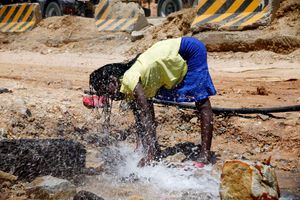
Water overflows from a damaged pipe at Kibarani area in Mombasa. The government plans to construct a second Sh35 billion pipeline from Mzima Springs in Taita Taveta County.

State-owned Chinese firm, Sichuan Roads and Bridges Group, set to develop a 220-kilometre pipeline linking Mzima Springs in Taita Taveta to Mazeras storage tanks in Kilifi, in a Sh50.6 billion project aimed at boosting water supply to four coastal counties.
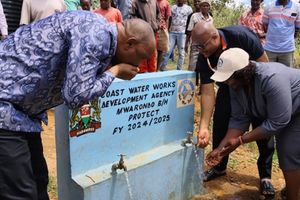
The public listed company will develop the water pipeline in a 30-year build-operate-transfer (BOT) arrangement with the Coast Water Works Development Authority (CWWDA).
A BOT model is a public-private partnership (PPP) where a private company finances, builds, and operates a large infrastructure project for a fixed concession period before transferring ownership back to a government or public entity.
The pipeline will serve the residents of Mombasa, Kilifi, Kwale and Taita Taveta counties, in a bid to boost water supply in the Coast region, where demand continues to outstrip production.
“Development of a 220 kilometre water pipeline with a diameter of 1,200millimetres (mm) and attendant facilities to abstract and transmit 105,000m3/d (cubic meters per day) of water from Mzima Springs to Mazeras Tanks and various towns along the pipeline at an estimated cost of US$ 335.338 million (Sh43.5 billion),” the PPP Directorate of the National Treasury said.
“The proposed term of the project is 30 years with a construction period of three years and an operation and maintenance period of 27 years.”
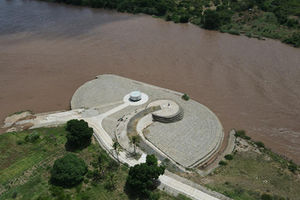
The project will transport 105,000 cubic metres (105 million litres) of water daily from Mzima Springs in Taita Taveta County to Mazeras storage tanks.
In this arrangement, the Sichuan Roads and Bridges Group will take on the entire burden of financing, designing, and constructing the project.
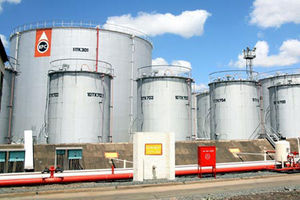
The investment is expected to include water intake facilities, the transmission pipeline, pumping stations, and storage infrastructure.
Once the water pipeline is built, the company will operate and maintain it for the set period of 30 years, earning back its investment and making a profit either by collecting user fees or receiving fixed government payments.
After the contract expires, Sichuan will transfer full ownership and operational control of the fully functional asset back to the coastal government.
The Mzima II project is designed to expand an existing water supply system that has served the Coast since the 1950s.
The original Mzima pipeline, or Mzima I, transports water from Mzima Springs in Taita Taveta to the Coast but has struggled to keep pace with rising demand, with ageing infrastructure also contributing to supply disruptions.
The new 220km pipeline is expected to supplement the existing system by transporting an additional 105 million litres of water daily, increasing bulk water availability to the four counties.
“The project proposal was approved in August 2024 for the project to progress to the project development/feasibility study,” the directorate has said.
Samuel Soda Bengi, an engineer and contractor associated with the CWWDA, says the project is awaiting final approval.
“The Mzima pipeline 1 is dilapidated. It was commissioned in 1957. It’s an old pipeline, and because of its condition, it has a lot of leaks and bursts. The design for Mzima One was to supply 3,000 cubic metres per day to take care of a population of the 70s,” he says.
“Thereafter we were supposed to have Mzima 2, but we are yet to see it; what I understand is that the project is at the approval stages.”
The Coast has struggled to match water production and distribution with demand from households, businesses and institutions. Mombasa's urban concentration, the expansion of settlements in Kilifi and Kwale, and the region's tourism and industrial activities all place pressure on existing supplies.
A reliable bulk water source could help reduce supply interruptions, improve the operating environment for businesses and support the development of new housing and commercial facilities.
For businesses such as hotels, manufacturers and property developers, water shortages are not simply a social inconvenience. They can translate into higher operating costs, investment delays and dependence on alternative supplies.
Data presented to the Senate in June 2026 showed that Mombasa, Kilifi, Kwale and Taita Taveta had a combined daily water demand of 512,000 cubic metres against production of 185,000 cubic metres, leaving a deficit of 327,000 cubic metres.
The proposed pipeline, with a daily capacity of 105,000 cubic metres, will provide a substantial additional source of water, although it would not fully close the regional supply gap.
The additional supply is expected to benefit more millions of residents, while supporting water-intensive sectors such as tourism, manufacturing, agriculture and real estate.
Once the project is complete, it could reduce dependence on private water vendors, boreholes and water storage facilities, lowering operating costs and supporting expansion.
It is also expected to improve access to clean water for households, reduce supply disruptions and strengthen the region's capacity to accommodate more economic growth and investment.
Follow our WhatsApp channel for breaking news updates and more stories like this.