East African Community integration agenda: Scorecard of Kenya’s one-year stewardship
Sponsored by Ministry of East African Community, the ASALs and Regional Development, Republic of Kenya
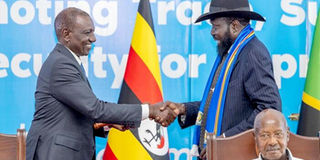
H.E President Dr William Ruto when he was elected EAC Chairman in November 2024, succeeding H.E President Salva Kiir. Partially hidden in the foreground is H.E President Yoweri Museveni of Uganda.
What you need to know:
- The foundation laid during this period stands as a platform for accelerated integration, shared prosperity and enduring peace.
- The journey continues – undertaken together, guided by Treaty principles, and driven by a collective determination to realise the full potential of the East African Community
From November 30, 2024 to November 30, 2025, Kenya’s Chairmanship of the East African Community (EAC) unfolded as a defining chapter in the bloc’s integration journey. Anchored in the Treaty for the Establishment of the EAC and guided by the vision of H.E Dr William Samoei Ruto, the year was shaped by a deliberate effort to consolidate regional unity, expand economic opportunity, strengthen institutional credibility, and safeguard peace and stability.
The scorecard of this period reflects a Community in motion – confronting structural challenges, expanding its footprint, and reinforcing its collective voice on the continental stage.
At the heart of Kenya’s stewardship was a six-pillar agenda focused on expanding the regional market, deepening economic and socio-cultural ties, advancing trade facilitation, strengthening private sector leadership, enhancing representation and strategic dialogue, and building institutional capacity. These priorities were not pursued in isolation. They were interconnected strands of a broader ambition: To nurture a resilient, competitive and people-centred EAC capable of delivering tangible benefits to over 300 million citizens.
Representation and diplomacy featured prominently throughout the year. The region rallied behind the candidature of Rt. Hon Raila Odinga (now deceased) as the EAC’s sole nominee for the African Union Commission Chairmanship. Although the bid did not succeed, the unified endorsement by Partner States demonstrated a shared determination to amplify East Africa’s influence in shaping continental priorities, from transboundary infrastructure to climate resilience and private sector development. The moment underscored the bloc’s maturity in presenting a common front in global affairs.
Kenya’s assumption of the rotating chairmanship of the Common Market for Eastern and Southern Africa (COMESA) further elevated the region’s strategic standing. By pledging to harness digitisation to deepen value chains and unlock shared prosperity, Kenya positioned itself as a bridge between regional blocs, reinforcing synergies among EAC, COMESA and broader continental integration frameworks. The Chairmanship also demonstrated diplomatic responsiveness in moments of tension.
President Ruto’s decision to appoint Raila Odinga as Special Envoy to South Sudan signalled Kenya’s proactive commitment to mediation and stability, reaffirming the principle that economic integration flourishes only where peace prevails.
Unlocking regional commerce
The year also consolidated the significance of expanded membership. The accession of the Democratic Republic of Congo, Somalia and South Sudan continued to reshape the Community’s geographic and economic landscape. With a span stretching from the Indian Ocean to the Atlantic corridor, the EAC strengthened its strategic positioning, broadened its market base, and enhanced its attractiveness to investors.
Somalia’s integration, in particular, boosted trade flows and expanded access to the common market framework, while South Sudan advanced professional mobility through regional agreements.
Trade facilitation emerged as one of the most visible markers of progress. The EAC recorded a trade surplus in the first quarter of 2025, driven by a surge in exports and increased competitiveness among Partner States. Growth in domestic exports and re-exports reflected improved value addition and production capacity. Intra-African trade contributed significantly to this performance, reinforcing the bloc’s internal economic dynamism even as inflation remained a concern requiring coordinated macroeconomic management.
Digital integration strengthened these trade gains. By harmonising roaming charges and reducing communication costs, the One Network Area initiative stimulated cross-border connectivity and economic activity. Expanded participation among Partner States moved the region closer to a unified digital single market.
Complementing this progress, Tanzania’s introduction of satellite-to-phone guidelines expanded connectivity to underserved areas while ensuring domestic participation in the evolving telecommunications ecosystem. Together, these reforms underscored the centrality of digital infrastructure in unlocking mobility, commerce and financial inclusion.
Infrastructure development remained the backbone of integration. The Standard Gauge Railway (SGR) projects in Kenya, Uganda and Tanzania advanced steadily, with coordinated commitments to parallel completion timelines between Kenya and Uganda signalling a shift from fragmented national efforts toward harmonised regional execution.
Uganda secured financing and commenced construction on its SGR segment, linking to Kenya’s existing network and strengthening access to the port of Mombasa. Tanzania reinforced its SGR operations through the establishment of a dedicated electricity supply region, ensuring reliability and safeguarding investment. The joint Tanzania–Burundi electrified railway project further exemplified cross-border infrastructure collaboration.
Ports and logistics transformation complemented rail expansion. Dar es Salaam Port recorded historic growth in cargo handling and container throughput, enhancing its capacity to serve landlocked neighbours and cementing its role as a regional logistics hub. Investments in automation and efficiency reduced vessel turnaround times and strengthened competitiveness.
In Kenya, the Suam One-Stop Border Post approached completion, promising faster customs clearance and reduced cargo processing time, while the Kenya-Tanzania electricity interconnector went live, embedding both countries into the broader Eastern Africa Power Pool framework and deepening energy trade.
Road corridors advanced integration across multiple fronts. The Tanga-Bagamoyo Road, part of the East African Coastal Transport Corridor, progressed with support from development partners, reinforcing connectivity between Tanzania and Kenya. Legislators called for expedited completion of the transnational coastal highway linking Bagamoyo and Malindi, recognising its potential to boost tourism and cargo movement.
The Kampala-Juba-Bangui corridor initiative illustrated commitment to connecting East and Central Africa through phased, jointly financed road development.
Meanwhile, Kenya’s feasibility approval for the Nairobi-Mombasa Expressway marked another step toward modernising the Northern Corridor, with anticipated reductions in travel time and enhanced efficiency for cargo destined for inland Partner States.
Maritime integration also gained renewed momentum. The arrival of a record-length container vessel at Lamu Port signalled Kenya’s ambition to establish the port as a premier trans-shipment hub in the West Indian Ocean region. With expansion plans envisioning multiple berths and substantial cargo capacity, Lamu’s emergence complements the enduring centrality of Mombasa Port and strengthens East Africa’s maritime competitiveness. The Mombasa-Nairobi SGR marked its eighth anniversary, continuing to transport millions of passengers and significant freight volumes, symbolising modernisation and regional connectivity.
On Lake Victoria, the revitalisation of Kisumu Port and the operationalisation of MV Uhuru I and MV Uhuru II reshaped inland water transport. Increased cargo volumes and coordinated upgrades by Uganda and Tanzania signalled a collective revival of the lake as a functional regional transport corridor. These investments illustrated how integration extends beyond highways and rail to blue economy infrastructure that directly transforms livelihoods.
Powering integration
Energy cooperation deepened in parallel. The Kenya-Tanzania interconnector enabled bilateral electricity trade, while Tanzania’s policy shift to open electricity transmission to private participation marked a new phase in energy sector reform. Regional hydropower collaboration among Rwanda, DRC and Burundi advanced with renewed momentum for the Ruzizi III project, reinforcing energy security and integration. Cross-border power trade, supported by expanding transmission infrastructure, strengthened resilience and industrial capacity.
Integration beyond economics: Peace and security diplomacy
Beyond infrastructure and trade, the Chairmanship placed equal emphasis on socio-cultural and political cohesion. The 24th Extra-Ordinary Summit addressed developments in Eastern DRC, reaffirming Treaty principles of peace and regional stability.
Military chiefs convened to coordinate responses to security challenges, while diplomatic engagements between DRC and Rwanda reflected progress toward dialogue and economic cooperation. In health, cross-border malaria control initiatives, kidney transplant advancements, and regional health institutions demonstrated integration’s human dimension.
Sports and cultural events further reinforced unity. The co-hosting of CHAN tournaments and preparations for the Africa Cup of Nations 2027 showcased collective readiness and shared infrastructure development. Tourism cooperation expanded through international showcases and policy reforms, with Partner States securing recognition and nominations on global platforms. Kenya’s decision to expand exemptions under its Electronic Travel Authorisation system signalled responsiveness to continental calls for greater mobility, advancing travel freedom for EAC citizens and African nationals.
Broadening the economic frontier
The expansion of regional markets remained a central ambition. Uganda leveraged the African Continental Free Trade Area (AfCFTA) export facilities, while East Africa’s rising position in global coffee trade highlighted agricultural competitiveness.
MSME Trade Fairs fostered cross-border partnerships and innovation, reinforcing small business participation in integration. Agricultural transformation efforts spanned agro-ecology initiatives, beekeeping innovation, poultry expansion, and diversification strategies in DRC. Despite insecurity challenges, exports to DRC continued to grow, underscoring resilience.
Institutional capacity development underpinned these achievements. Discussions advanced on amendments to the EAC Treaty and frameworks to deter non-compliance with regional obligations. Judicial conferences, strategic dialogues among Heads of Public Service, and strengthened Lake Victoria conservation commitments reinforced governance and sustainability. Somalia’s fulfilment of financial obligations under the Treaty signalled institutional consolidation within the expanded bloc.
Private sector participation was deliberately elevated. Structured dialogues with the East African Business Council and the EAC Secretariat ensured that market-driven integration informed policy. The African Grain Trade Summit underscored agriculture’s role in food sovereignty and value chain transformation, while horticulture ambitions in Tanzania reflected sectoral confidence.
Challenges, however, remained. Cross-border traders faced disruptions linked to insecurity in parts of the region. Freight logistics encountered strain, and humanitarian pressures persisted in Somalia. These realities highlighted the complexity of integration within dynamic geopolitical and socio-economic contexts.
As Kenya concluded its Chairmanship, the narrative was one of progress grounded in collective resolve. Infrastructure connectivity strengthened, digital integration advanced, trade expanded, institutional frameworks matured, and regional diplomacy intensified. Yet the work ahead remains substantial. Deepening and widening integration requires accelerated implementation of pending directives, inclusive growth strategies that reach grassroots communities, and responsiveness to evolving global economic realities.
The year’s stewardship reaffirmed a central truth: A stronger, interconnected East Africa is not an aspiration but an unfolding project built through sustained collaboration. The foundation laid during this period stands as a platform for accelerated integration, shared prosperity and enduring peace. The journey continues – undertaken together, guided by Treaty principles, and driven by a collective determination to realise the full potential of the East African Community.
More content available here.


