How IWMI is helping Kenya unlock irrigation potential
Sponsored by International Water Management Institute
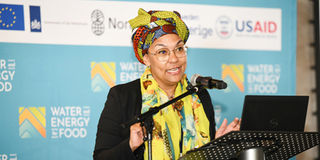
Dr Inga Jacobs-Mata, the Director for Water, Growth and Inclusion at the International Water Management Institute.
By Evans Ongwae
Kenya has entered an exciting phase in its drive to irrigate more land, with several jigsaw pieces falling in place. This is expected to help the country fully unlock its irrigation potential of 3.3 million acres. Currently, less than a quarter of this – 710,000 acres – is irrigated.
As per the National Irrigation Sector Investment Plan (NISIP), the government has pledged to irrigate one million acres by 2030.
The International Water Management Institute (IWMI) has a role in this quest, with the Director for Water, Growth and Inclusion, Dr Inga Jacobs-Mata, pledging the institute’s commitment to help close that gap without draining the aquifers.
IWMI’s Kenya modelling estimates that the country has 855,000 hectares of groundwater-fed irrigation potential. About 452,000 hectares of that could economically go solar. Kenya is already a regional leader, accounting for more than 65 percent of solar water pump sales in sub-Saharan Africa. The risk is that a solar pump runs on free sunshine, and free sunshine can mean depleting aquifers. “So,” says Dr Jacobs-Mata, “we test the models that work.”
She explains: “Our research supports Kenya's National Irrigation Sector Investment Plan, which affects how schemes are mapped, financed and governed. We have also supported solar irrigation that cuts fuel costs and emissions, with safeguards against groundwater over-extraction.”
Through the Solar Energy for Agricultural Resilience (SoLAR) Phase II project, funded by the Swiss Agency for Development and Cooperation, IWMI is also taking solar beyond irrigation, to cold storage, drying and milling that help farmers cut costs and reduce postharvest losses.
As a technical partner, IWMI is supporting Kenya’s push to entrench the sustainability of irrigation projects through the development of fair tariffs.
Says Dr Jacobs-Mata: “Kenya's public irrigation schemes recover only about a quarter of what it costs to run and maintain them, and the rest falls on public budgets. Canals silt up, pumps break, and within a few years, schemes fall into disrepair and need costly rehabilitation.”
On December 11, 2025, IWMI signed a Memorandum of Understanding (MoU) with the State Department for Irrigation in the Ministry of Water, Sanitation and Irrigation, supported by the CGIAR Scaling for Impact Program. The MoU covers technical assistance on sustainable water tariffs, irrigation policy support and scaling solar irrigation, to speed up delivery of NISIP.
Kenya’s first draft national guidelines for irrigation water tariffs were co-developed by a technical working group coordinated by the State Department for Irrigation, with the Water Resources Authority (WRA), the National Irrigation Authority (NIA) and the Water Services Regulatory Board (WASREB), and IWMI as technical adviser.
IWMI leads the costing and willingness-to-pay analysis and helps align national and county mandates. The draft proposes that commercial farms move to full cost recovery immediately, while smallholders transition gradually, with protections such as drought relief. The guidelines will undergo expert validation before they are finalised.
Notes Dr Jacobs-Mata: “Kenya is building a tariff system that is fair to smallholders, credible to investors, and good for the water itself.”
IWMI’s strategy to 2030 was launched in Nairobi on April 8, 2025, during CGIAR Science Week. It is built around three focus areas – mitigating water risks, overcoming inequalities and managing water sustainably – supported by four transformational levers: Water data science; water governance; gender, youth and social inclusion; and scaling, finance and investment. In Kenya, Dr Jacobs-Mata says, this translates into solar-powered, groundwater-safe irrigation expansion, data for decisions, resilience to floods and drought, financially sustainable irrigation through fair tariffs, and the inclusion of women and youth, “who are part of the solution, not a footnote”.
“On tariffs,” Dr Jacobs-Mata explains, “the path is co-design, validate, pilot, refine, and scale.”
She adds: “Next, we take the guidelines into selected schemes. We will test whether farmers are willing to pay, and also whether managers are willing to charge, because that is often the harder part politically. Then the framework expands to farmer-led irrigation and payments for ecosystem services, with the end goal of a national tariff and incentive framework built into policy and regulation.”
According to her, the three elements required for the development of sustainable irrigation are what she describes as three Ps.
One is patient capital. DrJacobs-Mata says this comprises blended finance that makes solar affordable for smallholders, not only the lucky few, and funding for the tariff pilots and monitoring.
Two is policy alignment.In this, the ministries of energy, water and agriculture have to work together, so that the policies developed and implemented are not discordant.
Three is the need to rope in and support private partners who can reach millions of farmers, with science making sure growth doesn't empty aquifers.
IWMI also supports the use of data in water policy decisions. For example, the Water Availability and Demand dashboard, co-developed by IWMI and the National Irrigation Authority (NIA), with support from the Food and Agriculture Organization of the United Nations (FAO), is now in operational use at NIA. It shows where the water is, where it isn't, and where a dam would make the biggest difference.
"Africa,” says Dr Jacobs-Mata, “has plenty of water challenges and not enough water data. That data gap is what our Digital Innovations for Water Secure Africa programme, DIWASA, is working to close. It uses satellite data and tools for flood and drought monitoring and water accounting.”
In Turkana County, IWMI has used Earth observation data and machine learning to improve flood forecasting and give communities earlier warnings.
IWMI is part of CGIAR. Its work is to undertake research and innovation on water for food, climate and people.
Says Dr Jacobs-Mata: “We produce the evidence, build the tools, and then do the important part: Scaling them through policies, networks and partners.”
How does IWMI work with countries?
Dr Jacobs-Mata explains: “We don't arrive with a finished solution in our suitcase. We co-design with governments, communities, universities and the private sector.”
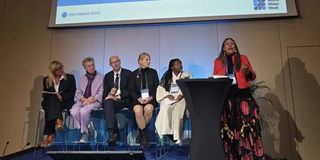
IWMI's Director for Water, Growth and Inclusion, Dr Inga Jacobs-Mata, during a session at the SIWI World Water Week 2026 held in Stockholm, Sweden, in August.
In Kenya IWMI works with the Ministry of Water, Sanitation and Irrigation and its State Department for Irrigation, the National Irrigation Authority and, since January 2026, the National Environment Management Authority (NEMA), with which it signed a three-year MoU on climate-smart environmental governance.
"Research that stays in a journal is like a borehole with no pump: Impressive, but nobody drinks,” argues Dr Jacobs-Mata. She adds: “Our role with government is to sit beside them, not to hand over a report and wave goodbye.”
Across the region, IWMI works in Ethiopia, Kenya, Rwanda, Somalia and beyond, alongside regional bodies such as IGAD and the East African Community.
This CGIAR water research centre that serves the global south opened its Kenya office slightly more than two years ago. It, however, has been technically supporting the country over the last decade.