Women, shared effort, and what has been gained
Sponsored by Sustainable Agriculture Foundation-Africa
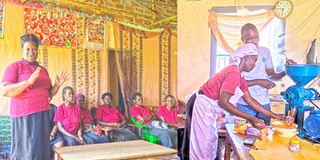
The Chairperson of Sirenga Group in Western Kenya's Bungoma County Edith Mbachi, chats up members as they skillfully process groundnuts into rich, golden peanut butter.
The International Women’s Day offers a moment to reflect. It invites us to consider what changes take effect when women are supported and in turn invest their time, effort, and leadership in their families and communities. This year’s theme, Give to Gain, reflects the progress when women give, and how the benefits extend well beyond individual households.
In Bungoma County, Edith Mbachi is a farmer and a community leader. She is the chair of Sirenga Community Based Organisation – a women-led group in Bukembe, Kanduyi Sub-County – formed to support vulnerable community members, including widows, orphans, people with disabilities, and the elderly. Edith joined the group because, as she explains, “the members had a heart to help, but they lacked the means.”
That began to change when the group started growing and processing groundnuts. Through value addition, income increased, allowing the group to provide greater support to its community. “Since we received a processing machine and started producing peanut butter, we have increased production and income. Now we can not only pay school fees but also buy books and uniforms for the orphans we support,” Edith says. Members process and sell their produce, and contribute a portion back to the group to sustain its work.
The gains are also felt at home, with learning about nutrition influencing how food is prepared and consumed. Edith now uses peanuts when cooking vegetables, reducing the amount of oil used, and has noticed improvements in her own health. She also recalls elderly members of the group saying that processing groundnuts into peanut butter has allowed them to enjoy a nutritious food they value.
These changes did not come without giving. Edith began by offering one acre of her own land so the group could grow groundnuts together. As opportunities grew, more members contributed land, expanding from one acre to eight. She also invested time in learning new farming practices and sharing that knowledge with other women, turning individual effort into collective progress.
In Busia County, Mildred Auma’s journey is equally powerful. A farmer, she grows African leafy vegetables and keeps poultry. She is the chair of Mumbiri Women Group in Busibwabo, Matayos Sub-County. She also runs an agri-enterprise that sells food produce and poultry feed made using local resources.
“I used to be a housewife with no source of income, relying on my husband for financial provision,” Mildred says. After her group received support and practical skills, each member got 20 chicks, which Mildred raised and sold. With the income, she started her business. She now contributes to household finances and has helped pay school fees for her children.
Her priorities at home have also shifted. “I ensure that I feed my family a balanced diet before I sell my poultry products,” she explains, adding that this has improved her children’s health and given her peace of mind.
Like Edith, Mildred emphasises that progress requires personal investment. She provides land for a demonstration plot where new farming techniques are tested and shared, supports other women when poultry-related challenges arise, and actively shares what she learns as a farmer and businesswoman. “I am proud to have transitioned from a housewife to a businesswoman. I now contribute to my family’s finances and can feed them well from my own business,” she says.
Through collaboration with county governments in Busia and Bungoma, the Nutrition in City Ecosystems (NICE) Project has supported efforts to strengthen nutrition planning and promote safer food environments through the development of policies and action plans. These system-level efforts help ensure that the time and labour women invest in producing, selling, and preparing food are supported by conditions that allow their gains to last.
Now in Phase II, one lesson from NICE stands out: When women give their time, labour, and leadership, and when institutions create space for that effort to thrive, the gains extend beyond individual households. Families are healthier, livelihoods are stronger, and communities are better equipped to shape their futures.
For the NICE Project in Kenya, these stories reflect years of learning about how food systems, nutrition, livelihoods, and gender intersect in everyday life. They reinforce the value of working with women as active contributors to change, while strengthening the systems that support their efforts. As Phase II begins, the focus remains on deepening collaboration with counties and communities so that the gains women have made can be sustained and extended.
The Nutrition in City Ecosystems (NICE) project is supported by the Swiss Agency for Development and Cooperation (SDC). It is implemented and co-financed by a public-private Swiss consortium comprising the Swiss Tropical and Public Health Institute (Swiss TPH), ETH Zürich (Sustainable Agroecosystems Group and World Food Systems Center), Sight and Life, Sustainable Agriculture Foundation-Bangladesh and Sustainable Agriculture Foundation-Africa, and the Enterprise for Society Centre (E4S), University of Lausanne.
Article compiled by NICE Project team, Kenya