Meet Derrick Mboya, the agripreneur
Sponsored by KCB Group
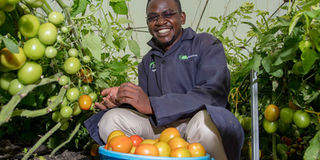
In 2018 while a third-year student at Jaramogi Oginga Odinga University, Derrick Mboya won the Enactus business contest, landing himself a trip to California in the United States of America.
The Enactus contest is sponsored by professional services multinational KPMG, technology giant Google, and a couple of other companies.
Derrick had led his team to develop a business concept where the water hyacinth, a big problem on Lake Victoria, was turned into charcoal briquettes, which helped deal with the weed and provided clean energy. Further, the use of this form of cooking had the added advantage of saving trees from being harvested for charcoal.
Derrick, aged 27, is the first born of three siblings – two boys and a girl. His father is a businessman in the textile sector, while his mum owns and runs a chemist in Nairobi.
He completed his bachelor’s degree in Education Arts and IT in 2018. He has already been involved in several businesses. “I am a serial entrepreneur,” he states with a chuckle.
He started business while still at university, where he ran a fast-food joint. However, it did not last because he had to concentrate on his studies and the manager he had hired did not do a good job. “You know how people you employ can be dishonest sometimes. I think that is what brought that business down,” he says.
After that, he tried his hand at maize and beans farming, and in brick making, without much success in either. Thereafter, he went into onion-growing in Bondo and made some good returns. “My first crop gave me a profit of Ksh48,000 and I felt that all I had done in business had not been in vain,” he recalls.
Derrick’s entrepreneurship journey did not stop with the onions. He came to Nairobi and used the proceeds from his onion business to set up a laundry and a beauty shop. Unfortunately, he could not replicate the success he had with the onion farming in these new lines of business. It was about this time that the Young Africa Works Project came calling. A friend told him about it. He applied and was accepted.
The Young Africa Works Project is a partnership between Mastercard Foundation and KCB Foundation. The project aims to create 1.5 million jobs for the youth in agriculture, manufacturing, construction and the creative arts, within five years. The project aims to do this through facilitating the youths to establish 86,000 micro, small and medium enterprises (MSMEs). Of these, 28,000 will be greenhouses, with the balance being businesses in manufacturing, construction and the creative arts. A total of 114,000 beneficiaries will own these enterprises.
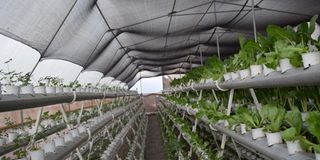
The plumbing system in a greenhouse.
For a person to qualify to join this project, he or she must be in the age range of 18-35 years, must have completed at least secondary education and be willing to undertake a three-month course. The project targets to have 70 percent of the beneficiaries being ladies and 10 percent being persons with disabilities.
Those interested in greenhouse ownership should be willing to form a partnership of two. This is essential to ensure shared responsibility and a higher chance of success. The pair should then be willing to raise at least 10 percent of the greenhouse capital. The rest is then financed by KCB as loan.
Derrick reported for training at Miramar International College in December 2019 and completed in March 2020. Miramar International College is the anchor partner in charge of training beneficiaries in hydroponic farming. Other anchor partners on the project are Gearbox who manufacture the greenhouse parts and Arcskills who construct the greenhouses.
While at Miramar International College, Derrick met Ruth Mumbi, and they agreed to set up a business together that they named Greentalows. In August 2020, they were allocated a greenhouse at Ngong Kibiko farm and proceeded to prepare it for planting, and later planted tomatoes.
The period of nurturing the tomatoes came with several challenges. In the first week of life of the crop, there was a lot of work to do since the tomato crop had to be fed five times a day. After that intensive first week, things slowed down somewhat, and feeding would happen once a day, early in the morning.
The second challenge was at the level of maintaining hygiene in the greenhouse. Keeping visitors and other curious individuals out became a constant task. Finally, Derrick and his partner had to be vigilant against pests. At the first sign of an infection, they had to spray to control and eliminate pests. Through all these challenges, they stayed focused and relied on the support of the Miramar team who guided them in overcoming the difficulties.
On November 8 and 12, 2020, after three months of labour, Derrick and Ruth harvested their first tomato crop, bringing in over 200kg of tomatoes valued at Ksh12,000. In subsequent weeks, their production picked up and they have so far harvested about two tonnes of tomatoes valued at about Ksh100,000. The project has an off-taker, Miramar Limited, which buys all the produce.
Derrick and Ruth’s greenhouse is among 100 greenhouses that the Ngong-Kibiko farm hosts. These greenhouses are the first steps towards setting up 28,000 hydroponic facilities to be rolled out countrywide.
Derrick’s long-term vision is to build expertise in agriculture so that he can grow into other levels of agripreneurship, especially in value addition businesses. He believes that he is also on his way to becoming a consultant for other greenhouse owners who may need guidance.
See related story.


