Kenya’s donkeys on the edge of extinction in growing global skin trade
Sponsored by Brooke East Africa
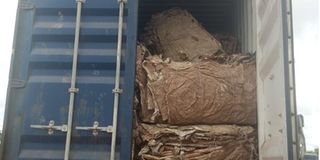
A consignment of 3,700 donkey skins seized on 31st of March 2026 en route to Mombasa Port.
For millions of Kenyans, especially in the country’s rural areas, the donkey is not merely an animal. It is the uncelebrated engine of rural Kenya, hauling water across parched northern landscapes, ferrying farm produce to village markets, and, in many households, quite literally sustaining daily survival. It is an economic lifeline.
Yet today, this humble beast of burden is facing an existential threat from an international skin trade that animal welfare groups warn could decimate Kenya’s donkey population before the decade ends if enforcement failures and legal loopholes persist.
Once overlooked in national livestock conversations, donkeys have become the target of a lucrative billion-shilling black market driven largely by demand for ejiao, a gelatin derived from donkey skins used in traditional Chinese medicine, cosmetics, and health products.
Animal welfare advocates now fear Kenya’s donkeys may be edging toward a silent extinction.
“Communities, especially in rural areas, rely heavily on donkeys for labour and transport. Entire rural economies are supported by these animals,” said Elijah Mithigi, Brooke East Africa’s Regional Programs Manager. “But weak enforcement and inadequate laws continue to leave these animals dangerously exposed.”
Donkey hide trade
Reports by the Kenya National Bureau of Statistics (KNBS) and other livestock stakeholders indicated that Kenya’s donkey population had fallen from approximately 1.8 million in 2009 to between 1 million and 1.17 million by 2019. The decline was largely attributed to the rapid growth of the donkey hide trade, increased slaughter, theft, and illegal trafficking driven by international demand for donkey skins used in the production of ejiao in AsiaKenya’s donkey skin trade exploded after China’s own donkey population sharply declined, pushing traders to Africa in search of hides. Africa, with its large working donkey populations and relatively weak regulatory frameworks, became a prime target.
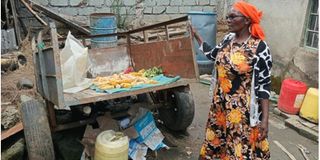
Beth Wambui, a small-scale farmer from Nyandarua shows her empty donkey cart after her donkey was stolen in November 2025. Beth now uses the cart to dry her produce whereas she used to use it to make a living
Kenya emerged as one of the continent’s epicentres, with four slaughterhouses in Naivasha, Baringo, Turkana, and Bomet.
The 2019 research by the Kenya Agricultural and Livestock Research Organization (KALRO), titled “The Status of Donkey Slaughter in Kenya and its Implication on Community Livelihoods,”revealed that more than 300,000 donkeys were slaughtered in Kenya, representing a devastating depletion rate for an animal that reproduces slowly. At one point, the four legal slaughterhouses were collectively processing as many as 1,600 donkeys per day. The study also estimated that Kenya had lost approximately KSh 28.3 billion in potential income because slaughtered donkeys could no longer support household livelihoods and economic activities.
“This humble animal is being slaughtered at five times the rate at which it reproduces,” Dr Raphael Kinoti, Regional Director, Brooke East Africa has warned during anti-trade campaigns. “That is simply not sustainable.”
Faced with mounting public outcry, Kenya banned commercial donkey slaughter in 2020. The move was hailed as a major conservation and livelihood victory. Then Agriculture Cabinet Secretary Peter Munya condemned the trade as an act of “criminality and brutality” that had fueled widespread donkey theft and devastated communities whose livelihoods depend on the animals.
But campaigners warn that the victory remains fragile.
A thriving black market has since emerged, exploiting inadequate laws and weak enforcement.
Even with the existing ban on commercial donkey slaughter, implementation has remained inconsistent. Court reversals, legal ambiguities, and weak penalties have created loopholes that traffickers continue to exploit.
“The laws are simply not punitive enough,” Mithigi said. “If traffickers are fined Sh50,000 or even a few hundred thousand shillings in a billion-dollar industry, that is not deterrence …it is a business expense.”
One of the major concerns is that while licensed slaughterhouses were officially shut, illegal operations continue to thrive in those same facilities, particularly along smuggling corridors. Authorities have recently intercepted a truck loaded with over 3,000 hides suspected to be destined for export. In one recent court case last month, individuals caught transporting some 12 tonnes of donkey hides toward the Port of Mombasa were fined, only to promptly reclaim the consignment and continue on their way.
Commercial slaughter ban
Just this year, publicly documented enforcement actions in Kenya include this major seizure involving more than 3,700 donkey hides, alongside multiple illegal slaughter crackdowns, signalling that despite the 2020 commercial slaughter ban, the illicit donkey skin trade remains deeply entrenched. This represented 3,700 households left without a lifeline.
Welfare organizations hailed the April seizure, but warned it exposed just how active the underground trade remains.
According to Mithigi, a critical weakness lies in classification. In Kenya, although commercial slaughter is banned, donkey meat can still legally be consumed in certain cultural contexts, particularly in parts of northern Kenya such as Turkana, creating loopholes that traffickers allegedly exploit.
Advocates argue traders move donkeys across borders under the guise of local meat consumption while skins are diverted into export channels.
“The loophole is dangerous,” said Mithigi. “As long as donkey meat and skin are not fully declassified from commercial systems, traffickers will keep finding ways to exploit it.”
Cross-border smuggling from neighbouring countries, including Ethiopia, Somalia, and Tanzania, has compounded the crisis, creating regional enforcement headaches. The African Union’s 2024 continent-wide push to ban donkey slaughter for skin export was a significant step, but implementation across member states remains uneven. Porous borders and corruption continue to undermine broader protections.
Yet in rural counties, donkey theft or slaughter is not simply an animal welfare issue; it is a direct socioeconomic blow.
Women and children often bear the heaviest burden. In many households, donkeys fetch water, carry firewood, transport produce, and reduce physical labour.
Without them, women can spend hours walking long distances under punishing conditions.
“Losing a donkey can mean losing income, food security, and mobility all at once,” Brooke notes in its regional assessments.
In areas like Homa Bay, Kajiado, Turkana, and Marsabit, communities have reported severe hardship linked to rising donkey theft.
Unlike other livestock, donkeys reproduce slowly. Conservationists warn that replacement rates cannot match slaughter rates.
“Unfortunately, donkeys do not breed regularly enough to sustain this kind of extraction,” Mithigi explained. “Even advanced breeding systems have struggled. China, with all its advanced technology, has not been able to use it for this purpose.”
This biological limitation means continued skin harvesting could permanently collapse populations.
Recent global research has similarly warned that demand for ejiao requires millions of skins annually, a rate many countries’ donkey populations simply cannot sustain.
Animal welfare groups, including Brooke East Africa and partners, are pushing Kenya’s Parliament and the Department of Veterinary Services to strengthen the Prevention of Cruelty to Animals Act and related livestock laws.
Without legislative reform, campaigners argue, enforcement remains symbolic.
Some activists now describe donkey skins as “the new ivory” a commodity whose international demand is devastating African livelihoods.
But unlike elephants or rhinos, whose conservation status attracts global attention, donkeys often remain invisible in policy discussions.
“The donkey may not be seen as a sexy conservation species like elephants or rhinos,” Mithigi said, “but there are entire economies built around it.”
He adds, “In villages where loss is measured not in biodiversity statistics but in heavier water loads, reduced market access, and shrinking household resilience, that invisibility may be its greatest vulnerability.”
Increasingly, donkey welfare organisations are framing the issue not just as an animal rights concern but also as one of rural justice, economic resilience, and national heritage.
For pastoralists and smallholder farmers, the disappearance of donkeys would deepen poverty, increase labour burdens, and destabilise already fragile livelihoods.
Kenya’s battle to save its donkeys now hinges on whether policymakers can close loopholes faster than traffickers exploit them.
According to Mithigi, the fate of Kenya’s donkeys may ultimately depend on whether policymakers begin to see them not merely as livestock, but as critical infrastructure for some of the nation’s most vulnerable communities.
If enforcement remains weak, penalties remain trivial, and legal loopholes persist, she warns, the country risks not only devastating a species essential to rural survival but also undermining millions of livelihoods tethered to one of Africa’s most overlooked working animals.