Meet Dr Asonga, the CEO helping to rewire Kenya’s tech industry and its leadership culture
Sponsored by Technology Service Providers of Kenya
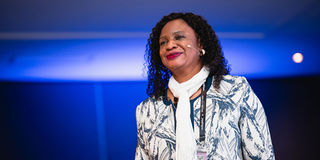
Dr Fiona Asonga, Chief Executive Officer, Technology Service Providers of Kenya.
By Pauline Kairu
In 2006, when Dr Fiona Asonga walked into the offices of the Technology Service Providers of Kenya (TESPOK), she did not walk in as a CEO-in-waiting. She came in as a junior administrative staff member.
Today, as CEO of TESPOK, she leads the very organisation she once joined at entry level. She is shaping policy, setting industry standards, and influencing the trajectory of Kenya’s, and Africa’s, digital infrastructure.
Her rise is more than a personal success story. It is a blueprint for how women can build institutions and transform the systems within them.
In many ways, Dr Asonga’s journey mirrors the evolution of Kenya’s ICT sector itself: Deliberate, structured, and forged from the ground up.
Founded in 1999 during the liberalisation of the telecoms sector, TESPOK was created to give private service providers a unified voice. When Dr Asonga joined, the organisation had only two staff members. Over the years, she helped formalise internal structures, build departments and expand the team to 17. Many of those employees started as interns for roles she created as TESPOK evolved.
“When you are growing an organisation, you are also growing the job descriptions,” she says. “You build the structure as you go.”
Under her leadership, TESPOK strengthened coordination of the Kenya Internet Exchange Point, formalised infrastructure colour-coding for fibre networks to improve identification and maintenance, and developed a Data Protection Self-Assessment Tool for its members. These may sound technical, but they are foundational to how the country stays connected.
Dr Asonga’s influence extends beyond Kenya. She serves as a director at the African Network Information Centre (AfriNIC), which is responsible for allocating IP address resources across the continent.
Dr Asonga’s leadership is not confined to cables and policy papers.
Inside TESPOK, she has implemented workplace reforms that quietly challenge corporate norms. She introduced a maternity transition policy allowing new mothers to return on half days in the fourth month, mandatory paternity leave taken immediately after birth, and period leave separate from sick leave. “You cannot expect productivity if you ignore biology,” she says matter-of-factly.
Despite progress, she acknowledges persistent barriers. She has watched female engineers enter the workforce only to be redirected into softer roles after marriage or pregnancy, often due to cultural expectations. “There is no job for men or women, except giving birth,” she says. “Everything else is conditioning.”
As Kenya celebrates International Women’s Month, Dr Asonga’s legacy is not simply about breaking ceilings, but about building systems that endure.
She wants institutions that attract investors because of integrity; an industry that respects merit; and a tech ecosystem where women rise not as exceptions but as leaders whose presence is normal.
She advocates for breastfeeding rooms and flexible structures that allow women to maintain careers without sacrificing motherhood.
Her push for inclusion extends to governance. For years, she consistently urged member companies to elevate more women to C-level positions, not for optics, but to influence decision-making.
“Women in C-level roles don’t just lead. When they sit on boards, they shape the direction of entire industries, including the ‘softer’ aspects that improve employees’ lives overall,” she says.
She believes inclusive governance is not a symbolic gesture, but a stabilising force in institutions that underpin Africa’s digital future.
“When there is too much ego in the boardroom, negotiation collapses,” she says. “Women negotiate differently.”
Beyond TESPOK, Dr Asonga mentors young women across the continent, including through initiatives like African Women in ICT. Her mentorship style is direct.
When a young mentee once told her she wanted a car like hers, Dr Asonga advised her to apply for a bank loan; not to discourage her, but to help her understand financial systems, creditworthiness and the real cost of ambition. “All dreams are valid,” she says. “But you must understand what it takes.”
Dr Asonga encourages women negotiating promotions to ground their case in measurable performance. At TESPOK, she conducts candid KPI reviews where staff calculate their own delivery percentages.
“Ask yourself: If you’re giving only 50 percent, what are you really asking for?” she challenges, encouraging women to step fully into their potential. “Let your work speak for you.”
Her philosophy is rooted in patience and merit. Confidence, she argues, comes from knowing you earned your position.
Her own path – from an administrative assistant to CEO – is proof that leadership is not always inherited or appointed. “Sometimes it is built. Slowly. Deliberately. And with purpose,” she states.