Made to go the extra mile
Sponsored by Isuzu East Africa
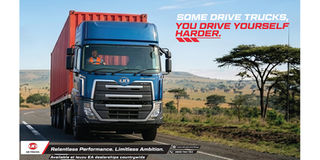
A businessman, veteran of his trade and renown of name, walks slowly through a truck yard and stops at one specific truck parked facing the exit.
He has put his heart and soul into the transport business, and this truck has given its heart and soul to its master. It has never let him down and it will not let him down now.
Transport is business and business is about numbers, but it is not always about numbers. If you want to talk numbers, we can talk numbers: 20 years. 2 million kilometres. Thousands of completed deliveries; all these per truck. But it’s more than just figures on a spreadsheet. It’s about giving back and paying it forward. It’s about trust. It’s about dependability.
“Leo kazi ni ya wapi, mzee? Tanker hadi Lodwar ama container ya hapa Kisumu?”
“Leo wacha niendeshe. Huyu ni first born wangu; siku mingi “sijaongea” na yeye”
* * * * *
Jeremy Clarkson, a globally recognised motoring journalist, described vehicles as more than just a cluster of wires, glass, metal and rubber. He considers them living things with personalities that you can develop a relationship with. That’s why we name our cars, he should have added.
Ultimate Dependability is the name the Japanese truck-maker chose to go with, and with good reason. UD trucks have a reputation for resilience, and the brand rings bells within the transport sector as having an unbreakable personality. If you wanted a bus to operate in the Northern Frontier District, which model did you turn to? If you had a contract to deliver clinker to Tororo, which truck would your compatriots in the industry recommend?
Those old enough to recall the early and mid-90s might be familiar with the name “Nissan Diesel”; but they would be forgiven if they’re not. While a lot of the competition boasted increasingly flashy designs and oversized badging to broadcast their identities, Nissan Diesel trucks and buses discreetly announced themselves to those who bothered noticing with an inoffensive and laid-back design language topped off by a subtle name tag comprising white block letters against a black strip. You had to be up close to read what it said. Those who didn’t notice undoubtedly benefitted from their presence all the same – albeit in other ways – but the invariable parameter was that presence.
Look around and you will see UDs past still serving as both trucks and buses. Look around in the near future and you will see UDs current taking the mantle from their predecessors.UD was there. UD is there. UD will always be there. Call it your constant companion in your transport journey. Names are a manifestation of intent, and the intent here is ultimate dependability, hence “UD”.
And speaking of names, let’s have a look at some of the previous unsung heroes from the brand formerly known as Uniflow Diesel:
Dubu and Nyati: Dubu is the Swahili name for a bear; while Nyati is a buffalo. Ferocity and resilience. This pair formed the smaller entries in the old line-up, starting off from 12 tons GVW to 19 tons.
Ndovu: The Elephant. Their father, a.k.a “Baba Lao”. Unstoppable, with the might of an entire continent pulsating within his musculature. If you wanted to move the earth – or anything heavier than 26 tons, to be more accurate – the Ndovu is what you needed.
These were names carefully curated to evoke reactions; to inspire courage and boldness for those that dabbled and to sell fear to those that doubted. But that was a bygone era. We are now in the 21st Century and things have moved on.
* * * * *
A new era
Operational efficiency and environmental considerations are now key factors in selecting a truck, over and above the usual suspects of uptime and price of entry. Efficiency is not just about the truck; though the line-up does represent well here with outstanding fuel economy, extended service intervals (up to 40,000km) and the reliability that is synonymous with the name. There is also driver efficiency.
“Customers will never love a company until the employees love it first,” it is said. Give your drivers an ideal working environment and their productivity and loyalty will shoot through the roof. A more ergonomic in-cabin design festooned with creature comforts and backed up by a mild sprinkling of ADAS (Advanced Driver Assistance Systems) ensure the captains of your freighters work under ideal circumstances, because as our businessman will gladly explain, those trucks don’t drive themselves… yet.
They may not drive themselves but they will certainly give a hand towards their own well-being. Besides the ADAS, there is an inbuilt FMS (Fleet Management System) that provides real-time oversight on how a particular trip is progressing. Fleet management systems have proven to be a godsend to logistics firms worldwide, streamlining operations and cutting overheads, as well as allowing “helicopter parenting” of both staff and inventory without resorting to intrusive methods such as endless phone calls or periodic reporting. While FMS systems started off as aftermarket installations, forward-thinking truck manufacturers nowadays offer it as a factory add-on. UD is no exception.
The flagship
With UD officially back on these shores, we have three offerings from them: The 12/14-ton GVW LKE210/240 a.k.a the Croner, the CWE350 in the Dubu/Nyati class and of course, it wouldn’t be worth mentioning if Ndovu didn’t make a return. This would be the Quester prime mover, pushing engine outputs from 350hp to 460hp.
First impressions of the Quester point at a thoughtful product. We live in a crowded world obsessed with identities, so the badging is more prominent. But badging aside, you would not mistake it for anything else.
The consistency in design language – understated lines that prioritise function but not necessarily at the expense of form – is immediately apparent in the looks; but more importantly, there is an adherence to an engineering ethos where longevity and the aforementioned consistency are paramount. This predilection for time spans and infallibility is further highlighted by the inclusion of the automated manual transmission referred to as the ESCOT gearbox. By reducing the number of variables chiefly from human input in the form of gearshifts, the operational protocols of the vehicle become more predictable, which in turn allows for better charting of the business trajectory with fewer adjustables.
Motion, power, advancement
I have driven the Quester, with a standard 12-speed AMT, and my professional opinion is the UD truck brand has not lost its sense of place. It feels rugged and hardy (Ultimate Dependability) without feeling cheap (thoughtful engineering); but it IS affordable. The competitive pricing is down to that sense of place. The Quester is a labourer, and a trusted one at that.
The truck has both retained and gained the features necessary for operational optimisation without succumbing to the urge to incorporate gimmicks just to get its name behind a hash tag. This has kept the pricing not just within sanity, but very competitive as well (details available at your local dealer).
And what a dealer this is. Corporate geopolitics mean the Japanese brand is now housed under another Japanese brand: Isuzu. This is critical to previous, existing and potential customers because of aftersales. Isuzu as a brand is currently enjoying runaway success at the zero-mileage sales forecourt, and while a large part of this is attributable to product superiority, we cannot ignore the team behind the product.
I have met this team and there are two words that describe them best: Inventiveness and initiative. They are enthusiastic about what they sell and they are not afraid to go out and convince everyone of this fact. They know when they have a good product in their hands, and the Quester is the newest leaf added to their historically overachieving laurel wreath of products. So, about this Quester…
…Apart from being a UD (we cannot stress the “ultimate dependability” angle enough), it’s also nice to drive: Quiet and comfortable. A smooth diesel thrum spiced with a distant turbo whine in the modernised captain’s deck which now comes with a virtual assistant, enhance the driver experience as (s)he rides a wave of seamless and relentless torque going up through the gears. The best analogy I can come up with is also the most obvious: It’s like riding a very friendly and considerate elephant which can hold a polite but intelligent conversation. Ndovu, indeed.
* * * * *
The transporter is appreciative of the old CWB450 he started out with and the subsequent fleet it bore him. And now he has a newborn, the Quester GWE460. If you want to talk numbers, we can talk numbers. GH11E. 460 horsepower. 2200 newton-meters. 12-speed transmission. 40,000km service intervals. 95 percent bank financing.
But it’s not always about numbers. Mzee had just watched a short film from UDT Kenya’s new dealers, Isuzu East Africa; as evocative as the best of any home-grown art, and his heart filled with hope for the future. There is a blue Quester in this film pulling a colour-coded semitrailer, and this Quester is compared to Loxodonta Africana, the African bush elephant – largest and most powerful of the landlubbers in the animal kingdom. It is a short but beautiful film. Mzee’s preferred truck brand was back again after a hiatus, and is here to stay.
His eyes glisten with emotion, and he tries to keep his smile subtle even though he is alone in the cabin of his brand-new Quester GWE460. It is deep blue in colour, just like the truck in the film.
Ndovu lives.