How WaterFund is applying blended finance to help Kenya expand water and sanitation access
Sponsored by Water Sector Trust Fund

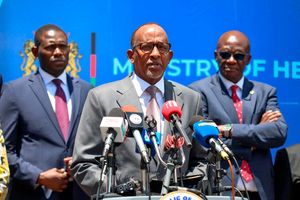
Water Sector Trust Fund CEO, Mr Willis Ombai.
By Pauline Kairu
Water Sector Trust Fund (WaterFund) is leveraging public grants, commercial lending and results-based subsidies to mobilise investment and expand water and sanitation services in underserved communities, building on its experience in implementing innovative financing models.
Kenya needs about KSh995 billion to accelerate universal access to water and sanitation by 2030, a financing requirement that cannot be met through government allocations and support from development partners alone. The challenge is finding ways to mobilise additional investment without leaving behind the low-income households and remote communities least likely to attract commercial financing.
WaterFund, a State corporation under the Ministry of Water, Sanitation and Irrigation, is looking to blended finance, public-private partnerships and results-based funding to help bridge that gap while protecting access for underserved populations.
The Fund provides conditional and unconditional grants to counties and supports water services in marginalised and underserved areas. Its mandate also covers low-income urban settlements, and community-level water resource management, sanitation, research and innovation.
Speaking in an interview with Nation, WaterFund CEO, Willis Ombai, said Kenya needed to mobilise more capital while improving how available resources are structured and deployed.
Strategic plan
WaterFund’s 2023-2027 strategic plan identifies a financing requirement of about KSh52.5 billion, with an initial resource deficit of approximately KSh30 billion.
Since its establishment, WaterFund has mobilised about KSh60 billion from the Government of Kenya and development partners, for water supply, sanitation and water resource management. Its investments have contributed to improved water and sanitation access for more than 8.4 million people in underserved and marginalised communities.
Ombai explained that a central part of WaterFund’s approach is to use different forms of financing for different needs. Commercial lending may be suitable for projects with credible repayment arrangements, while grants and targeted subsidies remain essential where household incomes or the cost of providing services make full cost recovery unrealistic.
One example is the Output-Based Aid Programme. Under this model, water service providers used commercial loans to finance investments upfront, with subsidies of up to 60 percent paid against agreed milestones. These included independently verified customer connections and confirmation that services remained functional.
The approach links financial support to results rather than construction alone. It also helps utilities build a record of borrowing and repayment, potentially improving their ability to access commercial financing in future.
For the model to expand, projects need adequate preparation, credible verification and appropriate sharing of risks. Utilities also need stronger revenue collection, operational efficiency, asset management and business plans, while public support must protect households that cannot afford the full cost of services.
Climate resilience
Climate resilience is another part of the financing agenda. WaterFund received a €17.65 million grant, equivalent to about KSh2 billion, from the European Union, for the Ending Drought Emergencies (EDE) programme, which supports climate-proofed water supply and sanitation infrastructure in arid and semi-arid lands.
WaterFund’s current strategy also targets conservation of 2,500 square kilometres of catchment and the creation of an additional 550,000 cubic metres of storage by 2027. These priorities reflect the need to protect water sources and strengthen infrastructure against droughts and floods.
Sanitation presents further investment opportunity. Kenya’s national water and sanitation investment plan recognises that universal access cannot be achieved through sewer networks alone. Decentralised systems, household sanitation and appropriate treatment options are needed in communities where conventional sewerage is impractical or too expensive.
Mr Ombai argues that sanitation should be financed as a complete service, covering containment, collection, transport, treatment and safe disposal or reuse, alongside the long-term costs of operating infrastructure.
According to him, expanding sanitation access will also require investment in decentralised and on-site sanitation systems, particularly in areas where conventional sewerage is impractical or too costly, alongside wastewater treatment and resource-recovery solutions that can generate value from waste.
For WaterFund, the next phase involves bringing government, counties, utilities, development partners and private investors together around coordinated investment priorities. The aim is to use grants and concessional resources strategically to reduce risks and mobilise additional capital, while ensuring that marginalised and underserved communities remain part of Kenya’s drive towards Sustainable Development Goal 6.
As Kenya works to close its water and sanitation financing gap, WaterFund's experience demonstrates how innovative financing approaches can help extend essential services to underserved communities. Sustaining and scaling these gains will require continued investment, stronger partnerships and financing models that prioritise affordability, reliability and long-term service delivery.